
In urgent ICE detention situations, having a habeas corpus lawyer for immigration detention can make the difference between remaining in custody and regaining your freedom.
On this page, we will explain:
- When it makes sense to use habeas corpus in immigration.
- What outcomes a federal court can order.
- What steps often strengthen a case so your family is not moving forward in the dark.
If your loved one was detained by ICE and has not received a fair review, this remedy may apply to your situation.
Attorney Carolina Curbelo and her team can evaluate and file habeas corpus petitions in immigration detention cases in federal court, including matters in New Jersey and Colorado, depending on the facts and the proper jurisdiction.
On this page
When does it make sense, and what can a federal habeas corpus lawyer achieve in an immigration detention case?
Habeas corpus in immigration is a constitutional tool used to challenge unlawful or excessively prolonged detention.
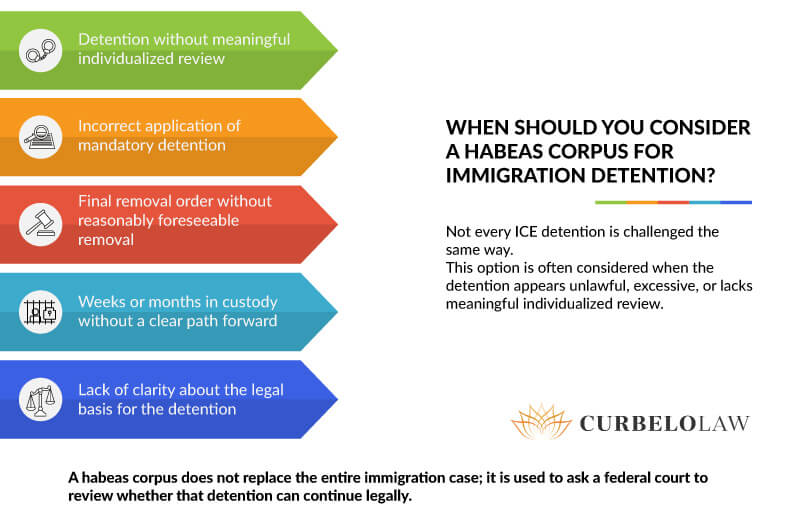
This is often relevant when:
- There is no meaningful individualized review,
- Mandatory detention is being misapplied, or
- There is a final order, but removal is not reasonably foreseeable.
Let’s look at what each of these scenarios means and how a lawyer can help in each one.
When is this option typically triggered?
This path is often considered in scenarios such as the following:
- Detention without a real individualized review.
- Incorrect use of mandatory detention.
- A final order with no real progress toward removal.
What does a lawyer do in a habeas corpus case?
The role of a habeas corpus attorney is not to ask the government for a favor. It is to demand judicial review when custody goes beyond what the law allows.
In simple terms, the petition typically:
- Is filed in a U.S. District Court.
- Is supported by evidence and a verifiable timeline.
- Shows the court that the custody is unlawful, disproportionate, or lacking due process.
What outcomes can a federal court order?
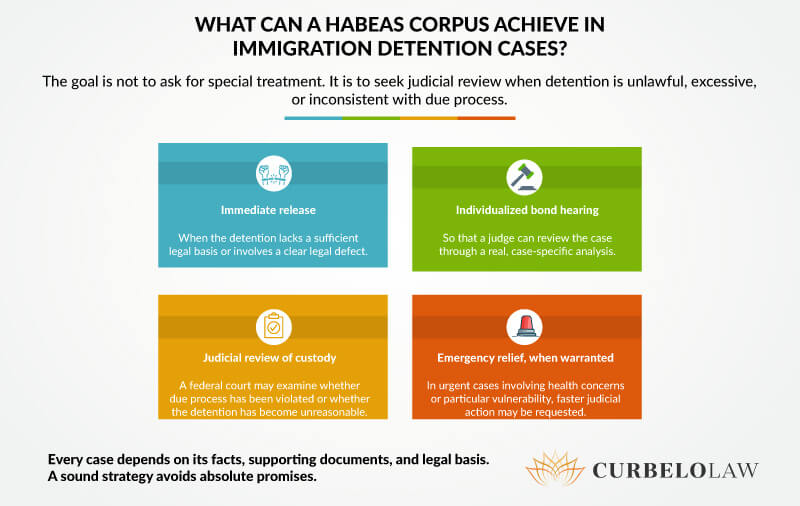
In practice, outcomes usually focus on two goals:
- Immediate release, when detention lacks a sufficient legal basis or there is an urgent reason.
- An order for an individualized bond hearing, so an immigration judge can evaluate the case with a proper, fact-specific analysis.
Real experience from our firm
At our firm, we have obtained favorable results in habeas corpus petitions for people detained by ICE in everyday situations, such as:
- On the way home from work, or
- While waiting at a bus stop.
In these cases, clients had no criminal history and had strong family ties in the United States.
Next steps if your loved one was detained
If a bond strategy is the right path, it helps to understand what the judge evaluates and how to prepare ahead of time. Learn more here: “What happens at an immigration bond hearing”.
If the detention is recent, it helps a lot for the family to have a plan, contacts, and documents ready, as we explain here: “How to alert family members if ICE detains someone”.
Signs of unlawful or excessively prolonged ICE detention
Not every ICE detention is illegitimate on its own. However, it can become a rights violation when:
- Basic safeguards are not respected,
- Rules are applied incorrectly, or
- Custody drags on without a valid justification.
To evaluate the federal option, it is often helpful to work with federal habeas corpus attorneys who litigate with evidence and precedent, not assumptions.
Detention without a bond hearing
A common red flag is spending weeks or months in custody without a real opportunity to request an immigration bond.
Another warning sign is a denial that does not individually assess flight risk and danger to the community. In practice, this tends to matter even more when there are:
- A history of compliance.
- Family in the United States.
- A stable residence plan and community support.
In many cases, the strategy starts with a clean timeline showing detention dates, transfers, hearings, filings, and the responses received.
If the case allows for bond, it is smart to prepare the practical step to avoid administrative delays. It is important to know where to pay an immigration bond so release is not delayed by mismanaged paperwork.
Incorrect application of mandatory detention
In certain situations, mandatory detention may apply, but it does not automatically apply in every case.
A common mistake is assuming it applies without reviewing details that can change the analysis completely, such as:
- The true nature of the conviction.
- The date and final disposition.
- The legal basis the government is relying on.
Even a detention that looks “correct” on paper can have vulnerabilities, especially when the person has no criminal history or the record is very old.

In recent matters, our firm has seen detentions of people in ordinary situations that share a pattern, such as:
- No criminal history.
- Years living in the United States.
- U.S. citizen family members or lawful permanent residents.
Those facts, supported by documentation, help show the custody is disproportionate.
A final removal order with no reasonably foreseeable deportation
Another important sign appears when there is a final order but removal is not moving forward for practical or legal reasons, such as:
- Consular delays.
- Lack of travel documents.
- A home country that will not cooperate with repatriation.
In that situation, detention can become indefinite in practice. Under Zadvydas v. Davis, when removal is not reasonably foreseeable, post-final-order detention has constitutional limits.
Courts often use 180 days as a reference point to evaluate whether custody has become unreasonable.
If the family does not know where the case stands, it helps to confirm first whether there is a final order. For that, our guide on how to find out if you have a deportation order may be useful.
What habeas corpus is in immigration cases
Put simply, habeas corpus allows you to ask a federal court whether ICE can continue holding someone in detention.
Under 28 U.S. Code § 2241, habeas corpus is a legal remedy used to challenge the lawfulness of detention. In immigration, it often focuses on:
- Challenging the legality of ICE custody.
- Demanding due process protections.
- Imposing limits on excessively prolonged detention.
For a more detailed explanation, see our guide on what habeas corpus is in immigration and how it can be used, with a focus on freedom and judicial review.
Why it is filed in a U.S. District Court
Unlike many steps that happen inside immigration court, habeas corpus is filed in federal court.
The core question is not whether you “win” the immigration case itself, but rather: “Can the government keep this person detained under these circumstances and for this length of time?”
A U.S. District Court can order effective remedies when detention:
- Violates constitutional principles, or
- Becomes unreasonable or disproportionate.
To understand why this path is different from immigration court, you can review how the federal court system works.
Difference between habeas corpus and an immigration judge bond hearing
It is common to confuse these paths, but they have different goals and different forums:
- Bond hearing (immigration): Takes place before an immigration judge and evaluates whether the person should be released on bond. The court considers flight risk, danger to the community, and family ties.
- Habeas corpus (federal): Challenges whether the detention is lawful or has become incompatible with due process.
In many cases, habeas corpus serves as a federal remedy to secure access to an individual hearing in immigration court. There, a judge evaluates the person’s situation, family ties, and risks on a case-by-case basis.
Writ of habeas corpus lawyers for immigration detention
The “writ” is the procedural instrument used to ask a federal court to review a detention.
That is why many families look for a strong writ of habeas corpus attorney when the case is stalled, time in custody keeps growing, and there is no clear path out.
In other cases, families come directly to teams of writ of habeas corpus attorneys when there is already:
- A bond denial, or
- A pattern of unexplained delays.
When a federal petition is filed
In general, it makes sense to file a habeas corpus petition when:
- There is a strong legal argument that detention is unlawful or excessive.
- The evidence is ready to support it.
- The filing is prepared to withstand scrutiny from the government and the court.
It is not enough to file quickly. You need a solid legal basis, evidence, and a clear timeline.
What the federal judge reviews
A federal judge primarily reviews whether:
- The legal basis for custody is correct.
- Due process protections have been respected.
- The length of time and circumstances make detention unreasonable.
The analysis depends on concrete facts, including dates, prior decisions, transfers, immigration history, family situation, health, and whether removal is realistically possible.
What the court can order
Remedies a habeas corpus relief attorney may seek include:
- Immediate release.
- Release under supervision conditions.
- An order requiring an individualized bond hearing.
In recent cases, our firm has obtained both immediate releases and orders for individualized hearings that resulted in release on bond.
This has allowed people to return to their families while their cases continue.
When a family needs to locate a loved one or confirm custody information, the ICE detainee locator can help verify location and basic details.
How to build a strong habeas corpus case

A strong habeas corpus case is not just about saying detention is unfair. It must show, with documents and facts, why the custody violates the law.
That is why it helps to work with our habeas corpus attorneys who can turn facts into a clear federal record, including:
- A timeline,
- Exhibits, and
- Well-supported legal arguments.
Detention documents and timeline
The timeline is the backbone of the case. It often includes:
- Date, place of detention, and transfers.
- Bond requests, hearings, and the judge’s decisions.
- Notices and communications with ICE.
Families can help by gathering documents such as:
- Identification and proof of residence.
- Employment and tax records.
- Children’s birth certificates and marriage certificates.
- Support letters.
It is also useful to document the context of the detention, including where it happened, years of residence, and the family situation.
Key evidence for federal court
In addition to the timeline, the following items are often important:
- Custody records.
- Hearing records.
- Written decisions.
- Evidence showing a lack of individualized review.
- Documents contradicting mandatory detention.
- Evidence that removal is not practically possible when there is a final order.
The goal is for the court to see a specific detention with specific failures, not a generic complaint.
This path is grounded in the legal principle of habeas corpus in law, which focuses on challenging the legality of custody, not resolving the underlying immigration case.
Family ties and humanitarian factors
Humanitarian factors matter, especially when evaluating risk, conditions, and the real impact of keeping someone detained. Supporting evidence may include:
- Minor children or family members with medical needs.
- A primary caregiver role in the household.
- A work history and tax payments.
- Community support letters.
When presented well, these facts strengthen the perception of stability and responsibility and help counter overly simplistic narratives.
What to expect after filing a habeas corpus petition
Filing habeas corpus does not mean freedom happens automatically. The process has steps, timelines, and typical government responses.
Still, with a strong record, the process can lead to faster decisions when there is urgency.
The federal government’s response
After the petition is filed, the government often responds by:
- Defending the legal basis for detention.
- Challenging jurisdiction.
- Arguing that there are already available options within immigration proceedings.
That is why it is critical for the petition to anticipate those defenses with facts and law.
If the detention happened in the context of operations or raids, knowing what to do during an ICE raid can help organize documents, contacts, and early decisions.
Emergency court orders
In some situations, the court may consider emergency measures when there are serious risks, such as:
- Health issues.
- Heightened vulnerability of the detainee.
- Clear unlawfulness in the custody.
It is not always granted, but when it applies, it can speed up review or lead to quicker hearings.
Our firm’s federal litigation experience has shown that every day in detention matters and that every delay has real consequences for families who depend on the detained person.
What are the possible outcomes?
Depending on the circumstances, the court may order:
- Immediate release.
- Release with supervision conditions.
- An order for an individualized bond hearing within immigration proceedings.
When that hearing is granted, advance preparation is essential to turn it into release on bond, with a stable residence plan and family support.
Attorney Carolina Curbelo and her team have worked on immigration custody and federal litigation matters related to ICE detention, including cases seeking immediate release or an individualized bond hearing. This is reflected in news coverage discussing immigration custody and decision-making.
Federal representation for habeas corpus cases in New Jersey and Colorado
When a case requires federal litigation, jurisdiction matters. The firm can file habeas corpus petitions in federal court, including:
- U.S. District Court for the District of New Jersey.
- U.S. District Court for the District of Colorado.

For NJ-specific matters, you can review our guide on habeas corpus in New Jersey for ICE detention.
In practice, our firm has actively litigated in these forums with concrete outcomes such as:
- Immediate release, and
- Federal orders requiring an immigration judge to conduct an individualized bond hearing.
When someone is detained far from family or is transferred, it becomes essential to coordinate:
- Communication with the detained person.
- Documents and evidence.
- Witnesses and support letters.
Federal litigation requires precision because the court works with a complete record, not last-minute pieces submitted in a rush.
Common situations where an immigration habeas corpus petition may be filed
While every case is different, some scenarios repeat. Recognizing them can help you decide whether to speak with a strong habeas corpus lawyer for immigration detention and evaluate the federal option.
Examples of real-world scenarios include:
- Detention on the way home from work.
- Detention after a traffic stop.
- Detention of people with no criminal history.
- Prolonged detention without a bond hearing.
In these cases, a habeas corpus lawyer can evaluate whether detention is legally supportable or whether it is appropriate to demand court intervention.
The lawyer can also help decide whether to seek immediate relief or focus on obtaining an individualized bond hearing, depending on the facts and the risks in the case.
Frequently asked questions about habeas corpus in immigration detention
When does it make sense to file habeas corpus?
It makes sense to file habeas corpus when there are clear signs that custody is unlawful or disproportionate. For example, a person has spent months in detention or has a removal case that is not moving forward. The decision, however, should be based on documented facts.
Can it lead to immediate release?
Sometimes, yes, especially when detention lacks a strong legal basis or the situation requires urgent relief. In other cases, the more realistic outcome is an order requiring an individualized bond hearing, followed by a well-prepared plan to seek release.
How long does a federal habeas corpus case take?
There is no fixed timeline for habeas corpus cases. Some can be resolved in weeks when there is urgency, while others can take several months depending on the court, the facts, and the judge’s docket.
What most affects readiness is having complete evidence and focused arguments. A weak record often leads to longer delays.
Is habeas corpus filed in immigration court or federal court?
Habeas corpus is filed in U.S. District Court, while bond is handled before an immigration judge. Many strategies aim to have the federal court order an individualized bond hearing when that review has not happened or was inadequate.
What is the difference between a habeas corpus lawyer and a writ of habeas corpus lawyer?
In practice, people are referring to the same type of litigation because the “writ” is the procedural form of the petition. What matters most is federal experience.
That is why, when a strict federal route is needed, it helps to work with a federal habeas corpus lawyer who is used to federal litigation and responding to government objections.
How a habeas corpus lawyer can help in immigration detention cases
When a family faces ICE detention, the priority is often to regain freedom.
With a quick evaluation and an evidence plan, a habeas corpus lawyer can identify whether there is a basis to challenge the detention in federal court, seek immediate release, or obtain an order requiring a bond hearing.
To speak with our legal team and review your options, it helps to request a consultation as soon as possible and have:
- Basic documents.
- Custody dates.
- Any notices received.
In immigration detention, every day matters. Acting strategically from the start can change the outcome of the case.