

Adjustment of status allows certain individuals to apply for lawful permanent residence (a Green Card) without leaving the United States. An immigration attorney can determine whether you qualify to file Form I-485, identify potential issues in your immigration history, and help document your eligibility before you pay USCIS filing fees.
At Curbelo Law, attorney Carolina T. Curbelo provides bilingual legal guidance from Ridgewood, New Jersey. Because immigration law is federal, our services are not limited to New Jersey residents. Her team handles family-based, employment-based, and humanitarian immigration matters, depending on the relief available.
Let us know about your case We can help youOn this page
Adjustment of Status: What Carolina T. Curbelo Reviews Before Filing Form I-485
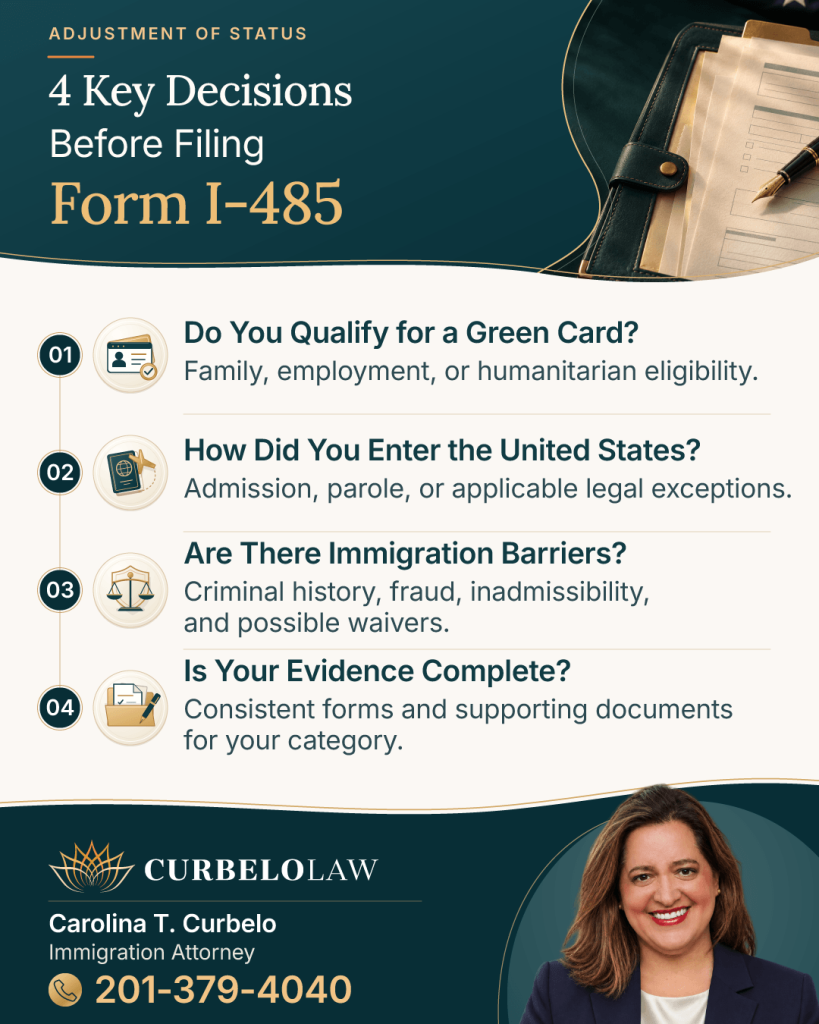
Preparing a case starts with a question the application itself cannot answer: Is adjustment of status the right legal path for your immigration history? Carolina first reviews your entries into and departures from the United States because an approved family petition does not always mean you can obtain a Green Card from within the country.
- Basis for permanent residence: A family petition, employment sponsorship, or humanitarian category that may allow you to get a Green Card, each with its own requirements.
- Admission and immigration history: Form I-94, parole, entries without inspection, and prior immigration proceedings.
- Eligibility and strategy: Visa availability, waivers, and alternatives to adjustment of status.
- Initial evidence: Consistency across forms, civil documents, and the Form I-693 medical examination.
The distinction between falling out of status and making a material misrepresentation is more than a matter of wording. Certain status violations may be exempted for immediate relatives of U.S. citizens, while a ground of inadmissibility requires a different legal analysis. Before filing, we identify what must be established, which documents can support it, and whether another immigration path should be considered.
Carolina has more than 10 years of experience and has handled hundreds of successful adjustment of status and permanent residence matters. Her background helps her prepare each case carefully, although USCIS makes the final decision based on the applicant’s individual circumstances.
Who Qualifies for Adjustment of Status in the United States, and Who Does Not?
To adjust status in the United States, applicants must meet basic eligibility requirements and avoid grounds of inadmissibility that could lead to a denial. Exceptions and supporting evidence depend on the immigration category, including family, employment, VAWA, asylum or refugee status, and U or T visas.
Basic Eligibility Requirements (Who Qualifies)
- You were inspected and admitted or paroled into the United States under a path governed by INA § 245(a), unless a specific statutory exception applies.
- You are physically present in the United States when you file Form I-485.
- An immigrant visa is available for your Green Card application when your category requires visa availability.
- You are admissible under U.S. immigration law or qualify for a waiver or exception to a particular ground of inadmissibility.
Common Grounds of Ineligibility (Who May Not Qualify)
- Entering as a crew member or under certain transit classifications may bar ordinary adjustment of status. Exceptions depend on your immigration history.
- Entering under the Visa Waiver Program (ESTA) carries restrictions, with important exceptions for certain immediate relatives of U.S. citizens.
- Holding J-1 status subject to the two-year home-country physical presence requirement without satisfying it or obtaining a waiver when applicable.
- Entering on a K-1 visa and seeking residence based on marriage to someone other than the original U.S. citizen petitioner, except in specific circumstances allowed by law.
- Getting married while removal proceedings are pending may trigger stricter evidentiary requirements and limited exceptions.
- Immigration fraud, material misrepresentations, or submitting forged documents may result in inadmissibility.
Unauthorized employment or falling out of lawful status can prevent adjustment of status in many categories. However, immediate relatives of U.S. citizens are generally exempt from these particular bars. That exemption does not eliminate grounds of inadmissibility.
Hypothetical example: An F-1 student who was lawfully admitted and later entered into a bona fide marriage with a U.S. citizen might qualify for adjustment of status. However, the student’s immigration history, statements made upon entry, and other requirements must still be reviewed.
How to Apply for Adjustment of Status Step by Step
The application process involves several stages. Before submitting any forms, you must establish that you qualify under current law and have the evidence needed to demonstrate your eligibility:

- Confirm eligibility: Before starting the process, you must verify that you meet the requirements for lawful permanent residence under a USCIS-recognized category. Admission, inadmissibility, and potential exceptions must be evaluated separately.
- File the underlying petition: In most cases, another person, such as a family member or employer, must sponsor you. Depending on your circumstances, common forms include Form I-130 for family petitions and Form I-140 for employment petitions. Self-petitions and humanitarian options also exist.
- Check visa availability: Immigrant visas are not immediately available in every category. Applicants should review the Department of State’s monthly Visa Bulletin and the filing chart USCIS authorizes for Form I-485 submissions.
- File Form I-485: This is a central step in the process. Submit Form I-485, Application to Register Permanent Residence or Adjust Status, to USCIS. Certain categories allow concurrent filing with Form I-130 or Form I-140.
- Attend biometrics: After you file Form I-485, USCIS may send Form I-797C, a notice scheduling an appointment at an Application Support Center (ASC). Your fingerprints, photograph, and signature are collected there. Missing the appointment without justification can harm your case.
- Prepare for the interview: USCIS may schedule an in-person interview. Not every case requires one, but marriage-based applicants may need to establish that their relationship is genuine. Bring original documents and answer truthfully rather than memorizing a scripted story.
- Respond to an RFE and await a decision: A Request for Evidence (RFE) identifies missing evidence, where to send it, and the response deadline. USCIS does not always issue an RFE before denying a case for insufficient initial evidence. USCIS ultimately sends an approval or denial notice.
Hypothetical example: If a U.S. citizen files Form I-130 for a spouse who meets the adjustment requirements, concurrent filing of Forms I-130 and I-485 may be possible. That does not guarantee faster processing.
Documents Needed to Apply for Adjustment of Status in the United States
A well-prepared adjustment of status application depends on submitting the right documentation. Common documents required by USCIS, depending on the category, include:

- Form I-485: Application to Register Permanent Residence or Adjust Status.
- Form I-864: Affidavit of Support (required in most family-based cases and some employment-based cases).
- Proof of identity and lawful entry: Passport, visa, and Form I-94 (Arrival/Departure Record).
- Birth certificate with a certified English translation if the original is in another language.
- Current marriage certificate and proof that any previous marriages ended, such as divorce decrees or death certificates.
- Form I-693 medical examination: Completed by a USCIS-designated civil surgeon. When required, it generally must be submitted with Form I-485. Under current policy, its validity is tied to the application with which it was filed.
Additional Documents (Depending on the Category)
- Evidence of a family relationship: Photographs, joint bank accounts, insurance policies, and shared bills.
- Employment records or PERM labor certification: For employment-based adjustment cases.
- Proof of lawful status or physical presence when required by the category: Form I-94, school or employment records, bills, and travel records.
Attorney review: Carolina cross-checks dates of entry, addresses, and employment history across Forms I-485, I-130/I-140, and supporting documents. A discrepancy may have a legitimate explanation, but it is better to document it when filing than to improvise an explanation at the interview.
Missing required initial evidence or submitting an incomplete response to an RFE can lead to a denial. Before filing, check USCIS requirements and the current edition of each form.
Legal Changes That May Affect Your Adjustment of Status
In May 2026, USCIS announced more restrictive criteria and individualized review of adjustment applications for certain people holding temporary visas. Whether the guidance applies depends on the applicant’s category and statutory exceptions. Official USCIS announcement.
Initial Evidence and Public Charge Assessments
USCIS may deny certain applications without first issuing an RFE when required initial evidence is missing. USCIS guidance on evidence requirements.
Effective September 18, 2026, USCIS applies a broader public charge assessment to Forms I-485 that are subject to this ground of inadmissibility. The review may consider certain public benefits and personal circumstances. Some immigration categories are exempt, and receiving benefits does not automatically result in a denial. Official public charge guidance.
Where Do You File Form I-485?
The filing location for Form I-485 depends on the immigration category and the basis of the application. Family-based cases involving Form I-130 are generally sent to a USCIS lockbox in the United States, with the address varying by the applicant’s state of residence. In employment-based cases, the address also depends on whether the application is filed concurrently with Form I-140.
Filing addresses change frequently. Check the official Form I-485 filing address page before mailing your application. As of September 18, 2026, USCIS rejects older editions of Form I-485. Confirm the required version on the official form page, along with the filing fee and payment method.
How Long Does Adjustment of Status Take, and How Can I Track My Case?
USCIS processing times depend on the applicant’s category and the office handling the case. There is no single processing timeline. Wait times can vary significantly based on visa availability and the applicant’s immigration history.
Use the official USCIS processing times tool to check your form and category. To track your application, enter your receipt number in the Case Status Online portal and read every notice you receive. Online tracking does not replace official USCIS notices.
If you move, notify USCIS of your new address through the applicable AR-11 process. Curbelo Law reviews your receipt notice and case history before evaluating whether to submit an inquiry about a delay.
What Happens When USCIS Approves Form I-485?
If your application is approved, USCIS will send you a written approval notice, followed by your permanent resident card (Green Card).
The Form I-485 approval date marks the official beginning of your lawful permanent resident (LPR) status. This date matters when calculating eligibility for U.S. citizenship: generally five years, or three years for certain spouses of U.S. citizens who meet the legal requirements. Your physical Green Card arrives afterward.
What Happens if USCIS Denies My Adjustment of Status Application?
A Form I-485 denial can affect your employment authorization, travel plans, and immigration situation. The specific consequences depend on whether you have another lawful basis to remain in the United States or a separate pending proceeding:
- Unlawful presence may begin or resume accruing if no legal provision prevents it. Not every denial has the same retroactive effect.
- An EAD or Advance Parole document based on a pending Form I-485 may lose its underlying basis. Review the effective date and any other authorization you may have.
- USCIS may issue or refer a notice initiating removal proceedings in applicable circumstances. However, a denial does not automatically send every applicant to immigration court.
Most Common Reasons for Denial
- Incomplete forms or incorrectly paid filing fees.
- Inadmissibility resulting from an entry without legal protection, criminal offenses, or other immigration violations.
- Insufficient evidence, such as a marriage-based application with inadequate proof of a shared life.
- Suspected fraud, particularly in marriage-based applications.
Options After a Denial
A USCIS denial of Form I-485 generally cannot be appealed directly through the administrative appeals process. In certain cases, you may file Form I-290B to request reopening based on new evidence or reconsideration based on a legal error. Other options may include filing a new application or pursuing a strategy in removal proceedings. The best option depends on the USCIS decision letter, the facts, and the applicable deadlines.
Before deciding whether to file a motion, submit a new application, pursue consular processing, or seek relief before an immigration judge, we review the denial notice, the deadline, and how each option could change your legal risks.
Adjustment of Status Options: Marriage, Family, Employment, and Humanitarian Protection
Adjustment of status may be available through several immigration categories, provided the applicant meets the eligibility requirements. Common options include:

- Marriage and family: Spouses, children, and certain other relatives of U.S. citizens or lawful permanent residents. The relationship must be genuine, and visa availability depends on the family relationship and the petitioner’s immigration status.
- Employment: These cases commonly involve Form I-140 and, depending on the category, PERM labor certification. EB-1 extraordinary ability and EB-2 National Interest Waiver (NIW) classifications may permit self-petitioning.
- Humanitarian protection: Asylum, refugee status, certain VAWA self-petitions for survivors of domestic abuse, and relief for victims of human trafficking or qualifying crimes through T or U visas. Each category has its own presence and admissibility requirements.
- Diversity Visa and other categories: Selection in the Diversity Visa Lottery does not equal approval for permanent residence. Applicants must still satisfy the applicable requirements and deadlines.
Can I Adjust Status if I Entered on a Tourist Visa?
A lawful entry on a B-2 tourist visa does not guarantee eligibility. The Department of State’s 90-day rule does not prevent USCIS from investigating material misrepresentation. Read our guide to the 90-day rule and changes in intent.
Carolina distinguishes a genuine change in circumstances from an explanation that conflicts with earlier statements. She reviews dates, representations, and supporting evidence before recommending an immigration strategy.
Adjustment of Status Through Marriage in the United States
Marriage-based adjustment of status requires proof that the relationship was entered into in good faith, supported by evidence of living together and sharing a life when available. If the marriage is less than two years old when permanent residence is granted, the applicant generally receives a conditional Green Card. Entering without inspection calls for a different analysis than entering lawfully and later falling out of status.
If you are preparing for a marriage-based interview, review our common marriage-based Green Card interview questions. Do not memorize responses. Prepare to give truthful answers that are consistent with your documentation.
How Much Does Adjustment of Status Cost?
The cost of adjustment of status depends on your immigration category and how you file. Under USCIS’s fee changes effective in 2024:
- Form I-485 (Adjustment of Status): $1,440 (including biometrics).
- Form I-130 (family petition): $625 online or $675 on paper, depending on the filing method.
- Form I-140 (employment petition): Fees vary based on the category, including applicable asylum program fees and other current requirements.
Attorney fees depend on case complexity, outstanding evidence, and whether additional representation is needed. Since April 1, 2024, the filing fees for an EAD (Form I-765) and Advance Parole (Form I-131) are no longer included in the Form I-485 fee.
Example: Filing Form I-130 on paper ($675) and an adult Form I-485 ($1,440) totals $2,115. Adding Form I-765 ($260) and Form I-131 ($630) brings the total to $3,005, excluding medical examinations and attorney fees. Verify current amounts, form editions, and payment instructions in the official USCIS G-1055 fee schedule before filing.
Frequently Asked Questions About Hiring an Adjustment of Status Attorney
Do I Need an Attorney to File Form I-485?
The law does not require an attorney in every case. However, legal guidance can be especially important if you entered without inspection, spent extended periods outside the United States, received prior denials, have a removal order or criminal record, worked without authorization, or made inconsistent statements. An early consultation can help you decide whether to file now or pursue a different strategy.
Can I File Forms I-130 and I-485 Together?
Yes. Concurrent filing is allowed in certain categories, including many cases involving immediate relatives of U.S. citizens, as long as all other requirements are met. Approval of Form I-130 alone does not grant immigration status or overcome Form I-485 restrictions.
Does a Pending Form I-485 Give Me Lawful Status?
Not necessarily. A pending application does not, by itself, create lawful nonimmigrant status or authorize employment. Its effects on unlawful presence and any period of authorized stay must be evaluated separately for each case.
Can I Travel or Work While My Form I-485 Is Pending?
One of the most important issues during the process is what you are allowed to do while waiting for USCIS to decide your case.
International Travel
In many categories, leaving the United States before a decision without Advance Parole may cause USCIS to consider Form I-485 abandoned. Exceptions exist for certain status holders. Even with Advance Parole, reentry is not guaranteed because CBP makes the final admission decision at the port of entry.
Working in the United States
A pending Form I-485 does not, by itself, authorize employment. Eligible applicants can request an Employment Authorization Document (EAD) using Form I-765, which is often filed with Form I-485. Review your options for obtaining employment authorization in the United States.
Before traveling: Carolina reviews not only whether you have Advance Parole but also whether prior orders, grounds of inadmissibility, or unlawful presence could make departure and reentry risky.
Is Adjustment of Status Better Than Consular Processing?
Adjustment of status may allow applicants to avoid traveling outside the United States for a consular interview and, depending on the case, apply for employment authorization while waiting. However, it is not always available, faster, or less risky.
For someone who entered without inspection, has a prior removal order, or faces grounds of inadmissibility, choosing a path without reviewing alternatives can be harmful. Curbelo Law compares eligibility, the potential consequences of leaving the country, and consular processing options before recommending Form I-485.
How Carolina T. Curbelo Can Help With Your Adjustment of Status
At Curbelo Law, we understand how important lawful permanent residence is to you and your family. Our attorney, Carolina T. Curbelo, has more than 10 years of experience helping immigrants with adjustment of status and other complex immigration matters.
To discuss your case, gather your Form I-94 or entry record, passport, prior petitions and notices, and any relevant family, employment, or court records. We begin by reviewing the facts that could affect your eligibility, not simply the boxes on Form I-485.
Contact our immigration attorneys in New Jersey at our Ridgewood office. We handle federal immigration matters and do not limit our legal guidance to New Jersey residents.
Let us know about your case We can help you