


Special Immigrant Juvenile Status in New Jersey is the term used for the federal immigration classification known as Special Immigrant Juvenile Status (SIJS). This classification may provide a path to a Green Card for certain young people who have experienced abuse, abandonment, neglect, or a similar situation recognized under state law.
This status, commonly known as “Special Immigrant Juvenile Status,” allows many young people to gain immigration stability and, later, pursue a Green Card. However, SIJS is not a physical visa, a Green Card, or automatic protection from deportation.
In this article, you will learn about the steps, requirements, and benefits, as well as the differences between SIJS, “Special Immigrant Juvenile Status,” and a Green Card. We also explain the specific New Jersey process and the federal change involving deferred action and work authorization that took effect on May 10, 2026.
Let us know about your case We can help youOn this page
What Is Special Immigrant Juvenile Status in New Jersey and How Does SIJS Work?
Special Immigrant Juvenile Status (SIJS) is a federal immigration classification designed to protect individuals under 21 years of age who cannot live with one or both parents because of abuse, neglect, abandonment, or a similar basis recognized under state law.
Although the law does not create a physical visa, this immigration classification is commonly referred to as “Special Immigrant Juvenile Status.” It can provide a path to a Green Card when an EB-4 visa is available. If the young person is in the U.S. and meets the requirements, they may pursue permanent residence through adjustment of status.

Difference Between SIJS, “Special Immigrant Juvenile Status,” and a Green Card
- SIJS / special status: An immigration classification approved after filing Form I-360.
- “Special Immigrant Juvenile Status”: The term commonly used to identify the program. It is not a physical visa or a stamp placed in a passport.
- Green Card: The ultimate goal. Once SIJS is approved and an EB-4 visa number is available, the young person may apply for permanent residence.
Legal Basis and USCIS Consent
SIJS is governed by 8 U.S.C. §1101(a)(27)(J) and 8 CFR §204.11. USCIS reviews the I-360 petition, the state court order, and the factual basis for the findings to determine whether the case meets federal requirements.
USCIS must also grant its consent, confirming that the case was not filed solely to obtain an immigration benefit. More precisely, the agency must determine that obtaining relief from parental maltreatment was a primary reason for seeking the state court order.
Updated Special Immigrant Juvenile Status Requirements
The requirements for SIJS, or Special Immigrant Juvenile Status, are intended to protect young people who cannot live with one or both parents. To qualify, the young person must meet the age, marital status, and U.S. physical presence requirements and have an order from a juvenile court.
Age, Marital Status, and Physical Presence in the U.S.
- Be under 21 years old when filing Form I-360.
- Be unmarried, with no current valid marriage.
- Be physically present in the United States. SIJS cannot be requested from outside the country.
These requirements must continue to be met during the applicable stages of the process. In particular, USCIS requires the applicant to remain unmarried when the SIJ petition is adjudicated and to be physically present in the United States both when the I-360 is filed and when it is decided.

Many cases involve unaccompanied immigrant minors who arrived in the country alone and were placed in the custody of relatives, friends, or the child welfare system. However, SIJS is not limited to young people who arrived alone.
Juvenile Court Order, Reunification, and Best Interest
The state juvenile court must issue an order finding that the young person is dependent on the court or has been placed under custody or guardianship, that reunification with one or both parents is not viable because of abuse, neglect, abandonment, or a similar basis under state law, and that returning to the applicable country is not in the young person’s best interest as required under federal law.
Both parents do not need to have caused the maltreatment. A young person may continue living with a parent who provides appropriate care if the court finds that reunification with the other parent is not viable and all other requirements are satisfied.
SIJS Process in New Jersey: Court, I-360, and Permanent Residence
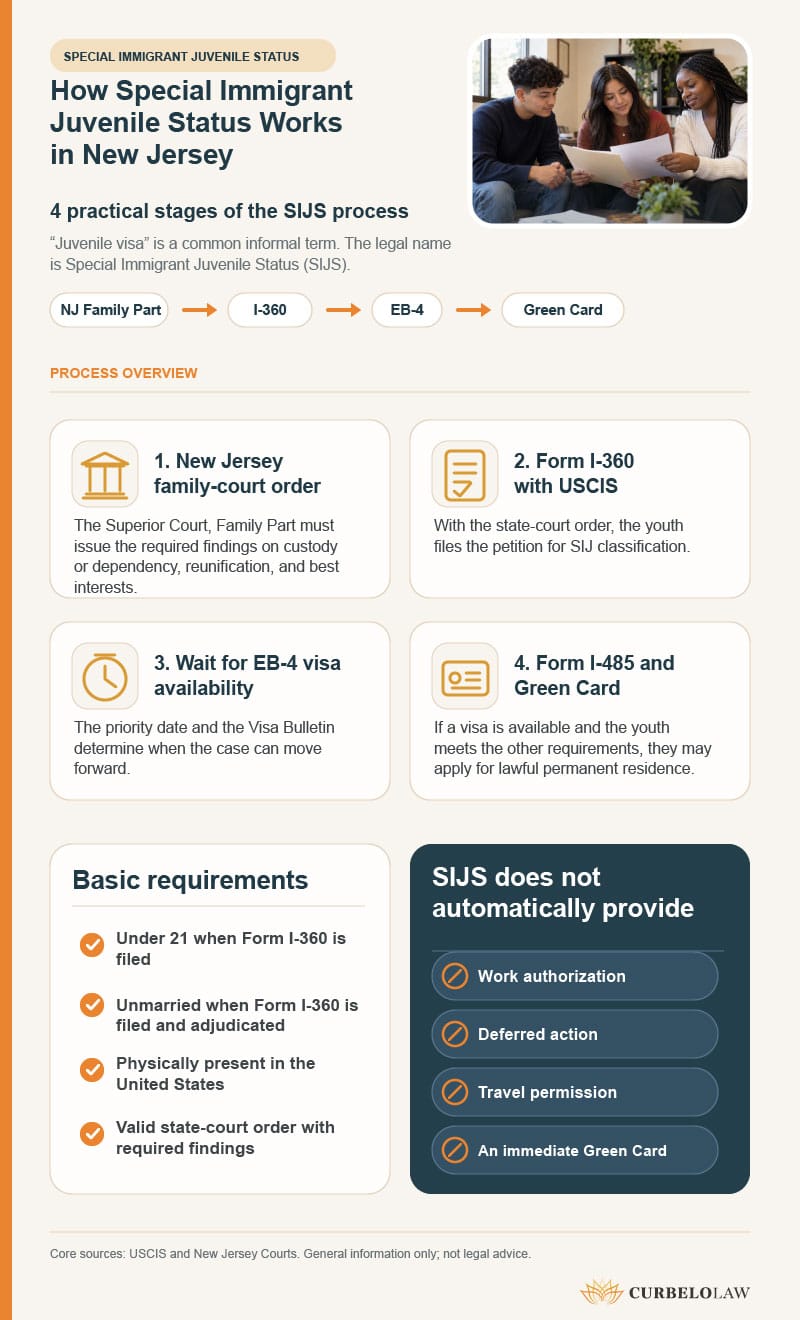
Special Immigrant Juvenile Status in New Jersey requires coordination between the state and federal systems. The process begins in state court, not with immigration authorities. The I-360 petition is then filed with USCIS, and when an EB-4 visa becomes available, the young person may move forward with adjustment of status.
First Phase: Superior Court, Family Part Order
The process begins in state court, not with immigration authorities. The judge issues a custody, guardianship, or dependency order containing the required findings regarding abuse, abandonment, neglect, and the child’s best interest. Each state has different age requirements and deadlines, so acting promptly is essential.
In New Jersey, Directive 04-25 requires the young person to be under 21 years old and unmarried when the complaint seeking the predicate order is filed. The request is filed in the Superior Court, Family Part, and is generally handled under the FD docket when there is no other active family case requiring a different docket.
New Jersey created the official Verified Complaint for Special Immigrant Juvenile Status Predicate Order (CN 13321). The form contains the minimum required information, although the court may request additional information to make the necessary findings.
Under the Directive, the complaint may be filed by a parent or guardian; by certain representatives in open child protection cases; by the young person if they are 18 years of age or older; or by a minor under 18 who does not have a parent or guardian.
Second Phase: I-360 Petition for SIJS and Basic Evidence
Once the court order has been obtained, the young person files the following with USCIS:
- Form I-360, Petition for Amerasian, Widow(er), or Special Immigrant.
- Evidence of identity and age, such as a passport, birth certificate, or government-issued identification.
- A complete copy of the court order.
- If the order does not sufficiently explain the underlying facts, other court records or declarations documenting the factual basis for the findings.
USCIS reviews whether the petition is bona fide and whether the state court order satisfies the federal requirements for Special Immigrant Juvenile Status. The agency does not replace the state judge or redecide matters of family law, but it does review whether the required findings have a reasonable factual basis.
Documents for SIJS Adjustment of Status and a Green Card
To obtain permanent residence through SIJS, also known by many as “Special Immigrant Juvenile Status,” USCIS requires immigration forms and evidence demonstrating identity, admissibility, and the connection to the juvenile court order.
When an EB-4 visa is available and USCIS has jurisdiction over the adjustment application, the applicant uses Form I-485. If a visa is already available, in certain cases the I-485 may be filed together with the I-360, while the I-360 is pending, or after it has been approved.
- Form I-485, Application to Register Permanent Residence or Adjust Status.
- Form I-693, immigration medical examination and vaccination record, when required under the current instructions.
- Forms I-797, including applicable prior receipt or approval notices.
- A copy of the passport or government-issued identification and birth certificate.
- A copy of the visa or admission stamp, if any, and Form I-94, if available and applicable.
Entry without inspection does not, by itself, prevent adjustment based on SIJ classification. However, the person’s immigration, criminal, and admissibility history must be reviewed because approval of the I-360 does not automatically eliminate every potential obstacle to approval of the I-485.
What SIJS Provides and Its Limitations
Although SIJS provides a strong path toward permanent residence, it also has important limitations. Its primary benefit is that a person with SIJ classification may apply for a Green Card when a visa is available in the EB-4 category and the person meets the adjustment of status requirements.

- Access to a Green Card when a visa is available in the EB-4 category.
- The future possibility of applying for U.S. citizenship if the individual later obtains permanent residence and meets all naturalization requirements.
Why a Young Person With SIJS Cannot Obtain Immigration Status for Their Parents
The biological parents or former adoptive parents of a person with SIJ classification cannot obtain an immigration benefit through that child based on the parent-child relationship. This restriction applies even when the finding that reunification was not viable involved only one of the parents.
Criminal History, Fraud, and Inadmissibility
SIJS does not erase prior immigration or criminal issues. USCIS may question eligibility when there is a criminal history or grounds of inadmissibility that affect adjustment of status.
In these situations, it may be necessary to evaluate a possible waiver of inadmissibility or analyze the case from a crimmigration perspective. Not all grounds of inadmissibility have the same solution, and the special SIJ exemptions have limitations.
Wait Times, Priority Date, and EB-4 Visa Availability

Special Immigrant Juvenile Status falls under the EB-4 category, which has a limited annual allocation. As a result, the time required to obtain permanent residence depends on the priority date and visa availability.
The priority date is the date USCIS receives the I-360 petition. This date determines the young person’s place in line under the Visa Bulletin. When the priority date becomes “current,” the applicant may move forward with the Green Card process, although the EB-4 category may advance or retrogress depending on demand and the number of visas available each year.
As of September 2026, the Department of State Visa Bulletin shows an EB-4 final action date of December 15, 2022, and a filing date of January 1, 2023, for all listed chargeability areas. These dates change each month.
The total wait time varies depending on the number of pending EB-4 applications and decisions affecting visa allocations. To file an I-485 with USCIS, applicants must also check each month which chart the agency authorizes for adjustment of status filings. For that reason, it is not appropriate to promise a fixed timeline for receiving a Green Card.
SIJS Work Permits, Deferred Action, and the May 10, 2026 Change
Work authorization for young immigrants with SIJS, including what many refer to as a work permit through Special Immigrant Juvenile Status, has changed several times in a relatively short period.
Beginning in 2022, USCIS had been granting deferred action to many young people with approved SIJS when an EB-4 visa was not available. That deferred action allowed them to receive temporary protection from deportation and apply for an Employment Authorization Document (EAD), giving them time while they waited for permanent residence.
On June 6, 2025, USCIS rescinded the policy of automatically considering deferred action for young people with Special Immigrant Juvenile Status who did not have an available EB-4 visa. Following several federal lawsuits, on November 19, 2025, a judge ordered the agency to resume those determinations while the litigation continued.
USCIS changed the policy again on April 10, 2026, with the change taking effect on May 10, 2026:
- Before May 10: I-360 petitions received before that date remain subject to the prior framework for consideration of deferred action, although the decision remains discretionary.
- Beginning May 10: USCIS no longer automatically makes a deferred action determination for an SIJ solely because a visa is unavailable for adjustment of status.
- Existing deferred action: In general, it remains valid until it expires, together with employment authorization based on that grant, unless USCIS terminates the deferred action and revokes the authorization earlier.
An individual request for deferred action may be possible under the general USCIS framework, but it is not a right that automatically results from SIJS. There may also be another basis for requesting employment authorization when an I-485 is pending. You can find additional information in our guide on how to get employment authorization in the U.S..
Approval of the I-360 should not be presented as automatic protection from deportation. SIJ classification, deferred action, employment authorization, and adjustment of status are separate decisions.
Can You Travel or Leave the Country With Approved SIJS?
Many young people ask whether they can actually travel with approved Special Immigrant Juvenile Status, but SIJS does not, by itself, provide authorization to travel.
An approved I-360 is not a document that authorizes entry into the United States. If an I-485 is pending, leaving the country without proper authorization may have procedural consequences and, in many cases, may cause USCIS to consider the application abandoned.
Even an advance parole document does not guarantee admission or parole upon return and does not necessarily eliminate other immigration consequences of departing the United States. This issue requires particular caution following developments in case law in 2026. Before traveling, it is advisable to review the person’s history of presence in the U.S., entries, deportation orders, and the exact status of each pending matter.
What Counts as Abandonment, Neglect, and Abuse for SIJS?
To obtain SIJS, which many families refer to as Special Immigrant Juvenile Status, the juvenile court must find that the young person cannot reunify with one or both parents because of abuse, neglect, abandonment, or a similar basis recognized under state law. Definitions vary by state, but certain patterns are common.
For example, a parent who has no contact with the young person for extended periods or disappears, a lack of support, certain forms of neglect involving the young person’s needs, or particular acts of mistreatment may be relevant. No example guarantees a particular outcome. The court applies New Jersey law to the specific facts of the case.
The court may also consider physical assaults, emotional abuse involving threats or humiliation, sexual abuse, labor or financial exploitation, and domestic violence in the home. The order must explain the factual basis and the state-law relief involved rather than simply repeating the language of federal immigration law.
Differences Between SIJS, Asylum, a U Visa, and VAWA
Many young people compare SIJS or Special Immigrant Juvenile Status with asylum, a U visa, or VAWA. Although all of these can provide forms of immigration protection, each has different requirements and benefits.
Political asylum is more appropriate when a young person fears persecution based on race, religion, political opinion, nationality, or membership in a particular social group, and the threat comes from the government or from actors the government is unable or unwilling to control. SIJS, by contrast, depends on state court findings regarding the young person’s care and reunification with one or both parents.
- Asylum: Learn how the asylum process in the USA works.
- U visa: This option may be relevant for certain crime victims who cooperate with law enforcement. Learn what a U visa is.
- VAWA: It has its own eligibility requirements for certain individuals who have experienced abuse by qualifying U.S. citizen or permanent resident relatives. Learn more about the VAWA visa.

Filing for SIJS and asylum without a coherent strategy, or switching from one form of relief to another without evaluating the risks, can create problems. When proceedings are pending in immigration court, it is essential to evaluate the complete immigration history with a professional.
What to Do If I Do Not Qualify for SIJS
When a young person does not meet the requirements for SIJS, or Special Immigrant Juvenile Status, other options for obtaining protection or even permanent residence may still be available. The key is to analyze the person’s family, immigration, and criminal history before deciding on the next step.
- Family petition: If the young person has an eligible relative.
- Asylum or persecution-based protection: When the threat comes from the country of origin and the asylum requirements are met.
- U visa: If the individual was the victim of a qualifying crime and meets the other requirements.
- VAWA: When the person has a qualifying family relationship and has experienced a form of abuse covered by the law.
Before beginning any immigration process, it is advisable to review prior entries, unlawful presence, possible grounds of inadmissibility that may require a waiver, and criminal history. The fact that an option appears to be available does not mean it is the best choice without first reviewing the complete case.
Frequently Asked Questions About SIJS
Below are brief answers to common questions about SIJS and what is often referred to as Special Immigrant Juvenile Status. These answers do not replace a review of the applicable dates, state court order, and each young person’s immigration history.
What Is Special Immigrant Juvenile Status and What Is It For?
Special Immigrant Juvenile Status (SIJS) is an immigration classification that protects certain young people who have experienced abuse, abandonment, or neglect and may provide them with a path to a Green Card in the U.S. Permanent residence requires a separate application and the availability of an EB-4 visa.
How Much Does an SIJ Petition Cost?
The USCIS G-1055 fee schedule in effect when this article was reviewed shows a $0 base filing fee for an SIJ I-360, but an additional $250 fee established by Pub. L. 119-21. For an SIJ-based I-485, the schedule shows a $0 base fee when filed with USCIS, with additional rules when the application is filed or adjudicated in immigration court.
Always confirm the amount before filing by reviewing the official USCIS G-1055 Fee Schedule, because fees may change and additional fees created by law have their own rules.
Can I Have SIJS If I Still Live With One Parent?
Yes, as long as the court determines that reunification with the other parent is not viable because of abuse, neglect, abandonment, or a similar basis recognized under state law, and all other requirements are satisfied.
Do I Have to Take Action Before Turning 21 in New Jersey?
Yes. USCIS must receive the I-360 before the young person turns 21. New Jersey Directive 04-25 also requires the young person to be under 21 and unmarried when the complaint for the predicate order is filed. Waiting until the last moment may leave insufficient time to complete both stages correctly.
Does SIJS Automatically Provide a Work Permit or Prevent Deportation?
No. For I-360 petitions filed on or after May 10, 2026, USCIS no longer automatically makes a deferred action determination based on the lack of an available visa. Work authorization requires a specific legal basis, and SIJ classification should not be confused with deferred action or permanent residence.
If you are considering Special Immigrant Juvenile Status in New Jersey, review these distinctions before assuming that approval of an I-360 automatically resolves issues involving work authorization, deportation, travel, or permanent residence.
When to Speak With an SIJS Lawyer in New Jersey
SIJS, commonly known as “Special Immigrant Juvenile Status,” combines family law and immigration law. For that reason, legal guidance is essential when coordinating the juvenile court order, I-360 petition, and adjustment of status while avoiding errors and delays.
An evaluation should confirm the young person’s age and Family Part jurisdiction, review the state-law basis for the required findings, organize evidence of abuse, abandonment, or neglect, and assess the immigration situation before determining the next step.
If you need help evaluating Special Immigrant Juvenile Status in New Jersey based on your specific circumstances, you can contact our immigration lawyers in New Jersey. Eligibility and strategy depend on each young person’s facts, dates, and documents.
Let us know about your case We can help you