


If you survived a severe form of human trafficking, our T visa lawyers in New Jersey can review whether the facts of your case fit this form of relief, identify eligibility issues, and help organize an application supported by evidence. Legal representation does not guarantee approval, but it can help clearly present the requirements, documents, and risks involved in your case.
T nonimmigrant status, commonly known as a T visa, is a form of temporary immigration relief available to victims who have experienced human trafficking in the United States.
This visa not only offers protection and assistance to foreign nationals, but also strengthens the investigative capabilities of law enforcement agencies.
Let us know about your case We can help youOn this page
How Can a T Visa Lawyer Help and Who May Qualify?
A lawyer can evaluate how the facts relate to each requirement, review potential grounds of inadmissibility, prepare the forms and personal statement, organize the evidence, and respond to USCIS requests. An application is not decided solely because someone suffered abuse or exploitation or lacks lawful immigration status. USCIS analyzes specific eligibility elements.
T Status Requirements
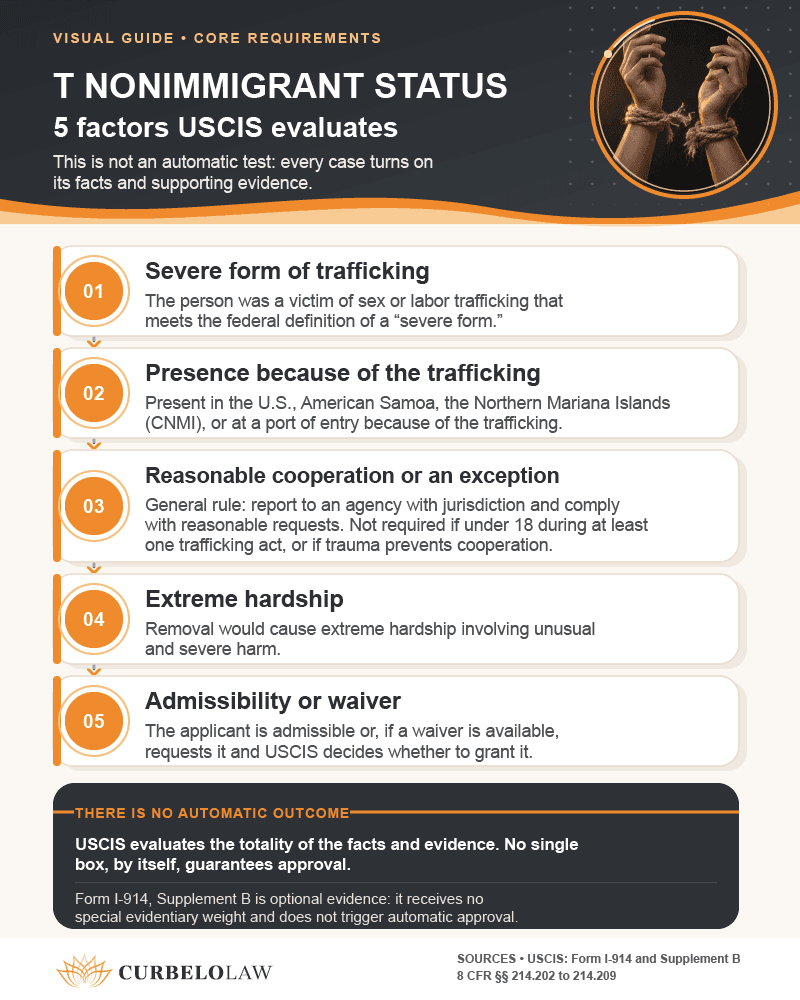
To be eligible for a T visa, you must meet the following requirements:
- Have been a victim of a severe form of trafficking in persons.
- Be physically present in the United States, American Samoa, or the Commonwealth of the Northern Mariana Islands on account of human trafficking. Current rules also cover certain circumstances at a port of entry.
- Show that you would suffer extreme hardship involving unusual and severe harm if you were to leave the United States.
- Be admissible to the United States. If you are not, you may apply for a waiver of inadmissibility if a waiver is available for the applicable ground.
- Comply with reasonable requests for assistance from law enforcement agencies in the investigation or prosecution of the crime. The current rule refers to the detection, investigation, or prosecution of trafficking or a crime in which trafficking is a central reason.
If you are under 18 or are unable to cooperate with law enforcement because of physical or psychological trauma, you may be exempt from this last requirement. The current regulation ties the age-based exception to having been under 18 during at least one act of trafficking.
Family Members Eligible for a T Visa
In addition to victims of human trafficking, certain family members may also be eligible for T visa status:
It is important to note that family member eligibility will depend on:
- The age of the principal trafficking victim, meaning whether the person is under or over 21 years old, and
- Whether family members face a risk of retaliation because of the victim’s cooperation with law enforcement or escape from human trafficking.
If the principal applicant is 21 or older, they can generally apply for their spouse and children. If the principal applicant is under 21, they may also include their parents and unmarried siblings under 18. When there is a present danger of retaliation, the regulations allow additional categories of qualifying family members.
Types of T Visas Available
Depending on the relationship and applicable circumstances, derivative categories include:
- T-1: For victims of human trafficking.
- T-2: Spouses of T-1 visa holders.
- T-3: Children of T-1 visa holders.
- T-4: Parents of the principal T-1 holder.
- T-5: Unmarried siblings under 18 of the principal T-1 holder.
- T-6: An adult or minor child of certain derivative family members when there is a present danger of retaliation as provided by the regulations.
Types of Trafficking Under U.S. Federal Law
Human trafficking under U.S. federal law is classified into two forms:
- Sex trafficking: Involves commercial sex acts induced by force, fraud, or coercion. When the person was under 18 during at least one act of sex trafficking, the law does not require proof of those means for the commercial sex act.
- Labor trafficking: Involves forced labor, servitude, or slavery through force, fraud, or coercion. It may also include peonage or debt bondage.
Threats, withholding documents, debt, or using immigration status as a means of control may be relevant depending on the facts. For more information about these concepts, see human trafficking and migrant smuggling.
How to Apply for T Status
To apply for T nonimmigrant status, you must submit the following documents to USCIS:
- Form I-914, Application for T Nonimmigrant Status.
- A personal statement explaining in your own words how you became a victim of human trafficking.
- Evidence showing that you complied with all reasonable requests for assistance from law enforcement. If possible, you may submit Supplement B to Form I-914.
- Court documents, police reports, news articles, or other credible evidence if you do not submit Supplement B.
- Evidence that you meet the eligibility requirements, including evidence related to physical presence and extreme hardship if you were removed.

Supplement B is optional evidence. USCIS has reiterated that it is not required, does not receive special evidentiary weight, and does not result in automatic approval. USCIS retains final authority to determine eligibility.
If necessary, you may also need to file Form I-192, Application for Advance Permission to Enter as a Nonimmigrant. In this context, it is used to request a waiver of certain grounds of inadmissibility when available.
To apply for an eligible family member, you must submit Supplement A to Form I-914. You may file it at the same time as Form I-914, while the I-914 is pending, or after obtaining T status, subject to the applicable rules.
What Evidence Can Support the Case?
The evidence depends on what is available in each case. In addition to police or court records, it may include communications with agencies, medical or counseling records, records from shelters or service providers, witness statements, messages, photographs, employment, school, or immigration records, and other materials that help establish the facts and timeline.
T visa lawyers can help identify gaps or apparent inconsistencies before filing the case and explain why certain documents do not exist. USCIS applies an “any credible evidence” standard, so the absence of a particular type of document does not automatically end the analysis.
Bona Fide Determination and Employment Authorization
Since the final rule took effect on August 28, 2024, USCIS may make a bona fide determination for certain T applications. If the application is bona fide and the person merits a favorable exercise of discretion, USCIS may grant deferred action and employment authorization before completing adjudication. This process is not the same as approval of T status.
USCIS states that this process generally applies to cases filed on or after August 28, 2024, with a limited exception for certain earlier filings when USCIS issues a Request for Evidence. The employment authorization category associated with this determination is (c)(40).
Whether Form I-765, Application for Employment Authorization, must be filed depends on whether you are the principal applicant or an eligible family member.
- Principal applicants: If you have been granted T visa status, USCIS will provide you with an EAD. USCIS uses the information from Form I-914 to generate the work permit, so you do not need to file Form I-765.
- Eligible family members: If you are in the United States, you must file Form I-765 to obtain an EAD. If you are outside the United States, you are not eligible to receive one until you have been lawfully admitted to the United States.

Employment authorization depends on the applicable stage and category. A bona fide determination is discretionary and should not be confused with final approval of T status.
Processing Time
It is difficult to know how long a T visa will take to be approved because processing times vary from person to person. USCIS’s historical national median for Form I-914 was 28.6 months in fiscal year 2026 through June 30, 2026. That figure included Form I-914A and is not a personalized estimate.
For a current reference, first use the official USCIS processing times tool with the information from your receipt notice. You can also review our explanation of USCIS processing times. If the agency asks for additional information, see what a USCIS Request for Evidence means.
Benefits and the Path to Permanent Residence
Foreign nationals who have obtained a T visa may:
- Remain lawfully in the United States.
- Receive authorization to work legally.
- Apply for adjustment of status to obtain a Green Card once they meet the applicable requirements.
T nonimmigrant status generally lasts 4 years, and it may be extended in certain circumstances.

Requirements for Getting a Green Card Through a T Visa
To be eligible for a Green Card through T nonimmigrant status, you must meet the following requirements:
- Have been lawfully admitted to the United States as a T-1 nonimmigrant.
- Maintain T-1 status when applying for a Green Card.
- Have maintained continuous physical presence in the United States for an uninterrupted period of 3 years, or for the duration of the investigation or prosecution of trafficking when the Attorney General has determined that it is complete, whichever period is shorter.
- Demonstrate good moral character during the period required by law.
- Meet the applicable cooperation requirement or one of the alternatives provided by law relating to age or extreme hardship.
To maintain continuous physical presence, you generally must not remain outside the United States for more than 90 days on a single trip or for periods totaling more than 180 days. There is a limited statutory exception when the absence is connected to the investigation or prosecution and is documented in accordance with the regulations.
In any case, to apply for a Green Card through a T visa, you must file Form I-485, Application to Register Permanent Residence or Adjust Status, with USCIS. At this stage, T visa lawyers can review whether the evidence continues to satisfy the requirements for adjustment.

Derivative family members have their own adjustment of status rules. Their eligibility should not be assumed based on the requirements that apply to the T-1 principal.
Travel Outside the United States
It is essential to speak with your immigration lawyer before considering travel outside the United States after obtaining a T visa. Departing the country may affect continuous physical presence and raise other admissibility or travel documentation issues.
If you have T status and have filed an application for lawful permanent residence, you must apply for “advance parole.” If you do not, USCIS may consider your permanent residence application abandoned when you leave the country, subject to the applicable rules and exceptions.
How Much Does It Cost to File a T Application?
Form I-914 and Supplement A have a $0 filing fee under the USCIS fee schedule. The (c)(40) Form I-765 category for a T application with a bona fide determination is also listed with a $0 fee. Other related forms or requests may be subject to different rules, so it is advisable to review the G-1055 Fee Schedule before filing.
What Is the Difference Between a T Visa and a U Visa?

The T visa focuses on helping victims of human trafficking, while the U visa is designed for victims of certain qualifying crimes who meet its own requirements. The U visa requires a signed certification on Form I-918, Supplement B. In a T visa case, Form I-914, Supplement B is optional evidence.
The distinction matters because a person may have experienced conduct that appears to fit more than one form of relief, but the legal elements, forms, and cooperation requirements are not the same. Before choosing a path, it is important to identify which facts can be proven and which requirements actually apply to each benefit.
Help for Human Trafficking Survivors in New Jersey
If you are looking for a T visa lawyer in New Jersey, it is important to separate the immigration application filed with USCIS from any immediate assistance you may need as a survivor. New Jersey maintains state resources for reporting human trafficking and obtaining support, and some state agencies may process requests for Form I-914B declarations within their jurisdiction.
The New Jersey State Police publishes the state’s 24/7 human trafficking hotline: 855-END-NJ-HT (855-363-6548). It also identifies PROTECT from Legal Services of New Jersey at 1-844-576-5776 and the National Human Trafficking Hotline at 1-888-373-7888, with text messaging available at 233733. Check the official New Jersey resources to confirm current information.
What Can Curbelo Law Do for You?
Curbelo Law can review the facts of your case, explain which requirements need supporting evidence, and help prepare the application and related documents. If issues involving inadmissibility, criminal history, removal proceedings, travel, derivative family members, or a Request for Evidence arise, each issue must be analyzed based on your specific circumstances.
Our immigration attorneys are available to provide specialized guidance on T visas. You can call us, email us, or schedule an appointment with our office in Ridgewood, New Jersey.
Eligibility and outcomes depend on the facts, evidence, and applicable law. A consultation can help determine what options may be available and what risks should be reviewed before filing.
Let us know about your case We can help you