

If you want to conduct business in the United States, the B-1 business visitor visa may be a suitable option for you.
Generally, foreign nationals traveling to the U.S. for business or tourism need a visitor visa unless they qualify for the Visa Waiver Program (VWP). The correct category depends on the actual purpose of the trip and the activities you will carry out in the United States.
The key distinction is that a business visit allows certain temporary commercial or professional activities, but it does not serve as a general employment authorization. For that reason, in addition to reviewing the requirements and documents, it is important to determine who will pay you, how long you will stay, and whether your activity could be considered productive work in the United States.
Let us know about your case We can help youOn this page
What the B-1 business visitor visa allows and where the line is drawn with employment
The B-1 category is intended for foreign nationals who need to enter the United States temporarily for commercial or professional business reasons. This includes:
- Attending scientific, educational, professional, or business conferences.
- Negotiating contracts.
- Consulting with business associates.
- Participating in certain short-term training programs when the activity and compensation comply with business visitor rules.
- Conducting independent research when it does not constitute employment in the United States.
The Department of State explains the permitted uses of the B-1 category and distinguishes those activities from employment or the performance of skilled or unskilled labor in the United States.
| Planned activity | Can it qualify under B-1? | Key point to confirm |
|---|---|---|
| Meetings, consultations, or contract negotiations | Generally yes | The visit must be temporary and must not involve local employment. |
| Professional conference or seminar | Generally yes | Any payment or reimbursement must comply with the applicable rules. |
| Installing, repairing, or servicing equipment sold from abroad | Only in limited cases | The sales contract must require the service, the visitor must have essential knowledge, and the visitor must not receive compensation from a U.S. source. The exception does not cover performing construction work. |
| Exploring an investment or negotiating for business premises | May qualify | Preparing an investment is not the same as managing the day-to-day operations of a U.S. business. |
| Temporary training | Depends on the facts | Who provides the training, the compensation, and whether productive work is involved must be reviewed. |
| Managing daily operations, filling a position, or performing productive work | Generally no | An employment, investment, or intracompany transfer category may be appropriate. |
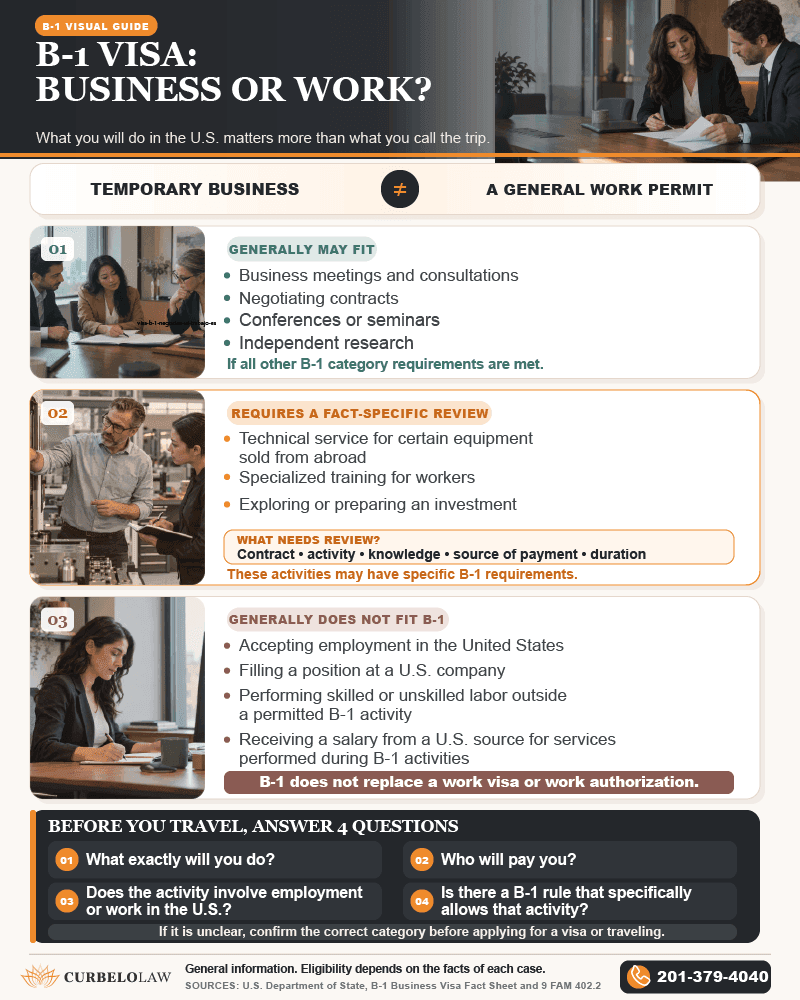
In general, a person in B-1 status may not receive a salary from a U.S. source for services performed during the visit. However, a U.S. source may cover reasonable incidental expenses related to the trip, such as transportation, lodging, and meals, within the applicable limits.
Do I always need to apply for a B-1 visa?
If you qualify for the Visa Waiver Program (VWP), you may not need to apply for a visitor visa for a business trip of up to 90 days, provided you meet the program requirements and obtain ESTA approval.
The VWP allows citizens of participating countries to travel for certain activities that would also be permissible as temporary business activities. It does not authorize employment and has more limited rules for extending a stay or changing status. Citizens of Canada and Bermuda, meanwhile, generally do not need a visa for certain temporary business visits, although exceptions may apply depending on the purpose of the trip.
What should I do if I want to travel to the United States for a purpose other than business?
If you plan to travel to the United States for reasons other than business or tourism, you will need to apply for a different type of U.S. visa.
If your passport has expired but your U.S. visa is still valid, the Department of State indicates that the visa may remain valid if it has not been canceled or revoked. In that situation, you would normally travel with a new passport and the previous passport containing the visa.
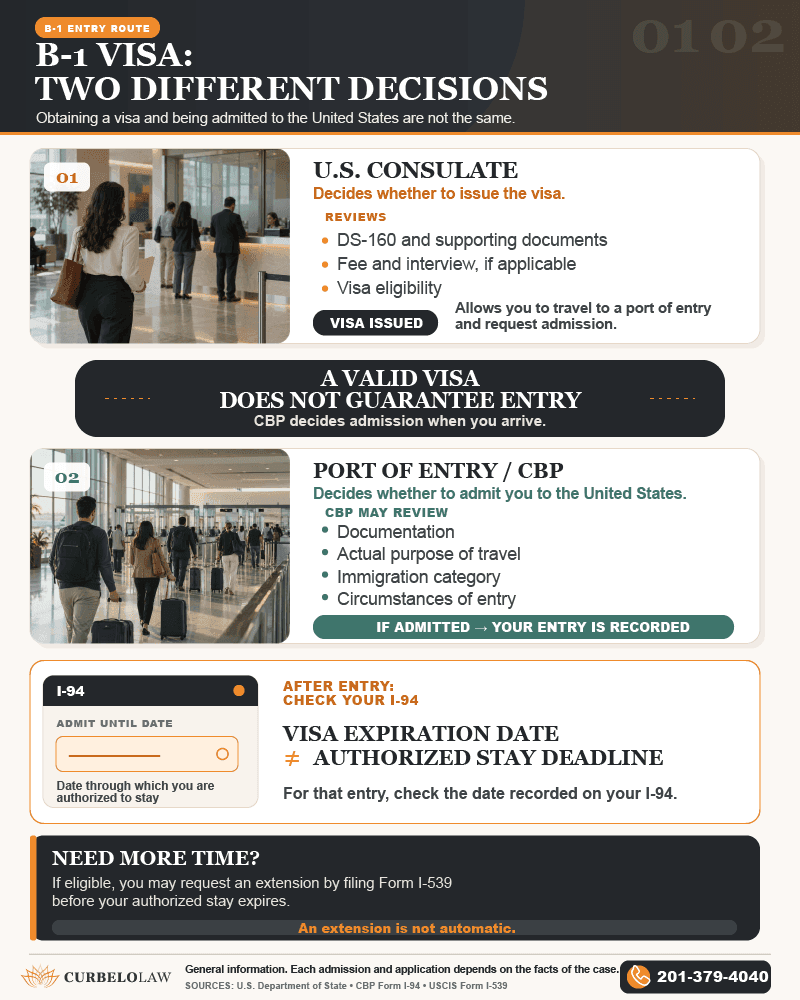
When you enter the United States, CBP records your admission and the date through which you are authorized to remain. This information can be checked in the electronic I-94 record and is different from the expiration date printed on the visa.
Requirements for a B-1 business visit
To obtain this classification, you must demonstrate that:
- The purpose of your trip to the United States is business.
- You plan to remain in the U.S. for a limited period.
- You have sufficient funds for your trip and stay.
- You have a residence outside the United States and ties that support your intent to return.
- You are admissible to the United States.
The nonimmigrant rule also requires you to demonstrate temporary intent. According to the Department of State Foreign Affairs Manual, a B visa applicant must maintain a residence outside the United States that they do not intend to abandon, seek entry for a specifically limited period, and travel for a legitimate business or pleasure purpose.
A refusal under section 214(b) may occur when the applicant fails to demonstrate that they meet the requirements of the category or fails to overcome the presumption of immigrant intent. If this has already happened in your case, review what to do if a visa application is denied before deciding whether it makes sense to submit a new application.
Do I need a certain amount of money?
No. There is no specific amount of money that, by itself, qualifies you for this classification. The financial assessment depends on each applicant and should be consistent with the length and cost of the trip.
The Department of State indicates that documents may be requested to demonstrate your ability to pay all travel costs. Evidence of employment or family ties may also help demonstrate the purpose of the visit and your intent to return to your country of residence.
Documents to demonstrate the business purpose of your trip
To apply, you will need to gather and prepare the basic documents required by the Department of State and review the specific instructions of the embassy or consulate where you will submit your application.
- Passport: Your passport must be valid for at least 6 months beyond your period of stay in the United States, unless an exemption applies under specific agreements with your country.
- Nonimmigrant visa application: This is the confirmation page for Form DS-160.
- Application fee payment receipt: If payment is required before the interview, you must present this receipt.
- Photograph: You must upload your photo when completing Form DS-160 online. If the photo upload fails, you will need to bring a printed photo that meets the photo requirements.
Possible additional documents
Review the instructions on how to apply for a visa on the website of the U.S. embassy or consulate where you will apply.
You may be asked to provide additional documents to establish whether you qualify. These documents may include evidence of:
- The purpose of your trip.
- Your intent to leave the United States.
- Your ability to pay all travel costs.
For a business trip, that evidence may include a meeting agenda, conference registration, business correspondence, contracts to be negotiated, information about your foreign employer, and documents explaining who will pay the expenses. An invitation letter does not replace the applicant’s eligibility requirements.

How to apply for a B-1 business visitor visa step by step
Applications in this category are processed by the Department of State through a U.S. embassy or consulate. The application fee for a B visa that does not require a petition is currently $185 and is nonrefundable. Depending on your nationality, a reciprocity-based issuance fee may also apply.
The basic steps for preparing an application are:
- Complete Form DS-160 online, submit it, and save the confirmation page because you will need it for the consular process.
- Review the embassy or consulate instructions and pay the applicable fee.
- Schedule and attend the interview when required.
- Prepare the documents that explain the temporary purpose of the trip and provide answers that are consistent with your DS-160 and the activities you will actually carry out in the United States.
As of July 15, 2026, the Department of State indicates that nonimmigrant visa applicants must schedule their interviews at the U.S. embassy or consulate in their country of nationality or residence, except for cases covered by a designated post or another exception. If you apply based on residence, you must be able to demonstrate it. Applying in another country may make it more difficult to qualify.
Before scheduling an appointment, review the current guidance on where to schedule the interview and the website of the appropriate consular post.
How do I renew a B visitor visa?
Renewal follows the same basic application process. As of October 1, 2025, the general interview rule for nonimmigrant visas requires an in-person interview, although some applicants renewing a B-1, B-2, or B-1/B-2 visa within 12 months after the expiration of a prior full-validity visa may qualify for an interview waiver if they meet the remaining criteria.
A consular officer may require an interview even when a person appears to qualify for a waiver. Always review the consulate’s instructions and, for more information about the general process, see how to renew a U.S. visa.
A visitor visa does not guarantee entry: CBP, length of stay, and the I-94
A valid visa allows you to travel to a port of entry and request admission, but it does not guarantee that CBP will allow you to enter. In addition, the validity period printed on a visa and the period of stay authorized for each entry are not the same. Visa validity may vary based on nationality and reciprocity rules, while CBP determines admission and the date through which you may remain in the United States.
With a B-1 business visitor visa, you should not assume that your authorized stay matches the validity period of the visa. The regulation for B visitors allows admission for up to one year, but CBP determines the specific length of each admission. You must check the date on your own I-94 to know when your authorized stay for that trip ends.
If you need to stay longer, you may apply for an extension using Form I-539 if you meet the requirements. The regulation generally limits B extensions to increments of no more than six months, and USCIS recommends filing before your authorized stay expires. An extension is not automatic.

Can I work in the United States as a B-1 visitor?
Because the B-1 category is not intended for ordinary employment, it cannot be used as a substitute for employment authorization.
The line can be difficult to draw when a person travels to install equipment, train personnel, explore an investment, or provide specialized expertise. In those situations, the specific activity should be compared with the official exceptions, not just the job title or the way the company describes the trip.
Family members and domestic employees: different rules
Spouses and children cannot be included as derivative dependents of B-1 classification. Each family member who needs a visa must submit a separate application and demonstrate that they meet the requirements of the category that corresponds to the purpose of their trip.
If a family member is traveling for tourism or a visit, B-2 may be the appropriate category. To understand its requirements and permitted activities, review our guide to the B-2 tourist visa for temporary visitors.
What about personal or domestic employees?
Certain personal or domestic employees may qualify for B-1 classification if they accompany certain employers and meet additional requirements. These situations are a specific exception and should not be confused with an ordinary business visit.
Depending on the case, the Department of State requires conditions concerning the employment relationship, residence abroad, and a contract governing wages and benefits. USCIS also includes certain B-1 domestic employees in category (c)(17) of the Form I-765 instructions for employment authorization. Therefore, you should not begin that work based solely on the visa without also reviewing the applicable employment authorization rules.
When a business activity no longer qualifies under B-1
In addition to meetings and negotiations, there are situations in which classification depends on technical details. To apply the limits of the B-1 business visitor visa correctly, the actual activity matters, not the label the company gives the trip. The following examples help identify questions that should be resolved before applying for or using a visitor visa.
Sales and contracts
If you travel to the United States to participate in a trade show, sign contracts, or take orders for goods produced and delivered from abroad, the activity may qualify as temporary business as long as it does not involve paid employment in the United States.
Installation, service, or repair of equipment
A person who installs, services, or repairs commercial equipment sold by a foreign company to a U.S. buyer may fall within a limited exception. The sales contract must require the service or training, the visitor must have knowledge essential to fulfilling the obligation, and the visitor may not receive compensation from a U.S. source.
This exception does not permit construction work. A person who otherwise meets the requirements may, in certain cases, supervise or train construction workers without personally performing the construction work.
Conferences and honoraria
Attending a professional or business conference is a typical visitor activity. The rules for receiving an honorarium from a U.S. institution, by contrast, are narrower and should not be presented as a general rule for every speaker. The Foreign Affairs Manual provides a specific academic exception with limits on duration and number of institutions.
Exploring an investment versus operating a business
An investor may travel to research opportunities, meet with business associates, or take permitted preparatory steps. However, if the plan is to actively develop and direct a business in the United States, it may be necessary to consider another category, such as an E-2 investor visa when its requirements are met.
If a related foreign company intends to transfer an executive or manager to direct U.S. operations, it may also be appropriate to consider an L-1A visa for executives and managers. The correct category depends on the facts and the business structure.

B-1, B-2, or B-1/B-2: which one applies to each purpose?
B-1 is for permitted temporary commercial or professional activities in the United States, such as consultations, meetings, and contract negotiations.
B-2, on the other hand, is for tourism, family visits, medical treatment, and other permitted pleasure activities.
Applicants often combine business and tourism purposes, so they may be issued a B-1/B-2 combination visa if they meet the applicable requirements.
When it may be helpful to review your case with an attorney
You are not required to hire an immigration attorney to file the application, but legal guidance may be beneficial when the line between business and employment is difficult to determine, there was a prior denial, payments will come from the United States, you plan to open a business, or the documentation does not clearly describe the intended activity.
At Curbelo Law, our immigration attorney Carolina Curbelo is available to help you evaluate whether the purpose of your trip fits the requested category, review consistency between the DS-160 and your supporting documents, and identify whether another immigration classification should be considered before you apply or travel.
If your case has a connection to New Jersey, you can learn about our immigration lawyers in New Jersey. Contact the Curbelo Law office in Ridgewood to request a consultation.
Let us know about your case We can help you