The B-2 tourist visa is a nonimmigrant visa for temporary travel to the United States for tourism, vacations, visits with family or friends, and certain medical treatments.
Obtaining this visa allows you to request admission at a U.S. port of entry, but it does not guarantee entry or determine how long you may remain in the country. To apply, you generally must demonstrate a permitted temporary purpose, an intention to leave the United States at the end of your visit, and sufficient financial resources for your trip.
Let us know about your case We can help youOn this page
How to apply for a B-2 tourist visa for the United States
To obtain a B-2 tourist visa, you must demonstrate that your visit to the United States is only temporary. Therefore, you must show that you have a residence in another country that you do not intend to abandon and that you plan to leave the U.S. at the end of your stay.
The consular officer may also consider your travel plans, financial resources, and ties outside the United States to determine whether you qualify for the requested visa category and overcome the presumption of immigrant intent that applies to nonimmigrant visas.
- Complete the DS-160: fill out the online Form DS-160, upload a photograph that meets the requirements, and save the confirmation page.
- Pay the fee: the processing fee for a B visitor visa is currently $185 and is nonrefundable. Depending on your nationality, an issuance fee may also apply.
- Schedule the interview: follow the instructions from the embassy or consulate where you will apply. The Department of State indicates that nonimmigrant visa applicants should schedule their interview in their country of nationality or residence, subject to the rules that apply to countries without routine visa operations.
- Prepare your documents: gather the required documents and any additional evidence requested by the consulate to establish the temporary purpose of your trip, your intention to leave, and how you will pay for your visit.
- Attend the interview: answer all questions fully and truthfully. The consular officer may approve the visa, deny it, or indicate that the case requires additional administrative processing.
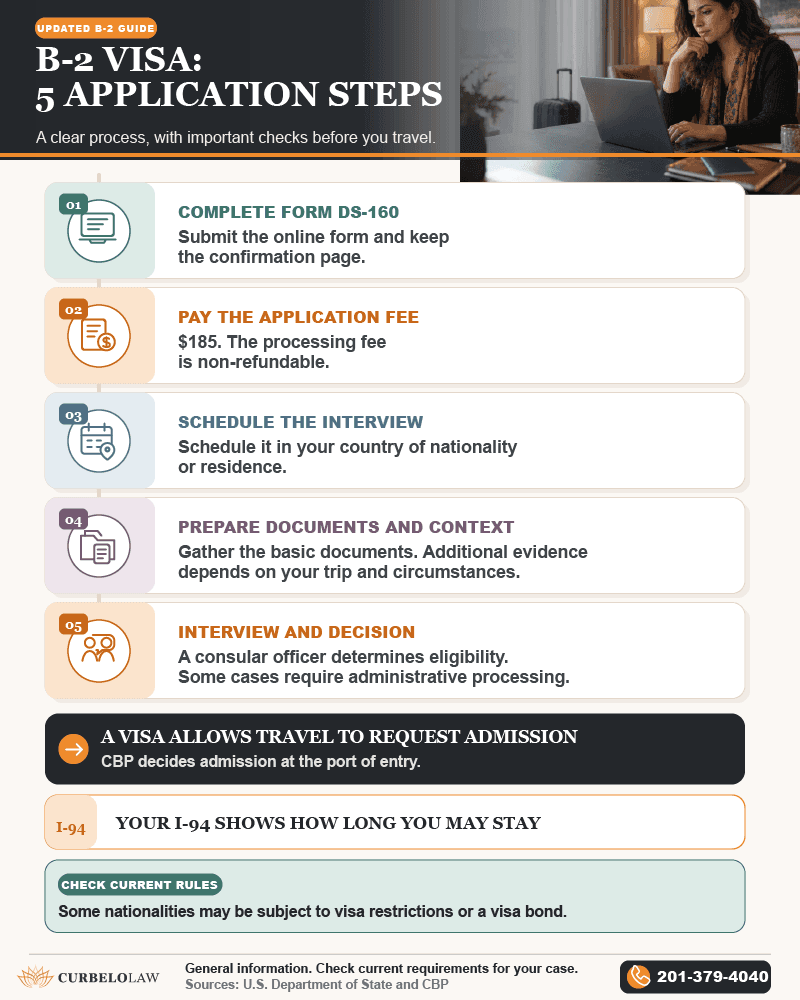
Since January 1, 2026, there have been full or partial restrictions on visa issuance and entry for nationals of certain countries, with limited exceptions. In addition, certain nationalities may be subject to a $10,000, $15,000, or $20,000 B-1/B-2 visa bond if required by a consular officer. Do not pay a bond on your own initiative. The consular officer must tell you whether this requirement applies to your case.
Is the interview mandatory?
In general, nonimmigrant visa applicants must attend an in-person interview. Since October 1, 2025, even applicants under age 14 and over age 79 generally need an interview.
A B-1, B-2, or B-1/B-2 visa renewal may qualify for an interview waiver if the application is submitted within 12 months after a previously issued full-validity visa expired and the other requirements are met. Even so, the consulate may still require an interview.
How much does it cost to apply for a visitor visa?
The processing fee for a B visitor visa is $185. This is a nonrefundable application fee, even if the visa is denied. Depending on your nationality, an additional issuance fee may apply under the Department of State’s reciprocity schedule.
Federal law also created a Visa Integrity Fee for individuals who are issued a nonimmigrant visa, with an initial amount of $250 for fiscal year 2025 and subsequent adjustments for inflation.
The Department of State’s operational fee schedule reviewed in September 2026 still lists $185 for a B visa application and does not publish a current amount for this separate charge there. Before calculating the total cost, confirm the current instructions from the consulate or embassy where your visa will be processed.
Documents required to apply for a tourist visa
Before the interview, the Department of State identifies the basic required documents as your passport, DS-160 confirmation page, fee receipt when payment is required before the appointment, and a printed photograph only if the photo upload failed while completing the DS-160.
- Passport: it must be valid for travel to the United States and, unless exempt under a country-specific agreement, remain valid for at least six months beyond your intended period of stay.
- DS-160: bring the confirmation page for your electronic application.
- Fee: bring the receipt if the consulate’s instructions require payment before the interview.
- Photograph: bring a printed photo in the required format if you were unable to upload the photograph successfully when completing the DS-160.
The consulate may request additional documentation concerning the purpose of your trip, your intention to return, and your ability to pay your expenses. Employment, family relationships, or other ties outside the United States may be relevant. A letter of invitation or an Affidavit of Support is not required to apply for a visitor visa and, by itself, does not determine whether the visa will be approved.
If you are traveling for medical treatment, the officer may request a diagnosis from your local physician, a letter from the U.S. physician or medical facility stating the expected duration and cost of treatment, and evidence showing how the medical, transportation, and living expenses will be paid.
Do I need to apply for a tourist visa before entering the U.S.?
If you want to travel temporarily to the United States, you may be eligible for a visitor visa. However, you may be exempt from the visa requirement if you are a foreign national of a country that participates in the Visa Waiver Program (VWP).
Travelers who qualify for the VWP may travel for tourism or business for 90 days or less without obtaining a B visa, provided they meet all program requirements and have valid ESTA authorization before traveling. If you believe you qualify, apply for or check your authorization on the official ESTA website.

How long is a tourist visa valid and how long can you stay in the United States?
The validity of the visa and the amount of time you are authorized to remain in the United States are not the same. The validity of a visitor visa depends, among other factors, on your nationality and the applicable reciprocity schedule, so you should not assume that it will always be valid for 10 years.
When you arrive, a U.S. Customs and Border Protection (CBP) officer decides whether to admit you and until what date. The date that controls your authorized stay is the admission date recorded on your I-94, not the expiration date printed on your visa. You can check your most recent I-94 record on the CBP website.
Can you extend your stay as a tourist?
Some individuals admitted as B-2 visitors may request an extension of stay from USCIS by filing Form I-539. The application must be filed before the authorized stay shown on the I-94 expires. Filing the application does not mean the extension will be approved.

Once your authorized period ends, you must leave the country unless you have a legal basis to remain. Staying in the United States on a tourist visa beyond the authorized period can have immigration consequences.
How to renew a tourist or visitor visa
To renew a tourist or visitor visa, you must do so at a U.S. embassy or consulate abroad. In general, you will need to complete the application process again, although some renewals may meet the current criteria for an interview waiver. For more information, review how to renew a U.S. visa.
What does a B-2 tourist visa allow me to do?
This visa allows foreign nationals to travel to the United States for tourism. This includes:

- A short vacation.
- Visiting family and friends.
- Receiving medical treatment.
- Participating in social events hosted by fraternal, social, or service organizations.
- Participating as an amateur in musical, sports, or similar events or competitions. However, you may not receive payment for participating.
- Enrolling in a short recreational course that does not provide academic credit. For example, a two-day cooking class during your vacation.
What can you not do with a tourist visa?
The following are some activities that require different visa categories and cannot be performed with a visitor visa:
- Study for academic credit or a degree.
- Work.
- Give paid performances or perform professionally before a paying audience.
- Enter as a crew member of a ship or aircraft.
- Work as a foreign journalist in radio, film, print journalism, or other information media.
- Visit the U.S. for the primary purpose of giving birth in the country to obtain U.S. citizenship for the child.
If your actual purpose is to study, you can review the requirements for an F-1 student visa. If you need to compare other categories, review the types of U.S. visas before submitting an application that does not correspond to your intended activity.
How long does it take to process a tourist visa?
There is no universal processing time. Appointment availability varies by embassy or consulate, and a case may require additional administrative processing after the interview. Check the official interview wait times before planning your trip, and avoid purchasing nonrefundable tickets until you have your visa.
Through December 31, 2026, the Department of State also maintains an expedited appointment pilot program at certain posts. Eligible B visa applicants may choose to pay $750 per appointment to attempt to obtain an interview within 10 business days, subject to availability. This payment does not replace the regular $185 fee.

What can I do if I was previously denied a visa?
If an application is denied under INA 214(b), there is no appeal of that consular decision. You may apply again, but you will need to submit a new application and pay another fee. The Department of State indicates that you should be able to show significant changes in circumstances since your previous application. For more information about this situation, review what to do if your visa application is denied.
Can my parents visit me with a tourist visa?
Your parents may apply for a visitor visa if their trip will be temporary and they meet the requirements for the category. The fact that you are a U.S. citizen or lawful permanent resident does not automatically entitle them to a B-2 visa or replace the consulate’s individual assessment of their applications.

A temporary visit is different from petitioning for a parent to live permanently in the United States. If permanent residence is the goal, review the requirements to petition for your parents as a U.S. citizen.
What happens when you arrive in the United States with a B-2 tourist visa?
Having a visitor visa does not guarantee entry. When you arrive in the United States, a CBP officer will review your documents and decide whether to admit you, under which classification, and until what date. Check your I-94 afterward and make sure you leave before your authorized stay expires unless you have obtained an extension or another valid authorization.
The visa expiration date indicates how long you may use the visa to request admission. It is not the date until which you may remain in the United States. For a person who has already been admitted, the controlling factor is the authorized period of admission, which is generally reflected on the I-94.
What is the difference between B-1 and B-2 visas?
B-1 and B-2 visas are for temporary visitors to the United States, but they serve different purposes. The B-1 business visitor visa allows certain temporary business activities, while the B-2 tourist visa is used for tourism, personal visits, and medical treatment.
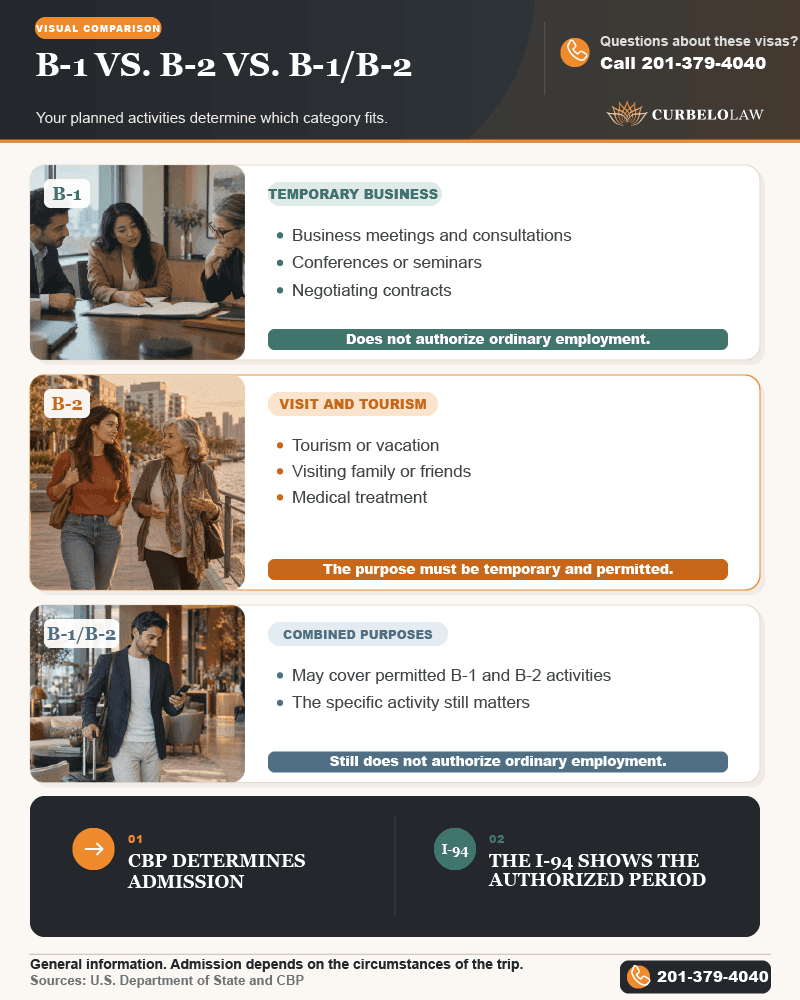
| Aspect | B-1 | B-2 |
|---|---|---|
| Primary purpose | Permitted temporary business activities | Tourism, personal visits, or medical treatment |
| Examples | Meeting with business associates, attending conferences, negotiating contracts, or settling an estate | Vacations, visiting family or friends, medical treatment, and short recreational courses without academic credit |
| Employment in the U.S. | Does not authorize ordinary employment for a U.S. employer | Does not authorize employment |
| Length of stay | Determined by CBP upon entry and reflected on the I-94 | Determined by CBP upon entry and reflected on the I-94 |
For a combination of business and tourism purposes, a B-1/B-2 visa may be issued. Having a combined visa does not eliminate the restrictions. The activities you engage in during each entry must be consistent with the purpose for which you were admitted.
How Curbelo Law can help with a visitor visa application
An application may appear straightforward, but inconsistencies between the DS-160, supporting documents, and interview responses can affect the evaluation of your case. A prior denial, immigration history, questions about the purpose of the trip, or a possible ground of inadmissibility may also require an individualized legal analysis.
Our attorneys have more than 10 years of experience handling these types of cases and immigration matters. Only after understanding the circumstances and facts surrounding your case can we provide more detailed information about its prospects.
Let us know about your case We can help you