
The L-1B visa allows a multinational company to temporarily transfer an employee with specialized knowledge to the United States. To qualify, the company must establish a qualifying relationship between the entities, at least one year of eligible employment abroad, and the need for that knowledge in the U.S. position.
This guide explains the requirements, documents, costs, length of stay, and application process. Curbelo Law can help you assess the evidence and determine the appropriate filing route for the transfer.
Let us know about your case We can help youOn this page
What Is the L-1B Visa and Who Is It For?
The L-1B visa is a temporary employment classification for employees who possess special knowledge of their organization’s products, services, or techniques, or advanced knowledge of its internal processes. It allows transfers between related entities and, subject to additional requirements, transfers to new offices in the United States.
There is no annual cap or lottery. The classification can help a multinational company share knowledge and establish U.S. operations. It also allows eligible spouses and children to accompany the employee.
It differs from the L-1A visa for executives and managers, which is intended for genuine managerial or executive responsibilities. Both classifications require a qualifying international corporate relationship.
What Are the L-1B Visa Requirements?
The employer must establish its international corporate structure and business operations. The employee must meet the foreign employment requirement and demonstrate that the proposed position calls for specialized knowledge.
Employer Requirements
- Maintain a parent, branch, subsidiary, or affiliate relationship between the U.S. and foreign organizations, based on ownership or control.
- Conduct business regularly in the United States and at least one other country, directly or through a qualifying organization, throughout the employee’s stay.
Simply registering a company or maintaining a mailing address is not enough to establish that it is doing business. The company is not required to engage specifically in international trade.
When a corporate group includes multiple entities, we distinguish ownership from control by examining corporate records, ownership interests, and organizational charts before identifying the petitioner. A support letter does not replace documents establishing the qualifying relationship.
If one entity pays the employee’s salary while another directs the project, we examine each entity’s role and determine which will receive the employee’s services. That distinction may change which entity should file the petition and what evidence is required.
Employee Requirements
- Have worked full-time and continuously for at least one year for a qualifying foreign entity within the applicable three-year period.
- Have performed managerial, executive, or specialized knowledge duties during that foreign employment.
- Be transferring to a U.S. position whose duties require the specialized knowledge being claimed.
Payroll records, entry and exit dates, and transfers between companies in the group should be checked against one another. A lengthy employment history does not automatically establish the required year of work abroad.
A previous U.S. assignment also requires examining which periods count as foreign employment. Certain brief visits may not interrupt continuity, but days spent in the United States do not, by themselves, satisfy the foreign employment requirement.

How Do You Prove Specialized Knowledge for an L-1B Visa?
USCIS distinguishes special knowledge of a company’s products, services, research, or techniques from advanced knowledge of its processes. That knowledge does not have to be exclusive or proprietary, but the evidence must show that it goes beyond ordinary skills and is relevant to the proposed position.
The official USCIS guidance on L-1B evidence explains why a generic job description is insufficient. What matters is what the employee knows, how that knowledge was acquired, and how it will be used.
Useful Evidence and Mistakes to Avoid
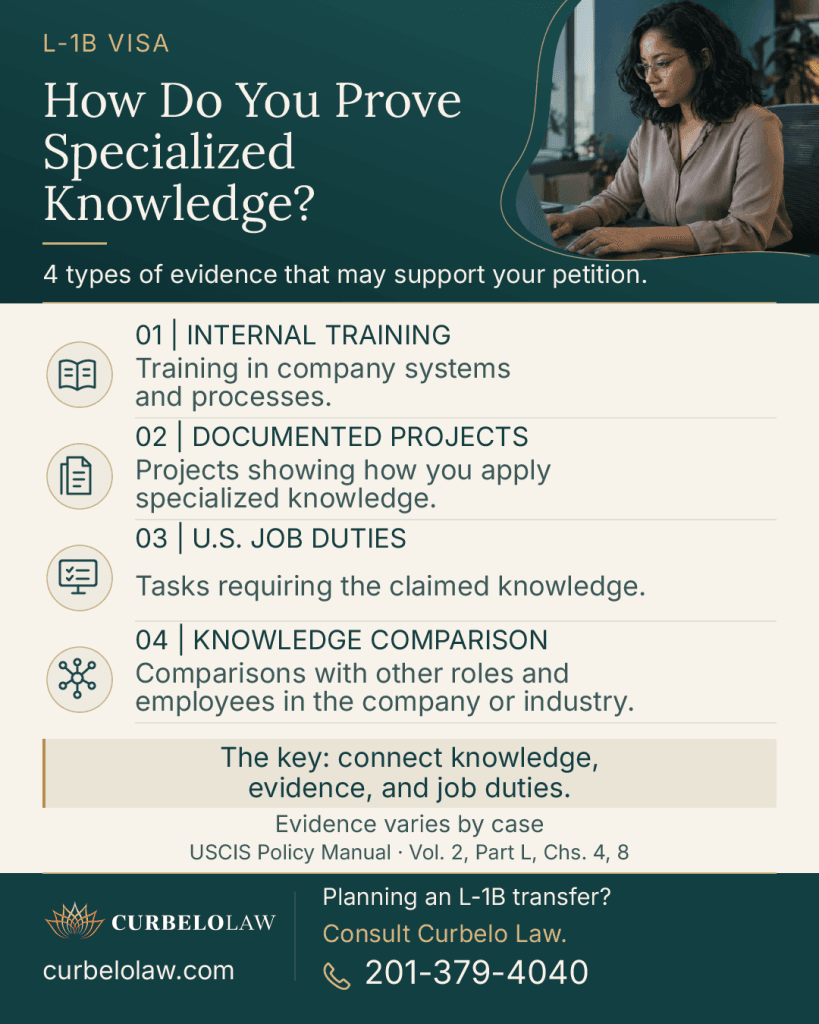
- Training records, internal manuals, and process documentation.
- Projects, deliverables, or reports establishing the employee’s participation and actual responsibilities.
- A detailed description of the U.S. position tied to specific knowledge.
- A reasoned comparison with typical industry skills or other employees’ responsibilities.
When reviewing this evidence, we distinguish general industry experience from knowledge acquired specifically within the organization. For example, knowing how to code does not necessarily mean someone has mastered a proprietary internal platform developed by the company.
Supervisor letters are more useful when they describe verifiable responsibilities rather than labels such as “indispensable.” A specific project can show how the employee acquired the knowledge and why it is advanced.
What if Other Employees Have Similar Knowledge?
The fact that other employees have similar knowledge does not automatically disqualify an L-1B petition. Nor is it necessary to prove a shortage of U.S. workers or an unusually high salary.
If the U.S. office already employs specialists, we examine what the transferee will do, what training another person would need, and the impact of not having the transferee available. Training plans, schedules, and project records may support that explanation more effectively than claiming the employee is “irreplaceable.”
USCIS may also consider the time, cost, or difficulty involved in transferring that knowledge. When relevant, training programs, required hours, and project deadlines can help document these factors. They are not mandatory evidence in every case and do not replace proof of specialized knowledge.
Hypothetical example: An employee spent two years helping design an internal system used in three countries. Her project reports, training records, and responsibilities could establish specialized knowledge. The title “senior engineer” alone would not.
A Request for Evidence (RFE) may challenge the connection between the employee’s knowledge, supporting documents, and proposed duties. The response should address the specific concern rather than repeat general statements from the petition.
What Documents Are Required for an L-1B Visa?
The documents must establish the corporate group’s eligibility, the employee’s previous employment, and the specialized duties. The exact evidence depends on the corporate structure, type of petition, and whether the employee is already in the United States.
Documents From the Petitioning Company
- A support letter explaining the transfer, the duties, and why specialized knowledge is needed.
- Formation records, ownership documents, and organizational charts establishing the relationship between the entities.
- Annual reports, financial statements, contracts, or other evidence of business operations.
- A description of the U.S. position, employment terms, and planned projects.
- Training records or technical documentation supporting the specialized knowledge claims.
Documents From the Foreign Employee
- A valid passport and consular documents, when applicable.
- Pay stubs, contracts, employment verification letters, or statements establishing the year of foreign employment.
- A résumé, work history, relevant certificates, and training records.
- A transfer letter and, if the employee is already in the United States, relevant status documents, such as a visa and Form I-94, when applicable.
Before filing, we cross-check dates and duties across payroll records, letters, organizational charts, and immigration history. If the U.S. job description attributes knowledge to the employee that is not reflected in their projects or training, we must strengthen the evidence or reconsider how the position is presented.
Not every case requires diplomas or photographs. We prioritize evidence that addresses the actual eligibility requirements and avoid generic checklists that add pages without establishing eligibility.

What Is the L-1B Visa Application Process?
The process depends on whether the employer has an approved blanket L petition and whether the employee applies for a visa abroad or requests a change of status in the United States. For an individual petition, the typical steps are:
- Gather evidence of the corporate relationship, foreign employment, and specialized knowledge.
- File Form I-129 with the L Classification Supplement and applicable fees.
- Respond to an RFE, if issued, and receive a decision from USCIS.
- If a consular visa is required, complete Form DS-160 and follow the appointment and interview instructions.
- Apply for admission to the United States and verify the authorized period of stay on Form I-94.
An employee already in the United States may be eligible for a change or extension of status, depending on their immigration circumstances. USCIS petition approval does not, by itself, mean that a consular visa has been issued or guarantee admission at the border.
Individual Petitions vs. Blanket L Petitions
An individual L-1 petition identifies one employee. When a company transfers several professionals, each petition is evaluated individually, even when USCIS permits coordinated filings for certain projects. This is not the same as blanket L approval.
A blanket L petition establishes qualifying relationships among entities in the corporate group in advance. It does not automatically establish each employee’s eligibility. The included organizations must engage in commercial trade or services.
To qualify for this option, the group must have a U.S. office that has been doing business for at least one year and at least three branches, subsidiaries, or affiliates. It must also meet one of these criteria:
- At least 10 approved L petitions during the preceding 12 months.
- At least 1,000 employees in the United States.
- Combined annual sales of at least $25 million among qualifying U.S. entities.
Under the blanket L-1B process, the employee must qualify as a specialized knowledge professional. Depending on where and how the employee applies, Form I-129S and documentation of blanket petition approval may be required.
If several employees will work on the same project, the company may organize shared supporting materials, such as contracts, implementation plans, or organizational charts. However, each employee must separately establish the required year of foreign employment, specialized knowledge, and proposed U.S. duties.
Before choosing the blanket process, we check which entities are covered by the current approval and whether each employee qualifies. The group’s approval does not automatically authorize transfers or eliminate applicable consular procedures.
What Questions May Be Asked at the Consular Interview?
The consular officer may ask about the companies, the employee’s experience abroad, specialized knowledge, and U.S. responsibilities. The answers should be consistent with the forms and support letters. Read our guide to U.S. consular processing to understand the steps and how they differ from a change of status.

New Offices and Work at Client Sites
Newly established offices and assignments at unaffiliated client locations require additional evidence of business operations and actual control over the work.
Requirements for Opening a New U.S. Office
To transfer a specialized knowledge employee to a new office, the employer must establish:
- Sufficient physical premises to establish the office.
- The financial ability to pay the employee and begin business operations.
A new office is generally an operation that has been doing business in the United States for one year or less. When evaluating this option, we distinguish legal formation from actual operations by examining the premises, budget, and proposed duties. Initial approval is generally limited to one year, and an extension requires evidence that the business is operating.
To request an extension after the first year, the employer must establish that the office has actually conducted business through evidence such as performed contracts, invoices, payments, and operating records. USCIS also reviews the continuing corporate relationship, financial statements, and the beneficiary’s past and proposed duties.
Hypothetical example: If a company leased office space but cannot yet show that it regularly provides services, the lease alone may be insufficient to support an extension. The strategy must be based on actual operations, not just initial projections.
Working at an Unaffiliated Client’s Location
If the employee will work primarily at an unaffiliated third party’s location, L-1B rules require showing that the petitioning employer retains principal supervision and control and that the arrangement is not merely the provision of labor for hire.
In that situation, we review the service agreement, who assigns tasks, who evaluates performance, and to whom the employee reports. If an unaffiliated client actually directs the work, the analysis changes even if the contract labels the petitioning company the “supervisor.”
Remote or hybrid work does not automatically disqualify an L-1B petition. However, the work location, the entity receiving the services, and the person supervising the employee should be documented. Work for a third party may trigger the specific restrictions described above.
What Are the L-1B Visa Application Fees in 2026?
Fees depend on the type of employer, petition, and services requested. The principal amounts for 2026 are:
- Form I-129: Generally $1,385, or $695 for qualifying small employers and nonprofit organizations.
- Asylum Program Fee: Generally $600, or $300 for qualifying small employers and $0 for nonprofit organizations.
- Fraud Prevention and Detection Fee: $500 for initial petitions and other applicable circumstances.
- $4,500 9-11 Response Fee: Applies to certain employers with at least 50 employees in the United States when more than 50% are in H-1B or L-1 status. As of September 9, 2026, it also applies to their petitions requesting extensions of stay, even when the employer has not changed and the fraud prevention fee does not apply.
- Premium processing: $2,965 using Form I-907, effective March 1, 2026.
- Consular application: The general visa application fee is $205, with possible additional charges depending on the case.
The $750 or $1,500 ACWIA fee applies to certain H-1B petitions, not L-1B petitions. Check the official USCIS fee schedule before paying. An incorrect payment may result in rejection of the filing.
Cost example: An initial individual petition filed by a standard employer may total $2,485 in USCIS fees ($1,385 + $600 + $500), or $5,450 with premium processing. This does not include legal fees, consular charges, or the $4,500 surcharge when applicable.
The rule effective in September 2026 exempts amended petitions that do not request an extension of stay. Additional fraud prevention and statutory surcharge fees may apply to consular applications under an approved blanket L petition.
How Long Is an L-1B Visa Valid, and How Long Does Processing Take?
The initial period of stay is up to one year for a new office and up to three years for an established office. Extensions of up to two years may be requested, subject to a general cumulative maximum of five years in L-1B status.
The visa’s validity period, petition approval period, and I-94 expiration date do not always match. Certain prior periods in L or H status may also count toward the limit.
How Long Does L-1B Visa Processing Take?
There is no fixed standard processing time. It depends on USCIS and, where applicable, the consulate. Review the latest USCIS processing times before setting a transfer date.
Premium processing generally requires USCIS to take action within 15 business days on eligible L-1B petitions. That action may be an RFE rather than an approval, and premium processing does not automatically expedite a consular appointment.
Can L-1B Visa Holders Bring Their Families?
Yes. A spouse and unmarried children under age 21 may apply for L-2 status, generally tied to the principal employee’s authorized period of stay.
- Family members applying to change or extend status in the United States may use Form I-539, as applicable.
- An L-2 spouse in valid status is authorized to work incident to that status. An I-94 marked L-2S may establish employment authorization when presented with appropriate identification.
- L-2 children are not authorized to work solely on the basis of their dependent status.
For information on acceptable documents when starting a job, see the Form I-9 compliance rules. An L-2 spouse does not necessarily need to apply for an Employment Authorization Document (EAD) to be authorized to work.
L-1B vs. L-1A and Other Employment Visa Options
Both classifications allow intracompany transfers, but their qualifying roles and maximum periods of stay differ:
| Feature | L-1B | L-1A |
|---|---|---|
| U.S. position | Specialized knowledge duties | Managerial or executive duties |
| General maximum stay | 5 years | 7 years |
| New office | Up to 1 year initially | Up to 1 year initially |
| Potential Green Card pathway | EB-2, EB-3, or other options, depending on the case | EB-1C, if its separate requirements are met |
L-1A approval does not automatically grant an EB-1C Green Card. Among other requirements, that immigrant classification calls for qualifying managerial or executive employment abroad and a position of that nature in the United States. A promotion within the United States does not, by itself, replace the required foreign employment history.
Can You Change From L-1B to L-1A Status?
Yes, if the employee takes on genuine managerial or executive duties. To qualify for the sixth and seventh years, the employee must have performed those duties for at least six months, and USCIS must have approved the change through an appropriate petition when the change occurred.
A promotion alone is insufficient if the employee continued performing L-1B technical duties or the change was not reported in time. The transition should therefore be planned before the five-year limit is reached, with verifiable duties, an organizational chart, and the date of the change.
If the position does not qualify for L-1B, another possibility may be the H-1B visa for specialty occupations, depending on the role, employer sponsorship, and applicable requirements. No alternative automatically removes the conditions governing L-1B classification.
For investors from eligible treaty countries, the E-2 visa may be evaluated separately. It serves a different immigration purpose.
Can You Get a Green Card With an L-1B Visa?
Yes. You may pursue permanent residence. The L-1B visa permits dual intent, but it does not automatically provide a Green Card. The available pathway depends on your background, employer, and the requirements of each immigrant category.
- The EB-2 category may be available to certain professionals with advanced degrees or exceptional ability.
- The EB-3 category may cover professionals and other qualifying workers.
Many EB-2 and EB-3 petitions require PERM labor certification, although exceptions exist, including certain National Interest Waiver cases. The permanent residence process should be planned without assuming L-1B status will automatically continue until it is complete.
Afterward, if you qualify and a visa number is available when required, you may be eligible for adjustment of status or an immigrant visa application through a U.S. consulate.
How Can Curbelo Law’s Immigration Attorneys Help You?
A strong L-1B petition connects three elements: the corporate relationship, the employee’s foreign experience, and the specialized duties in the United States. Inconsistencies can lead to an RFE, delays, or denial.
Attorney Carolina T. Curbelo, based in Ridgewood, New Jersey, advises clients on business and employment immigration matters. Our team can first review which entities are related, what specialized knowledge must be established, and who will direct the employee’s work in the United States.
Based on that analysis, we can organize evidence, identify contradictions, and determine whether an individual petition, a blanket L petition, or another option is appropriate. We also distinguish the requirements for an initial petition, a consular interview, and a future extension. Not all stages rely on the same documents. Contact us before committing to transfer dates and expenses.
Let us know about your case We can help you