Although there is no new birthright citizenship law, the Trump administration’s attempts to restrict birthright citizenship caused tremendous uncertainty for thousands of immigrant families.
Now more than ever, if you have a child who was born on U.S. soil or are expecting one, understanding your rights and knowing how to protect your family can make all the difference.
The latest birthright citizenship news marks a turning point, as the Supreme Court declared Trump’s Executive Order unconstitutional.
At Curbelo Law, we explain the current status of birthright citizenship, what the Supreme Court said, and what you can do today.
Let us know about your case We can help youOn this page
Is There a New Birthright Citizenship Law in the United States?
No law has been enacted to eliminate or restrict birthright citizenship in the United States.
What did happen is that on January 20, 2025, President Trump signed Executive Order 14160, which sought to deny citizenship to certain babies based on their parents’ immigration status. The order never took effect because:
- It was immediately blocked by multiple federal courts.
- On June 30, 2026, the Supreme Court declared it unconstitutional in Trump v. Barbara.
Birthright citizenship remains fully in effect and protected by the United States Constitution.
What Is Birthright Citizenship in the United States?
U.S. citizenship by birth is the principle that guarantees that every person born in U.S. territory is a citizen from the moment of birth, regardless of their parents’ immigration status.
There are two ways to acquire citizenship at birth in the United States:
- By place of birth (jus soli): Anyone born on U.S. soil is a citizen, with very limited exceptions.
- By descent (jus sanguinis): Children born abroad to U.S. citizen parents may acquire citizenship if certain legal requirements are met.
According to the Pew Research Center, approximately 1 in 9 babies born each year in the United States has parents who are undocumented or do not have permanent immigration status.
What Does the 14th Amendment Say About Children Born in the United States?
The Fourteenth Amendment, adopted on July 9, 1868, states: “All persons born or naturalized in the United States, and subject to the jurisdiction thereof, are citizens of the United States and of the State wherein they reside.”
This amendment was adopted after the Civil War to guarantee equal protection under the law and reverse the decision in Dred Scott v. Sandford (1857), which had declared that people of African descent could not be citizens.
In 1898, the Supreme Court confirmed in United States v. Wong Kim Ark that this principle extends to the children of immigrants, a decision that has remained in effect for many years.
The only historically recognized exceptions are:
- Children of foreign diplomats.
- Children of occupying military forces.
Neither group is considered subject to U.S. jurisdiction. Outside these circumstances, birthright citizenship applies to everyone.
What Changed With the Executive Order on Birthright Citizenship?
On January 20, 2025, President Trump signed an executive order stating that the federal government would not recognize U.S. citizenship for certain babies born in the country on or after February 19 of that year.
Specifically, the order sought to deny citizenship in two circumstances:
- When the mother was in the country without lawful immigration authorization and the father was neither a U.S. citizen nor a lawful permanent resident.
- When the mother was lawfully but temporarily present in the country, such as on a tourist, student, or employment visa, and the father was also neither a citizen nor a lawful permanent resident.
The order was immediately blocked. On January 23, 2025, a federal judge in Seattle called it blatantly unconstitutional and issued a restraining order.
In the following days, three other federal judges did the same in Maryland, New Hampshire, and Massachusetts. The order was never allowed to take effect, and no baby lost citizenship as a result.
What Is the Current Supreme Court Status of Birthright Citizenship?
The case reached the Supreme Court under the name Trump v. Barbara after a series of birthright citizenship lawsuits. Oral arguments were heard on April 1, 2026, with President Trump himself present in the courtroom.
On June 30, 2026, the Supreme Court issued its final decision:
- Executive Order 14160 is unconstitutional.
- The Fourteenth Amendment guarantees birthright citizenship regardless of the parents’ immigration status.
- There is no higher court to which the decision can be appealed, although the political debate could continue through legislative or constitutional channels.
For families with active immigration cases, it may be important to understand how adjustment of status works within the United States based on their circumstances.
What Rights Do U.S.-Born Children of Immigrants Have?
Children of immigrants born on U.S. soil are U.S. citizens with all the rights that citizenship provides, regardless of their parents’ immigration status. These rights include:
- A Social Security number.
- The right to a public education.
- Protection from deportation.
- The right to vote upon turning 18.
- The ability to apply for a U.S. passport.
- Potential eligibility for certain public benefits, such as Medicaid or state programs, if all requirements are met.
However, having a child who is a U.S. citizen does not automatically grant the parents any immigration status.
The child’s citizenship may be a relevant factor in certain future immigration proceedings, but it does not stop deportation or make the parents permanent residents on its own. To explore options to obtain legal status in the United States, you can review the available alternatives.
Can Citizenship Be Taken Away From Children Born in the United States?
A person born in U.S. territory cannot lose citizenship acquired at birth except in extremely rare and voluntary circumstances. One example is formally renouncing citizenship before consular authorities.
The Department of State maintains that birthright citizenship cannot be revoked by the government, even when the parents lack lawful immigration status.
Changing this principle would require one of the following two approaches, both of which face enormous obstacles:
- A constitutional amendment, which requires approval by two-thirds of Congress and ratification by three-fourths of the states.
- A radical reinterpretation by the Supreme Court that contradicts more than 125 years of settled precedent. The June 30, 2026 decision rejected that possibility.
If you have questions about your child’s legal status or need guidance on protecting important records, you can learn what to do if you need to replace a Certificate of Citizenship.
How Many Countries Have Birthright Citizenship?
According to the Pew Research Center, automatic and unrestricted birthright citizenship is less common than many people believe:
- In most countries, citizenship at birth is determined by the parents’ nationality rather than the child’s place of birth.
- Only a limited group of countries, primarily concentrated in the Western Hemisphere, recognizes it regardless of the parents’ immigration status.
- The United States is one of them, following a constitutional tradition that dates back to 1868 and that the Supreme Court reaffirmed in June 2026.
Would the Executive Order Have Affected Children of Undocumented Immigrants or Temporary Visa Holders?
Yes, if it had taken effect. According to a government document published on July 25, 2025, Executive Order 14160 would have denied citizenship to babies whose parents held statuses such as:
- Withholding of removal.
- TPS (Temporary Protected Status).
- Humanitarian parole.
- Student visas, U visas, T visas, or DACA.
- Employment visas such as the H-1B.
Citizenship would only have been recognized for children with at least one parent who was a U.S. citizen or lawful permanent resident, or whose mother was an asylee, refugee, or conditional permanent resident.
Who Would Have Been Most Affected?
According to the Brennan Center for Justice, Latino communities would have been affected the most:
- In the short term, they would have accounted for nearly 80% of all births affected by the order.
- By 2050, more than 90% of people born in the United States without citizenship under that policy would have been Latino.
However, the Supreme Court invalidated the order. None of these scenarios applies today.
If your family has mixed immigration status and you want to understand your options, you can review how a family-based immigration petition may provide a complementary immigration pathway.
Could It Have Been Applied Retroactively?
No. Executive Order 14160 itself stated that it would only apply to births occurring after February 19, 2025, with no retroactive effect.
In addition, the Supreme Court’s June 30, 2026 decision on U.S. birthright citizenship makes this question irrelevant:
- The order was declared unconstitutional.
- It cannot be implemented.
- No child born in the United States lost citizenship.
What Documents Should You Protect if Your Child Was Born in the United States?
Regardless of the political debate, protecting your child’s citizenship documents is a prudent step. The most important documents include:
- A birth certificate issued by the state where the baby was born. Request it promptly after the birth.
- A Social Security number, which should be requested through the hospital or the Social Security Administration.
- A U.S. passport, which can be requested at any time to formally document citizenship.
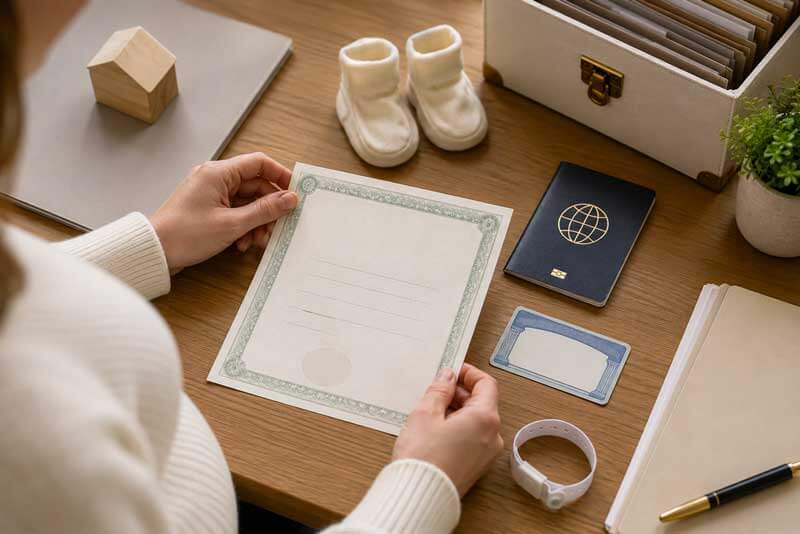
Keeping copies of these documents in a secure place and making sure a trusted family member knows where they are is especially important for mixed-status families whose parents may face immigration uncertainty.
If you need guidance on accessing benefits for your child without compromising your own immigration security, or if you are facing an immigration order, you can determine whether you have an active deportation order before making decisions.
What Happens if I Am a U.S. Citizen and My Baby Is Born in Another Country?
Your child may acquire citizenship through descent if you meet certain prior U.S. residency requirements established by federal law.
Given recent changes, it is also helpful to understand the alien registration requirements and your current obligations.
Common Misconceptions About Birthright Citizenship
Several misconceptions frequently circulate within immigrant communities and are worth clarifying:
My U.S. Citizen Child Protects Me From Deportation
False. Having a child who is a U.S. citizen does not automatically stop deportation proceedings or grant immigration status to the parents. It may be a relevant factor in certain cases, but it does not provide automatic protection.
If you believe you may be deported, you can determine whether you qualify for cancellation of removal.
The New Birthright Citizenship Law Is Already in Effect
False. No law has been enacted to restrict birthright citizenship. Executive Order 14160 never took effect and was declared unconstitutional by the Supreme Court.
My Child’s Citizenship Can Be Taken Away if the Administration Changes
False. Citizenship acquired by birth on U.S. soil is permanent and cannot be revoked through an executive order or a change in administration.
It Only Applies if the Parents Are Lawful Residents
False. The Fourteenth Amendment and more than 125 years of legal precedent confirm that birthright citizenship applies regardless of the parents’ immigration status.
If you are having difficulty responding to a Request for Evidence in an immigration case, you can learn how to respond properly and avoid losing opportunities in your case.
If your immigration application was denied, you can review what to do when your visa is denied and what options may be available.
Frequently Asked Questions About Birthright Citizenship
Are Babies Born in the United States Automatically U.S. Citizens?
Yes. The Fourteenth Amendment guarantees citizenship to every person born on U.S. soil, with very limited exceptions such as the children of foreign diplomats. The Supreme Court reaffirmed this principle on June 30, 2026, in Trump v. Barbara.
Is There a New Birthright Citizenship Law in the United States for 2026?
No. No law has been enacted to eliminate or restrict birthright citizenship. Executive Order 14160 was blocked by the courts and declared unconstitutional by the Supreme Court.
What Happens if I Am an Immigrant and Have a Child in the United States?
Your child is a U.S. citizen with all the rights that citizenship provides. However, this does not automatically grant you immigration status. It may be a factor in future immigration proceedings, but it does not stop deportation on its own.
Can Trump Eliminate Birthright Citizenship?
Not through an executive order. The Supreme Court reached that conclusion in June 2026. Eliminating birthright citizenship would require a constitutional amendment, which requires approval by two-thirds of Congress and ratification by three-fourths of the states.
Can Changes to Birthright Citizenship Apply Retroactively?
No. Trump’s executive order itself stated that it would only apply to future births. It was also declared unconstitutional before taking effect, so no baby lost citizenship.
What Will Happen to U.S.-Born Children of Immigrants?
They are U.S. citizens with full rights. The Supreme Court’s June 30, 2026 decision confirms that this remains unchanged.
How Can Curbelo Law Help With Changes to Birthright Citizenship Law?
The debate over birthright citizenship is not over. Although the Supreme Court rejected Executive Order 14160, the political environment surrounding immigration remains uncertain, and mixed-status families need to stay informed and prepared.
At Curbelo Law, we evaluate your family’s circumstances individually to identify the immigration options available to you and determine how to protect your children’s rights.
If you are facing deportation proceedings, have an active court case, or simply want to understand how your child’s citizenship may affect your immigration situation, our New Jersey immigration lawyers can provide clear guidance.
Let us know about your case We can help you