

The TN visa allows certain Mexican and Canadian professionals to work temporarily in the United States. A TN visa lawyer can determine whether your job and qualifications meet the requirements of the United States-Mexico-Canada Agreement (USMCA).
At Curbelo Law, our immigration lawyers in New Jersey review the job offer, duties, and supporting documents before recommending an application strategy.
If you are a Mexican citizen, Carolina T. Curbelo can also provide guidance in Spanish on urgent immigration matters. We evaluate your circumstances before recommending a legal course of action.
Let us know about your case We can help youOn this page
How Can a TN Visa Lawyer in New Jersey Help You?
A TN visa lawyer can assess whether your occupation and job offer qualify under the USMCA, prepare supporting evidence for a U.S. consulate or CBP, and advise your employer about the position’s requirements.
At Curbelo Law, we assist Mexican and Canadian professionals from our office in Ridgewood, New Jersey.
How We Review Your Job Offer and Qualifications
Before recommending an application route, our team examines three key elements:
- Your actual job duties.
- The qualifying professional category.
- The required credentials.
If the job title appears to qualify but the actual duties describe a different occupation, we first address that discrepancy and review the employer’s letter. Submitting more documents without resolving the mismatch will not fix the problem.
We also determine whether the applicant is outside the United States, already holds TN status, or needs to change employers. These circumstances affect the procedure, when the person may begin working, and what proof of admission or approval they should retain.
What Is the TN Visa for Mexican and Canadian Citizens Under the USMCA?
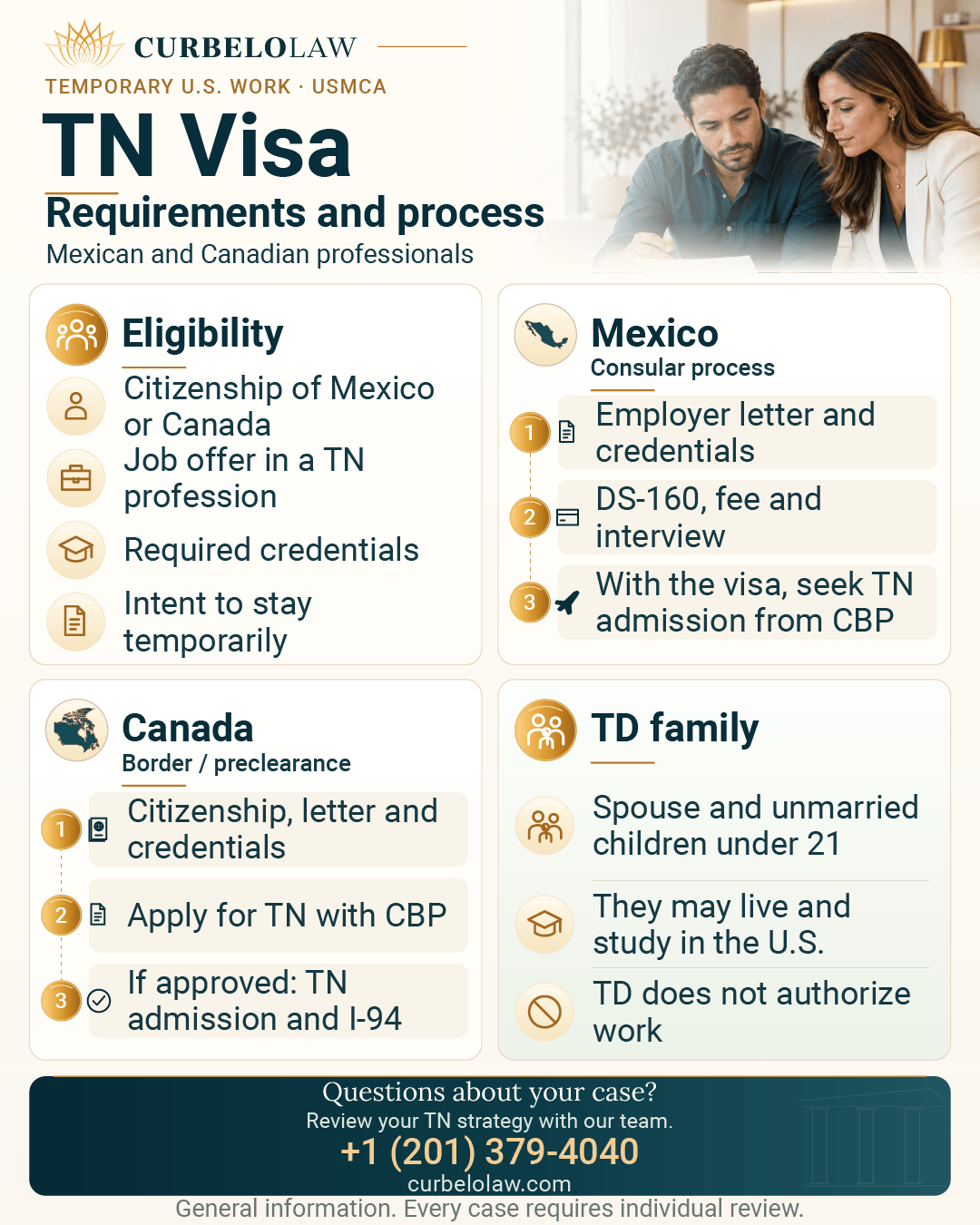
The TN visa allows citizens of Mexico and Canada to work temporarily in the United States in professions listed under the USMCA, which replaced NAFTA. It is not a general work authorization for every occupation. The position and the applicant’s qualifications must match a specific profession on the official list.
- Mexican citizens: They must apply for a visa at a U.S. embassy or consulate and then seek admission at a designated port of entry.
- Canadian citizens: They may apply for admission directly at the border without obtaining a TN visa. However, they must provide proof of Canadian citizenship and meet the other eligibility requirements.
What Are the Benefits of a TN Visa?
The TN classification offers several benefits, including:

- Spouses and unmarried children under age 21 may apply for TD dependent classification.
- TN status may be extended in increments of up to three years, provided the applicant continues to meet the eligibility and temporary-intent requirements.
- It does not require PERM labor certification or an annual lottery, but it does require a prearranged job and documentation from the employer or contracting entity.
- It allows individuals to seek readmission to continue authorized employment. Each new entry is subject to documentation requirements and CBP inspection.
- An individual may work for multiple employers, but each position must be authorized through the appropriate TN procedure.
Who Is Eligible for a TN Visa?
Only citizens of Mexico and Canada qualify for TN classification. To be eligible, you must meet the following requirements:
- Have a prearranged professional job in the United States, either full-time or part-time.
- Work in an occupation listed under the USMCA.
- Provide the degrees, licenses, or experience required for that profession. Work experience cannot replace a university degree when the degree is mandatory.
- Show that the intended employment and stay are temporary.
Initial admission may be granted for up to three years, with no general three-month minimum. Extensions require continued eligibility and a temporary employment arrangement.
Can I Bring My Family to the United States on a TN Visa?
A TN worker’s spouse and unmarried children under age 21 may accompany the worker or join them later in TD visa or status classification, depending on their nationality.
Although TD dependents cannot work in the United States, children may attend public or private schools without obtaining an F-1 student visa.
Which Professions Qualify for TN Classification Under the USMCA?
- Accountant: Bachelor’s degree; or C.P.A., C.A., C.G.A., or C.M.A.
- Architect: Bachelor’s degree; or state/provincial license.
- Computer Systems Analyst: Bachelor’s degree; or postsecondary diploma/certificate and three years of experience.
- Disaster Relief Insurance Claims Adjuster: Degree and specialized training in claims adjustment, or three years of claims-adjustment experience and relevant training, as required by the regulations.
- Economist: Bachelor’s degree.
- Engineer: Bachelor’s degree; or state/provincial license.
- Forester: Bachelor’s degree; or state/provincial license.
- Graphic Designer: Bachelor’s degree; or postsecondary diploma/certificate and three years of experience.
- Hotel Manager: Bachelor’s degree in hotel/restaurant management; or postsecondary diploma/certificate and three years of hotel/restaurant management experience.
- Industrial Designer: Bachelor’s degree; or postsecondary diploma/certificate and three years of experience.
- Interior Designer: Bachelor’s degree; or postsecondary diploma/certificate and three years of experience.
- Land Surveyor: Bachelor’s degree; or state/provincial/federal license.
- Landscape Architect: Bachelor’s degree.
- Lawyer (including Quebec Notaries): LL.B., J.D., LL.L., B.C.L., or a five-year Licenciatura degree; or membership in a state/provincial bar.
- Librarian: M.L.S.; or B.L.S. for which a bachelor’s degree was a prerequisite.
- Management Consultant: Bachelor’s degree or qualifying equivalent professional experience under the specific five-year experience requirement.
- Mathematician (including Statistician): Bachelor’s degree.
- Range Manager/Range Conservationist: Bachelor’s degree.
- Research Assistant: Bachelor’s degree; position must be at a postsecondary educational institution.
- Scientific Technician/Technologist: Theoretical knowledge of agricultural sciences, astronomy, biology, chemistry, engineering, forestry, geology, geophysics, meteorology, or physics, and the ability to solve practical problems in those disciplines or apply their principles to basic or applied research.
- Social Worker: Bachelor’s degree.
- Silviculturist (including Forestry Specialist): Bachelor’s degree.
- Technical Publications Writer: Bachelor’s degree; or postsecondary diploma/certificate and three years of experience.
- Urban Planner (including Geographer): Bachelor’s degree.
- Vocational Counselor: Bachelor’s degree.
Medical Professionals
- Dentist: D.D.S., D.M.D., Doctor of Dentistry, Doctor of Dental Surgery, or state/provincial license.
- Dietitian: Bachelor’s degree; or state/provincial license.
- Medical Laboratory Technologist (Canada)/Medical Technologist (Mexico and United States): Bachelor’s degree; or postsecondary diploma/certificate and three years of experience.
- Nutritionist: Bachelor’s degree.
- Occupational Therapist: Bachelor’s degree; or state/provincial license.
- Pharmacist: Bachelor’s degree; or state/provincial license.
- Physician (teaching or research only): M.D., Doctor of Medicine, or state/provincial license.
- Physical Therapist: Bachelor’s degree; or state/provincial license.
- Psychologist: State/provincial license; or bachelor’s degree.
- Recreational Therapist: Bachelor’s degree.
- Registered Nurse: State/provincial license or bachelor’s degree.
- Veterinarian: D.V.M., D.M.V., Doctor of Veterinary Medicine, or state/provincial license.

Scientists
- Agriculturist (including Agronomist): Bachelor’s degree.
- Animal Breeder: Bachelor’s degree.
- Animal Scientist: Bachelor’s degree.
- Apiculturist: Bachelor’s degree.
- Astronomer: Bachelor’s degree.
- Biochemist: Bachelor’s degree.
- Biologist (including Plant Pathologist): Bachelor’s degree.
- Chemist: Bachelor’s degree.
- Dairy Scientist: Bachelor’s degree.
- Entomologist: Bachelor’s degree.
- Epidemiologist: Bachelor’s degree.
- Geneticist: Bachelor’s degree.
- Geochemist: Bachelor’s degree.
- Geologist: Bachelor’s degree.
- Geophysicist (including Oceanographer in Mexico and the United States): Bachelor’s degree.
- Horticulturist: Bachelor’s degree.
- Meteorologist: Bachelor’s degree.
- Pharmacologist: Bachelor’s degree.
- Physicist (including Oceanographer in Canada): Bachelor’s degree.
- Viticulturist: Bachelor’s degree.
- Poultry Scientist: Bachelor’s degree.
- Soil Scientist: Bachelor’s degree.
- Zoologist: Bachelor’s degree.
Teachers
- College: Bachelor’s degree.
- Seminary: Bachelor’s degree.
- University: Bachelor’s degree.
This list covers professions recognized under the USMCA. Review the exact requirements in 8 CFR 214.6. A similar-sounding job title or a diploma alone does not guarantee TN eligibility.
A TN visa lawyer can check whether your profession appears in the regulation and whether your degree, license, and actual duties support that classification.
How Do Mexican and Canadian Citizens Apply for a TN Visa?
The process depends on citizenship, where the professional is located, and the type of application. For Mexican citizens applying at a U.S. consulate, the usual steps are:
- Check the instructions and appointment availability at the appropriate U.S. embassy or consulate.
- Complete Form DS-160 and save the confirmation page.
- Pay the application fee and determine whether a reciprocal visa issuance fee also applies.
- Attend the consular interview with the employer’s support letter, qualifications, and other required documents.
Canadian citizens generally do not need a TN visa issued by a consulate. They have two possible options:
- Apply for admission with CBP: Present supporting evidence at an authorized port of entry or preclearance facility.
- File a petition with USCIS: The employer may file Form I-129 when appropriate.
Even if USCIS approves the petition, the professional must still undergo CBP inspection upon entry.
Effective October 1, 2026, the Department of State expanded its online presence review to TN and TD visa applicants. For consular visa applications, applicants are instructed to set their social media profiles to public or open.
This measure applies to consular visa applications. It is not a general requirement for Canadian citizens applying directly to CBP for TN admission.
What Documents Do You Need to Apply for a TN Visa?
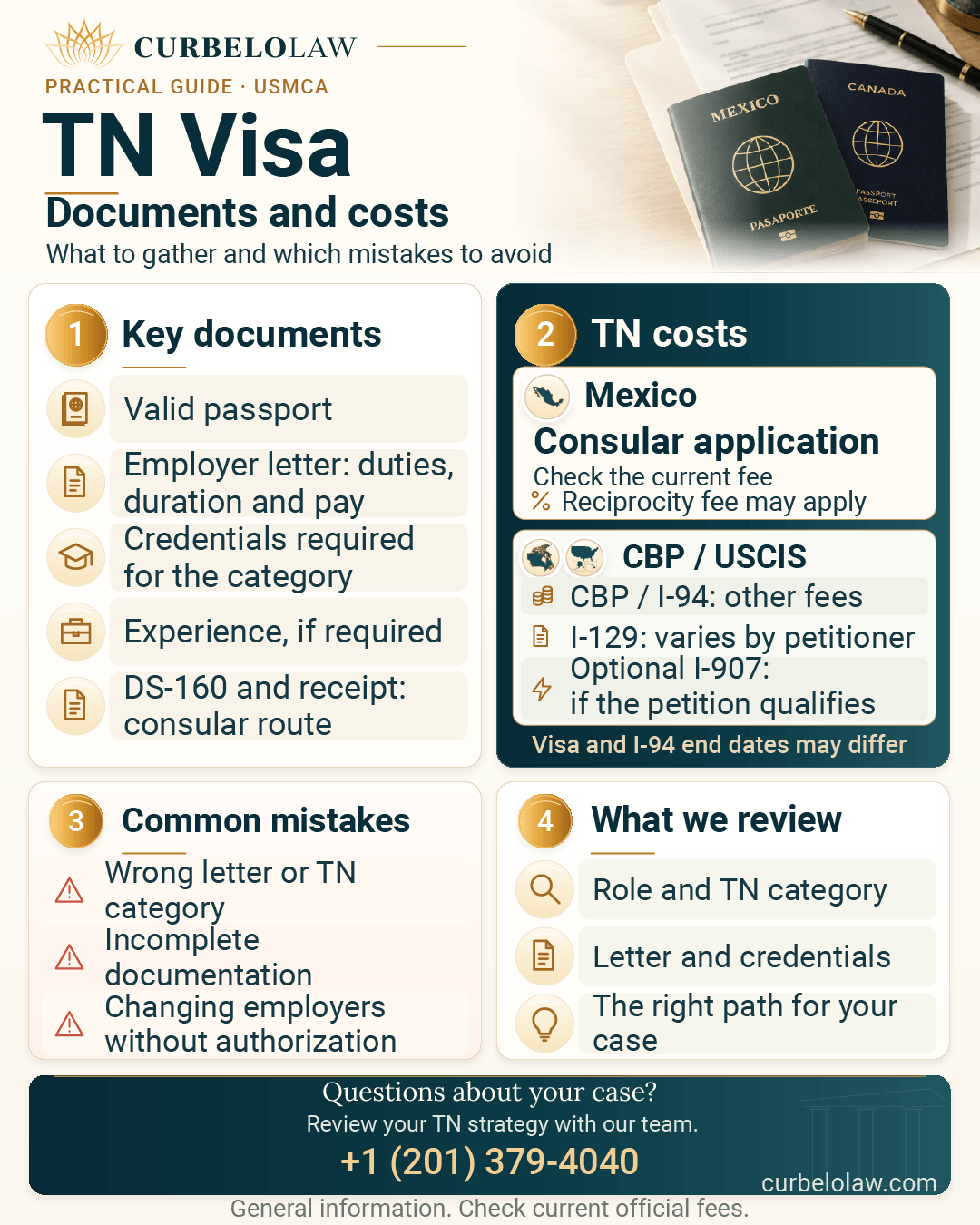
Common documents needed for TN classification include:
- A valid passport, subject to applicable travel rules and nationality-based exemptions.
- A completed Form DS-160 and proof of payment of the application fee (Mexican citizens only).
- A photograph (if it was not successfully uploaded with the DS-160).
- An employer support letter describing the TN profession, specific duties, purpose, expected duration, compensation, and required qualifications.
- Degrees, academic transcripts, licenses, and proof of experience when required for the category, plus an educational credential evaluation if applicable.
We believe the employer’s letter and the applicant’s qualifications should be reviewed together. If a job offer describes marketing duties but seeks classification as an economist, the job title alone does not resolve that inconsistency. The primary duties must be analyzed before selecting the professional category.
Documents Required for TN Applicants’ Family Members
Spouses and eligible children should prepare identity documents, proof of their family relationship, and evidence of the principal applicant’s TN status or application:
- Citizens of countries other than Canada or Mexico: They should check Department of State requirements to determine whether they need a visa. If they do, they must provide evidence of their relationship to the TN worker and proof that the worker maintains TN status.
- Canadian citizens: They do not need a visa, but must provide proof of Canadian citizenship, evidence of their relationship to the TN worker, and documents showing that the worker maintains TN status.
- Mexican citizens: They must apply for a visa at a U.S. embassy or consulate and provide proof that the TN worker maintains status.
How Much Does a TN Visa Cost for Mexican and Canadian Citizens?
TN visa costs depend on your citizenship and how you apply: through a U.S. consulate, through CBP admission, or by filing a petition with USCIS. Each route has its own fees. Attorney fees are quoted separately.
If You Are a Mexican Citizen
- Base consular application fee: $185.
- Reciprocity fee, if applicable: The official schedule for Mexico includes, among other options, 12-month TN visas ($79 issuance fee) and 48-month TN visas ($357 issuance fee).
- The visa’s validity period and the length of admission shown on Form I-94 are not necessarily the same. Both dates should be reviewed separately.
If You Are a Canadian Citizen
- You generally do not need a consular TN visa. Instead, you seek TN admission with CBP and pay the applicable processing and I-94 fees.
- If your employer files a petition using Form I-129, USCIS fees depend on the petitioner type and the chosen filing process.
- If premium processing is available through Form I-907, the separate fee is $2,965 as of March 1, 2026.
Before paying, confirm the TN consular fees, the Mexico reciprocity schedule, and, if your case involves USCIS, the current fee for the relevant form. Do not simply add all these amounts together, because they apply to different application routes.

Why Are TN Visa Applications Denied?
A TN application may be denied if the job does not match an eligible profession, the applicant lacks the required qualifications, or the temporary nature of the stay has not been established. Separate grounds of inadmissibility may also apply.
The selected category must match the actual job duties, not just the position’s title.
Previous immigration violations and other potential grounds of inadmissibility may also affect the case, including:
- Certain health-related grounds,
- Criminal history, or
- Fraud.
A consular visa refusal, a petition denial, and a decision at the border involve different procedures and consequences. It is important to review the official notice and immigration history before deciding whether to address missing evidence, reapply, or consider another classification.
Practical Tips for the TN Visa Process
To help avoid mistakes during the TN application process, we recommend the following:
- Keep your I-94 and other admission records so you can document your immigration status.
- Make sure you work for the employer and in the role authorized under your TN classification.
- Monitor expiration dates and file extension requests on time.
- If your application is denied or you receive a request for additional evidence, identify what was missing before submitting the same documents again.
How Long Does TN Status Last, and How Can You Extend It?
TN admission may be authorized for up to three years. The controlling date for your authorized stay is the one on your I-94 or status approval, not necessarily the expiration date on your visa stamp.
If the requirements are met, the employer may request an extension using Form I-129, and dependents may file Form I-539, as applicable.
An extension of status approved inside the United States does not automatically renew a consular visa stamp. If a Mexican citizen travels abroad, they should check whether their TN visa remains valid for readmission. Otherwise, a new visa may be required.
Grace Periods
If your employment ends earlier than expected, two rules may be important:
- Up to a 60-day grace period: This may apply once per authorized validity period after employment ends, or for a shorter period if the I-94 expires sooner. DHS may shorten the period.
- Up to 10 days before employment begins: In certain circumstances, you may be admitted to the United States before the authorized employment start date.
These periods do not authorize work before the approved start date or for a new employer without proper authorization. If you want to change employers, we can review which TN authorization you need and when you may begin working.
What Is the Difference Between a TN Visa and an H-1B Visa?
The H-1B visa and TN classification both allow temporary employment, but have different requirements. H-1B permits dual intent, while TN requires temporary intent. However, someone in TN status may explore separate pathways to obtain a Green Card.
At Curbelo Law, we distinguish between planning for possible permanent residence in the future and seeking TN admission with the immediate intent to settle permanently. Travel dates, immigration history, and pending applications may affect our recommendation.
Other important differences include:
- TN classification is limited to professions listed under the USMCA. H-1B requires a specialty occupation and compliance with its separate eligibility rules.
- The H-1B visa is subject to an annual cap, while TN classification has no annual cap.
- H-1B has specific portability rules. With TN, the necessary authorization or admission must be obtained before starting work for a new employer.
If you are considering employment-based or family-based permanent residence, review your immigration strategy before traveling, extending TN status, or filing an immigrant petition.
Why Consult Carolina T. Curbelo About a TN Visa?
At Curbelo Law, led by Attorney Carolina T. Curbelo, we help professionals and families navigate immigration decisions from our New Jersey office. Our team can review whether your situation calls for an initial TN application, an extension, authorization to work for another employer, or an alternative work visa.
Experience Assisting Mexican Professionals and Families
At Curbelo Law, we advise Mexican professionals and families on both employment-based immigration and urgent immigration matters. When someone faces detention, we review their history, available documents, and potential legal options before recommending the next step.
Carolina also participates in community immigration outreach events in New Jersey. These activities reflect our commitment to explaining legal rights, answering questions, and helping families understand when they need individualized guidance.

If a family member is detained by ICE, we assess whether a habeas corpus petition in New Jersey may be appropriate. If someone is considering leaving the country, we also review the consequences of returning to Mexico without lawful status.
These situations are separate from TN visa matters, which focus on professional employment and the requirements for working lawfully.
How Can Our Team Help With Your TN Visa?
- We determine whether the position genuinely fits a TN category and whether the employer’s letter accurately describes your responsibilities.
- We assess degrees, licenses, credential equivalencies, and experience to avoid submitting a weak application based on missing evidence or an unsuitable category.
- We help you prepare the supporting documentation and, if you are a Mexican citizen, plan for the consular interview.
- If TN classification is not suitable, we evaluate the requirements for other U.S. work visas before you spend time and money pursuing the wrong option.
Before consulting a TN visa lawyer, gather your job offer showing duties and salary, passport, degrees and academic transcripts, entry history, and any previous visas or petitions.
Let us know about your case We can help you