To complete the PERM labor certification steps in the United States, the first requirement is to show that there are not enough qualified U.S. workers available for the position.
This means a U.S. employer must meet several requirements set by the Department of Labor (DOL) to obtain PERM approval. If you need legal guidance, contact our New Jersey immigration attorney today.
Let us know about your case We can help youOn this page
What Is PERM Labor Certification in the United States, and How Do You Apply Step by Step?
The Program Electronic Review Management (PERM) process is used to obtain labor certification in the United States.
PERM labor certification is often the first major step for certain foreign workers to get a Green Card through employment. Because of its impact, only U.S. employers in the United States can file it for a foreign worker.
To apply, the employer must:
- Request a prevailing wage determination.
- Conduct a formal recruitment process.
- Show they were unable to recruit a qualified U.S. worker.
- File the PERM labor certification application with the DOL.
- File Form I-140 with USCIS.
If everything goes well, the foreign worker must complete the final step, which is filing Form I-485 to adjust status, although in some cases they may instead go through consular processing.
What Are the Step-by-Step Requirements to Apply for PERM Labor Certification in 2026?
More than ever, PERM labor certification has become a stricter process. Below, we break down the steps in detail:
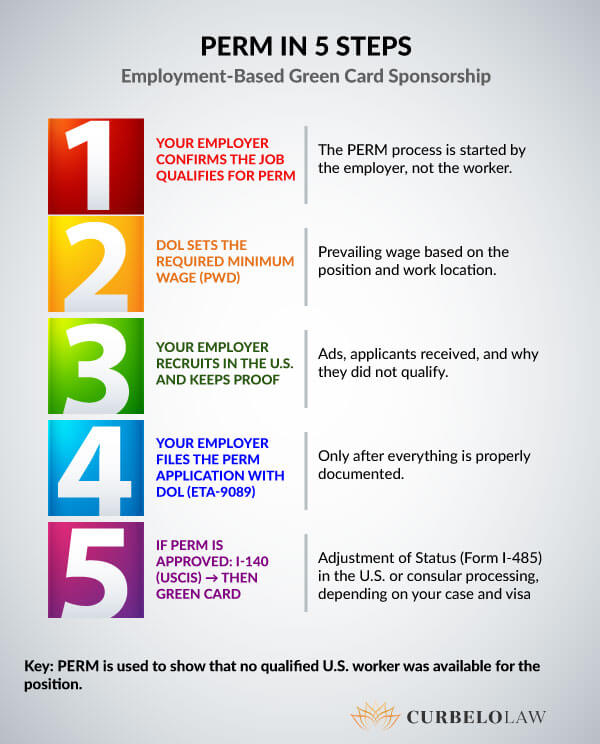
Step 1: Determine Whether You Need Labor Certification
The first step is to evaluate whether it is truly necessary to hire a foreign worker. To do so, the U.S. employer should:
- Evaluate the type of job. In other words, whether the position requires specific skills or highly technical education that is hard to find in the U.S.
- Understand the job requirements. Not every role requires labor certification. Depending on the nature of the position, certain fields may not qualify for this process.
At this stage, a careful evaluation is often key because it helps ensure the case meets the DOL’s minimum criteria.
Note: Before starting the process, it’s important to clarify that the employer usually has already identified the foreign worker they want to hire—either because the person holds an H-1B visa or because the employer met them through an international channel. PERM is not designed to “find” that worker. Instead, it is used to show the DOL that there is no available and qualified U.S. worker to fill the role.
Step 2: Prepare a Job Description for the DOL
This step should be completed before requesting a prevailing wage determination, because the job description helps the DOL better understand why the employer needs to hire a foreign worker.
Job descriptions should align with the O*NET system so the employer’s needs are clearly understood. Key elements include:
- Job title. This identifies the position to be filled.
- Job responsibilities. This section details the specific functions and duties the foreign worker will perform.
- Job requirements. For example, the worker’s education, experience, and skills. These should be listed with enough detail to show they meet the minimum requirements for the role. Expected skills for the position should also be included.
- Working conditions. The employer must also specify any special conditions the candidate should know, such as frequent travel or long work hours.
We recommend the employer review the job description with others in the organization (such as HR or department managers). As an additional tip, it’s also wise to ensure the description aligns with industry wage data.
Step 3: Determine the Prevailing Wage
This is one of the most critical steps, because the wage being offered must comply with U.S. regulations.
To meet those requirements, the employer should analyze the U.S. labor market by following these steps:
- Analyze the labor market. To determine the wage, the employer should use current data for similar positions. This helps establish an average rate based on the skills and experience required in that field.
- Match the correct job level. Positions can be classified into different levels, such as intermediate or advanced. The wage should reflect that level.
- Comply with legal requirements. The offered wage must meet labor laws (such as minimum wage and overtime rules).
Once the employer has an estimate, they must submit Form ETA-9141 through the DOL’s FLAG system. Depending on the agency’s workload, the government will approve or set the prevailing wage.

Step 4: Conduct U.S. Labor Market Recruitment
As a required step, the employer must attempt to hire a qualified U.S. resident or citizen for the position.
To do this, the employer must recruit by posting the job through at least three channels, such as:
- Radio or television ads.
- Employment organizations.
- Job-search websites.
- Local newspapers.
- Job fairs.
- The company website.
If no qualified U.S. worker is found, the employer can move on to the next step.
Step 5: Keep Records of the Recruitment Process
One of the PERM labor certification steps is to advertise the job opening.
However, to show the DOL that a genuine effort was made to hire a U.S. worker, the government requires an audit file that should include:
- Copies of all posted ads.
- Publication dates.
- A record of all applicants received.
Step 6: Complete Form ETA-9089 to Request PERM Labor Certification
Once everything is properly documented, the employer must complete Form ETA-9089 and submit it to the DOL.
This form is crucial, so it must be completed carefully. It should include:
- Employer information: Company details such as the legal name, address, and the industry in which it operates.
- Position details: The job description, job title, duties, and minimum requirements.
- Foreign worker information: Once the employer knows whom they plan to hire, they must provide the worker’s name, country of citizenship, work experience, and education level.
- Prevailing wage: The prevailing wage assigned by the DOL must be listed.
- Certification and signature: The U.S. employer must sign the form (and in some cases the employer’s attorney or authorized representative). This certifies that the information provided is truthful.
Step 7: File Form ETA-9089
After completing Form ETA-9089, the U.S. employer must submit it to the DOL through the PERM FLAG system.
It is important to follow all instructions and meet all deadlines, because the employer has between 30 and 180 days from the start of recruitment to file ETA-9089.
Working with an immigration attorney (such as our attorney Carolina T. Curbelo) can improve your chances of success.
Step 8: Wait for the DOL Decision
After filing Form ETA-9089, the U.S. employer must wait for the DOL’s response, which can take months.
As of 2026, DOL processing times are often around 14 to 18 months, although some cases can take much longer. During that time, the employer should:
- Watch for any notices from the DOL,
- Check the case status through the FLAG system, and
- Maintain regular follow-up on the filing.

In general, the DOL decision may be:
- Approval: The employer can file Form I-140 with USCIS.
- Audit: The DOL may select the case for a more detailed review. In that situation, the employer must submit the audit file within a strict 30-day deadline.
- Denial: If denied, the DOL will explain why the application was rejected. The employer may correct the issues or consider an appeal (though it is a longer process).
- Request for Additional Information (RFI): In some cases, the DOL may issue an RFI if it needs more information or clarity.
It’s important not to confuse an RFI with a Request for Evidence (RFE), which is issued by USCIS.
Step 9: File Form I-140 with USCIS
As soon as the U.S. employer receives PERM approval, they must file Form I-140 with USCIS.
The form classifies the foreign worker into an employment-based immigrant preference category, most commonly:
- EB-2 (for workers with an advanced degree or exceptional ability), and
- EB-3 (for skilled workers and professionals).
After the petition is filed, the parties must wait for USCIS to issue a decision. If approved, the foreign national may pursue adjustment of status or consular processing.
What Are the Basic Requirements to Apply for PERM Labor Certification in the United States?
There are several basic requirements to apply for labor certification, including:
- Full-time job: The employer must offer full-time employment, because part-time jobs are not permitted for PERM.
- Located in the United States: The full-time position must be in the U.S. and available to U.S. workers.
- Prove there are no U.S. workers for the role: As discussed, the employer must show the DOL that no qualified U.S. national is willing, able, qualified, or available to accept the job offer.
- Ensure the foreign worker’s employment will not harm the labor market: This is critical, because the hiring cannot adversely affect the wages or working conditions of U.S. workers.
If the job is temporary, the worker should explore other temporary visa options, such as the TN visa (for certain Mexican and Canadian citizens).
What Documents Are Needed to Apply for PERM Labor Certification and Complete the Steps?
For a proper filing, the documents typically needed include:
Company documents (U.S. employer)
- Articles of incorporation or formation documents.
- The employer’s Federal Employer Identification Number (FEIN).
- Federal corporate income tax return, current annual report, or audited financial statement.
- Lease agreement or deed for the business premises.
- A complete description of the proposed position, including duties, the immediate supervisor’s title, the title of any supervised employees, and annual wage and benefits information.
- Full name and title of the contact person who will coordinate documentation, as well as the company’s authorized representative.
- Any available brochures or promotional materials describing the business and its products or services.
Foreign worker documents
- Copy of the passport.
- A completed general immigration questionnaire and a completed labor certification questionnaire.
- Copies of diplomas and university or technical school certificates, as well as course transcripts if available.
- Copies of professional licenses, professional association memberships, or equivalent credentials.
- Updated résumé (CV).
- Reference letters verifying prior work experience, if available.

Now that you understand the labor certification process and think you may not qualify, reviewing the requirements for a work visa may help you identify categories that do not require such strict sponsorship.
What Is the Real Processing Time for PERM Labor Certification?
PERM labor certification processing times in 2026 can vary widely, but it is typically a long process that can take many months—or even years.
Generally speaking, from day one until the day a foreign worker can begin working in the United States with all documents in order, the timeline can range from 3 to 5 years.
Keep in mind that this timeframe also depends on the worker’s country of citizenship. China and India often have the longest wait times.
What Types of Workers Can Qualify for PERM?
PERM labor certification is the first required step for most employment-based immigrant visas, especially in the EB-2 and EB-3 categories. Workers who may qualify include:
- Professionals: Individuals with college or graduate degrees.
- Skilled workers: People with at least two years of training or work experience.
- Unskilled workers (Other Workers): Individuals doing work that requires less than two years of experience (such as certain roles in agriculture, construction, or services).
Some occupations—such as registered nurses and physical therapists—are exempt from the PERM process because the government already recognizes a shortage of U.S. workers in those fields.
Is Form I-140 the Same as PERM Labor Certification?
Form I-140 and PERM are not the same:
- PERM is a certification issued by the DOL showing the employer attempted to hire a U.S. worker and could not find one.
- I-140 is an immigrant petition filed with USCIS after PERM is approved. It classifies the foreign worker into an employment-based preference category.
Still asking, “How do I get labor certification?” If you have questions, contact our law firm today.
FAQs About PERM Labor Certification Steps

How Much Does It Cost to Apply for PERM Labor Certification in the United States in 2026?
The DOL does not charge a filing fee for PERM applications. However, USCIS does charge fees, in addition to costs associated with job advertising. In general, pursuing PERM may cost:
- $715 to file Form I-140.
- Between $300 and $600 for the mandatory I-140 Asylum Program Fee for companies, which varies depending on company size (small vs. large).
- $1,440 for Form I-485.
- There is no standard advertising fee, but it may range from about $1,000 to $2,500.
That totals at least around $3,500. Keep in mind the employer must pay all costs associated with the PERM process, including recruitment expenses and the cost of an immigration lawyer.
Can a Foreign Worker Who Doesn’t Speak English Apply for PERM?
There is no law requiring foreign workers to speak English to qualify for PERM. However, the DOL reviews these applications closely to prevent potential fraud.
If the job duties can be performed without English, the worker may qualify without issue.
On the other hand, if the employer requires a foreign language as a job requirement, the employer must show a legitimate business necessity. If not, the DOL may assume the requirement was added solely to favor the foreign worker.
What Is the 10-Business-Day PERM Notice Posting Requirement?
The DOL requires the U.S. employer to post a labor certification notice for ten consecutive business days. Keep in mind:
- The purpose of this notice is to inform current employees that the company intends to seek labor certification for a foreign worker.
- The notice must include wage and job duty information and state that anyone may submit comments or evidence to the DOL regarding the application.
- The notice must be taken down at least 30 days before filing PERM, but no more than 180 days before filing.
Notices must be posted physically in a conspicuous location at the worksite. In addition, if the company uses internal electronic communications, the notice should also be distributed through that channel.
What Are the Most Common Reasons a PERM Application Is Denied?
The DOL can deny a PERM application for many reasons. Some of the most common include:
- Recruitment errors, such as failing to post in required outlets or failing to properly document recruitment efforts.
- Offering a wage below the prevailing wage determined by the DOL.
- Errors, inconsistencies, or omissions in Form ETA-9089 or supporting documentation.
- Failing to respond on time to a DOL audit or RFI.
- Vague job descriptions or requirements tailored to favor the foreign worker.
How Can Curbelo Law Help You Complete the PERM Labor Certification Steps?
The PERM labor certification process is complex and lengthy, and a single mistake can lead to months of delay—or a denial. That’s why having experienced legal representation can make a real difference.
At Curbelo Law, attorney Carolina Curbelo and her team have extensive experience guiding employers and foreign workers through every stage of the process—from the prevailing wage determination to filing the I-140 with USCIS.
If you would like to get started or have questions about your case, contact us today to schedule a consultation.
Let us know about your case We can help you