


Choosing between a townhouse vs single-family home in New Jersey means making a decision that will affect your budget, privacy, maintenance, and overall quality of life.
Although both are common options in the state, they offer very different experiences for the homeowner.
Generally speaking:
- A townhouse shares at least one wall, is usually located within a community with an HOA, and tends to be more affordable and easier to maintain.
- A single-family home sits on its own lot, does not share walls, and offers more freedom, privacy, and outdoor space.

In New Jersey, the difference goes far beyond the type of construction. Factors such as:
- HOA dues,
- The actual lot size,
- Remodeling restrictions,
- Proximity to transportation, and
- Local property taxes,
can completely change your experience as a homeowner and the property’s future value. In short:
- A townhouse is ideal if you want a lower entry price, less maintenance, and quick access to more urban areas.
- A single-family home makes more sense if you prioritize privacy, your own land, and greater resale potential.
Below, you can compare both options in detail so you can decide which one best fits your lifestyle and buying goals in the Garden State.

FULL LEGAL REPRESENTATION AND COUNSELING
FLAT FEE RATE
On this page
Comparing a townhouse vs single-family home in New Jersey
On the New Jersey real estate market you will often see terms like “townhouse,” “single-family home,” “attached,” or “detached,” but for most buyers the key question is simple: do you prefer a home that shares walls, or one that is completely detached?
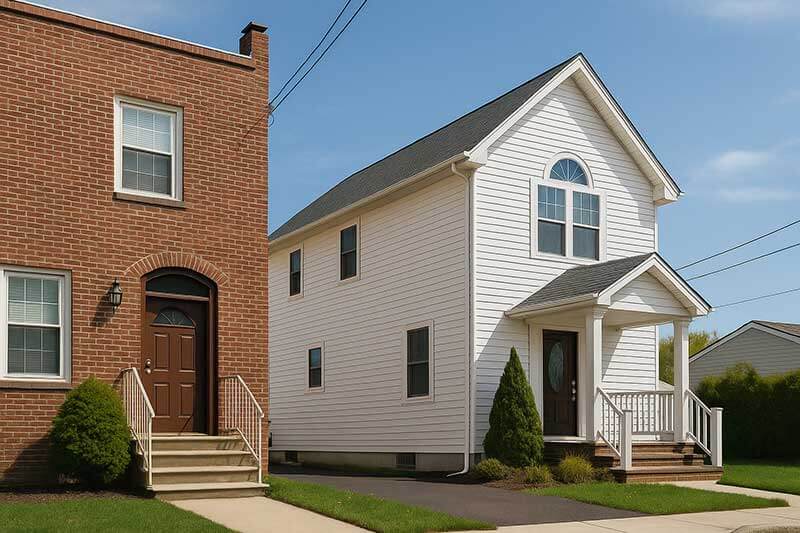
- Townhouse in New Jersey: Shares at least one wall with another similar unit. It usually belongs to a planned community and is subject to HOA dues in New Jersey, which regulate colors, façades, fences, and exterior maintenance.
- Single-family or detached home in NJ: Is built on its own lot, with no shared walls, and the owner controls everything related to the structure and land.
Key differences that matter most in NJ
Some of the main factors that influence the choice between these two types of homes in New Jersey include:
- Land ownership: With a townhouse, the lot is usually smaller and there are common areas; with a single-family home, the land is fully yours, which tends to increase appreciation.
- Outdoor space and garage: Townhouses generally have smaller yards or shared outdoor areas; single-family homes tend to offer larger yards and private driveways for multiple cars.
- Restrictions: Townhouses are subject to HOA rules, while single-family homes offer more freedom to add a deck or expansion, as long as you comply with local regulations.
- Location and amenities: Townhouses are often close to transportation, shops, and offices; single-family homes are more common in quiet residential neighborhoods.
- Privacy: In a townhouse you may hear your neighbors; in a single-family home you usually enjoy more separation and privacy.
You can learn more about layouts and home styles in our article on types of houses in New Jersey.
If you need legal advice before signing, you can contact our firm so that a professional can review the contract and help protect your purchase.
Real costs in New Jersey: purchase price, HOA dues, and long-term expenses
The upfront price is the most visible factor when comparing a townhouse vs single-family home in New Jersey, but it is not the only one.
A townhouse may look more affordable at first, but monthly homeowners association dues and other expenses can match or even exceed the budget for a detached single-family home.
Purchase price
- Townhouses in NJ typically have a lower sale price because they occupy less land and share structural elements.
- Detached single-family homes tend to be worth more due to the larger lot size and complete autonomy they offer the owner.
HOA dues
- In many New Jersey communities, HOA dues cover exterior maintenance, landscaping, snow removal, and repairs to common areas.
- The HOA may also impose special assessments for major projects such as roof replacement or repaving, so it is important to review the association’s financial health.
Closing costs and financing
- Both types of properties involve paying closing costs in New Jersey.
- With a townhouse, the process often includes extra documentation related to the community and its bylaws.
- For a single-family home, the appraisal evaluates both the structure and the full lot.
- You should also consider what seller concessions can be used for, as they can help cover part of your closing costs.
Taxes and insurance
- For a detached home, property taxes are typically higher due to the larger parcel and assessed value.
- For a townhouse, annual property taxes may be lower, but you need to factor in the master insurance on common areas paid through the HOA, plus your own policy for the interior.
Before you commit to a purchase, a careful buyer will usually order a New Jersey home appraisal. This helps you determine whether the listing price truly reflects the current market value.
To compare market prices and learn more about state rules for brokers and communities, you can consult the New Jersey Real Estate Commission and the residential market statistics published by the National Association of Realtors.
Maintenance and homeowner responsibilities
Another key difference between townhouses and single-family homes in New Jersey is how much time and money you will need to dedicate to maintenance.

For a townhouse
The HOA usually takes care of exterior maintenance, snow removal, and common areas.
This reduces your workload and is convenient for people who travel frequently or do not have much free time. In exchange, the owner must comply with the rules established by the community.
For a single-family home
The owner is responsible for all tasks: lawn care, cleaning gutters, exterior painting, roof maintenance, and replacing major systems. It offers more freedom but also comes with greater responsibility.
Quick tips:
- Set aside at least 1% of the home’s value per year for maintenance.
- Ask the HOA whether there is a reserve fund and whether any special assessments are planned.
- Check if the master insurance policy covers shared walls or only common areas, and what you must insure inside the unit.
Privacy, noise, and outdoor space: which option is more comfortable in New Jersey?
Privacy is one of the biggest factors when comparing a townhouse vs single-family home in New Jersey. Each option offers a different experience in terms of noise, insulation, and freedom to use the land.
Townhouse
Because it shares one or two walls, there is a chance you may hear your neighbors, although this largely depends on the quality of construction.
Exterior remodels are often limited by HOA rules and the close distance between units. On the other hand, these neighborhoods tend to foster more community life and, in many cases, a greater sense of security or informal surveillance.
Single-family home
Because it does not share walls, a single-family home provides more privacy, less noise, and a larger lot.
It is ideal if you want to install a pool, build a deck, expand the backyard, or simply enjoy your space with more freedom, always within local zoning rules and without relying on HOA approvals.
If you are planning to upgrade the property before selling or buying, it is wise to learn why time is of the essence in real estate, especially when permits or construction work are involved.
To understand state rules on residential noise control, you can review the noise control program of the New Jersey Department of Environmental Protection.
Location and lifestyle: urban areas, suburbs, and access to services
The type of home you choose will strongly influence your lifestyle. In New Jersey, townhouses are more concentrated in urban or high-density areas, while single-family homes dominate in larger, more residential suburbs.
Townhouses in NJ
They are common in cities like Jersey City, Hoboken, or Newark, where the priority is often proximity to public transportation, job centers, and daily services.
These communities frequently offer amenities such as gyms, pools, green areas, or playgrounds, typical of many modern urban developments.
Single-family homes in NJ
They are more common in suburbs such as Ridgewood, Princeton, or Cherry Hill, which are known for quiet streets, lower traffic, greater privacy, and generous outdoor space for families.
These neighborhoods tend to attract buyers who prioritize quality of life, a sense of safety, and a more residential atmosphere.
What makes sense for your profile: first-time buyer, family, or investor
Deciding between a townhouse or single-family home in New Jersey depends on your lifestyle and priorities as a buyer. There is no single right answer, because each profile benefits in different ways:
1. First-time homebuyers
For first-time buyers, townhouses often provide the most accessible entry point into the housing market:
- A townhouse in NJ is usually more affordable both in terms of purchase price and ongoing maintenance thanks to the HOA.
- It is ideal for young professionals or couples without children who want urban convenience, fewer chores, and easy access to transportation and services.
- State and local programs for first-time homebuyers can make these purchases easier, especially in high-demand areas.
2. Growing families
For families that need more space and long-term stability, a single-family home is usually the stronger option:
- A single-family home offers more space, privacy, a yard, and better conditions for children and pets.
- It allows more freedom to customize and expand: pool, deck, extra rooms, or larger remodels (always within local zoning rules).
- It is a good idea to review the mortgage requirements in New Jersey before making a purchase.
3. Investors
For investors, both townhouses and single-family homes can be profitable depending on the neighborhood:
- Either type of property can generate solid returns if you choose the right area.
- Townhouses tend to perform well in metropolitan areas with high tenant turnover, especially near New York or Philadelphia.
- Single-family homes usually appreciate more because land value and family demand carry a lot of weight in appraisals.
- More complex purchases may require help from a real estate litigation attorney in New Jersey.
4. Foreign or newly arrived buyers
Those who have recently moved to the state or the country may have very specific needs:
- Townhouses make maintenance easier, help new residents integrate into a community, and reduce daily chores.
- Single-family homes are often preferred by buyers who want long-term independence, privacy, and stronger equity growth.
- Newcomers from abroad can review our article “Can an illegal immigrant buy a house in the United States?”.
Home value and resale in the New Jersey real estate market
The value of a townhouse vs single-family home in New Jersey does not depend only on the purchase price, but also on its potential appreciation over time.
In markets like the Garden State, thinking ahead to resale is critical in the following areas:
- Townhouses: They tend to appreciate more moderately because their value is tied to the overall appearance and maintenance of the community. Values improve significantly when they are close to transit or cities with strong connections to New York or Philadelphia.
- Single-family homes: They usually have greater resale potential because land and structural flexibility carry significant weight in appraisals. They are in very high demand among families.
- Tips to protect your investment:
- Review recent sales history in your neighborhood.
- Check county-level statistics and market trends published by NJ REALTORS.
- Before listing or buying, make sure you have a New Jersey property deed with no defects.
Example: A buyer purchases a townhouse in Jersey City for $450,000. In 5 years, it appreciates to $500,000, but HOA dues increase over time. By contrast, a similar single-family home in a suburb like Westfield might go from $550,000 to $650,000 in the same period, offsetting higher maintenance costs.
Common mistakes when choosing between a townhouse and a single-family home in New Jersey
Comparing a townhouse vs single-family home in New Jersey can lead to a great investment, but it can also bring surprises if you do not review certain details before signing.
Some of the most common mistakes include:
- Underestimating HOA dues: In townhouse communities, dues can increase without much notice. Always review the bylaws and meeting minutes.
- Not budgeting for maintenance costs: In a single-family home the owner pays for everything; in a townhouse the HOA may not cover interior systems or finishes.
- Skipping or rushing the home inspection: An incomplete inspection can miss leaks, structural issues, or hidden defects.
- Ignoring the impact of local property taxes: Each NJ municipality sets its own tax rates.
- Not thinking about resale: In high-demand areas, single-family homes tend to hold their value better over time.
Before closing any deal, make sure all documents are complete. You can learn how the process works in our guide to a property title search in New Jersey.
For general information on taxes and homeowner obligations in the state, you can consult the New Jersey Division of Taxation.
When you need a New Jersey real estate attorney
Whether you are buying a townhouse or a single-family home in New Jersey, working with a New Jersey real estate attorney is the best way to protect your investment.
Some of the situations where legal guidance is especially important include:
- Reviewing contracts and HOA documents: An attorney can spot unfair terms or hidden costs.
- Boundary or easement disputes: For single-family homes, unclear property lines can lead to serious conflicts.
- Defects discovered after closing: If undisclosed damage appears, an attorney can help you pursue claims.
- Inherited or jointly owned properties: When there are multiple owners or heirs involved.
- Purchases by foreign buyers or investors: To review visas, ITINs, and tax requirements.

At Curbelo Law, we have experienced commercial real estate attorneys and residential real estate attorneys in New Jersey who regularly handle contracts, titles, and sale negotiations. You can also review the full process in our detailed guide on selling a house in New Jersey.
FAQs about townhouses and single-family homes in New Jersey
If you want to dig deeper into which type of home is the best fit for you, the following are some of the most frequently asked questions on this topic.
What is considered a townhouse in New Jersey?
A townhouse is a home that shares at least one side wall with another similar unit. It is usually part of a community with HOA dues that cover exterior maintenance, snow removal, roofing, and landscaping.
Are townhouses cheaper than single-family homes?
Generally, yes. Townhouses in NJ tend to have lower purchase prices because the lots are smaller. However, monthly HOA dues and limits on remodeling can balance out long-term costs compared to a single-family home.
What advantages does a single-family home offer in New Jersey?
A single-family home offers more space, privacy, and control over the land. It is ideal for families or buyers looking for a long-term investment.
Can you finance a townhouse the same way as a single-family home?
Yes. Most lenders offer the same mortgage programs for both types of homes, as long as they meet appraisal and occupancy guidelines. You can explore the main options in our guide to types of mortgage loans in the United States.
What should I review before signing the purchase agreement?
Before signing, you should at least review:
- HOA meeting minutes and community restrictions.
- The home’s structural condition through a professional inspection.
- Current certificates and permits.
- A recent appraisal and the status of the title. You can learn more in our guide on the certificate of occupancy in New Jersey.
Which option usually has better resale value?
It will depend on the neighborhood, size, and location. Overall, a single-family home tends to hold its value better in suburban areas, while townhouses in urban locations maintain strong demand because of their convenience.
Which is better for you and how a real estate attorney can help
Choosing between a townhouse vs single-family home in New Jersey means analyzing not only the purchase price, but also privacy, maintenance, and long-term value.
- Townhouses offer convenience and less day-to-day maintenance, making them a strong option for first-time buyers or those who want to live closer to urban centers.
- Single-family homes are more spacious, private, and customizable, which makes them ideal for families or long-term investments.
Before committing to a purchase, it is essential to have every clause, certificate, and title reviewed by a professional. At Curbelo Law, our attorneys can guide you through the entire purchase or sale process, helping you complete a safe transaction with minimal legal risk.
Contact our team to schedule a consultation and receive personalized advice.
FULL LEGAL REPRESENTATION AND COUNSELING
FLAT FEE RATE


