In recent days, the Donald Trump administration’s decision to slow the issuance of certain immigrant visas has raised concerns among families and workers who were expecting to move forward with their cases.
This is not a complete cancellation, but it is a temporary suspension that affects the final stage of many consular processes outside the United States.
The impact is felt most by people seeking lawful permanent residence from abroad who depend on a consular interview and final issuance at a U.S. consulate.
In this article, we explain what this pause actually means, who it may affect, and what options may still be available, in a clear and practical way.
Let us know about your case We can help youOn this page
What this pause on immigrant visas actually means
This measure involves a temporary stop in the issuance of immigrant visas for certain foreign nationals who must complete their process at a U.S. embassy or consulate.
Simply put, the issue shows up at the final stage of consular processing, when the applicant is close to the interview or the final decision needed to receive an immigrant visa.
In practice, this pause often means:
- Cases that were already far along may be placed on hold pending final issuance;
- Planning travel, a move, or a job start date becomes more uncertain; and
- Wait times can grow longer, even when the file was nearly ready.
The first step is to identify what stage your case is in. This pause mainly hits the final consular stage, not every immigration process in the same way.
Which immigrant visas may be affected and which follow a different path
The suspension relates to immigrant visas used to obtain lawful permanent residence from outside the United States. The most common pattern is that the case stalls when it depends on the consular interview, final review, and visa issuance.
Scenarios most likely to feel the impact include:
- Family- or employment-based cases that must be completed through consular processing;
- Cases where the applicant is outside the U.S. and needs an interview to receive the immigrant visa; and
- Files that had already advanced and were waiting for the final step.

Many applications filed inside the U.S. follow a different route. For example, when someone can apply for adjustment of status, the case is handled by USCIS and does not depend on immigrant visa issuance abroad.
If you need help placing your case within the system, you can start with this guide on the types of U.S. visas and then identify whether your path ends at a consulate or inside the U.S.
The difference between consular processing and adjustment of status
This is one of the most confusing points. The pause mainly affects the consular route. It does not affect people the same way when they have a viable option from inside the United States.
Consular processing from abroad:
- The applicant is outside the U.S.;
- The interview takes place at a consulate or embassy;
- The visa is issued at the end of that process; and
- This is the route most likely to be affected by the suspension.
Adjustment of status inside the U.S.:
- The person is already in the United States with a lawful basis that allows them to apply;
- The application is filed with USCIS;
- It does not require leaving the country to complete the process; and
- In many cases, it continues on its own track, although it can face delays for other reasons.
In practice, distinguishing between consular processing and adjustment of status can completely change your case strategy. Before traveling or making decisions that are hard to undo, it helps to review that difference carefully.
What happens to visa cases that are already underway or approved
It is normal to think this pause wipes out everything already achieved, but that is usually not how it works. What typically stops is the final step, not necessarily the validity of the underlying petition or prior case history.
In general terms:
- Applications do not disappear just because of the announcement;
- Approved petitions may remain valid, unless there is another legal issue;
- The final consular step may be paused; and
- The risk of mistakes increases if someone travels or changes plans without reviewing their situation first.
If your case is in a sensitive phase, speaking with immigration attorneys can help protect your strategy and avoid steps that could complicate the process later.
How the pause impacts family-based immigrant visas
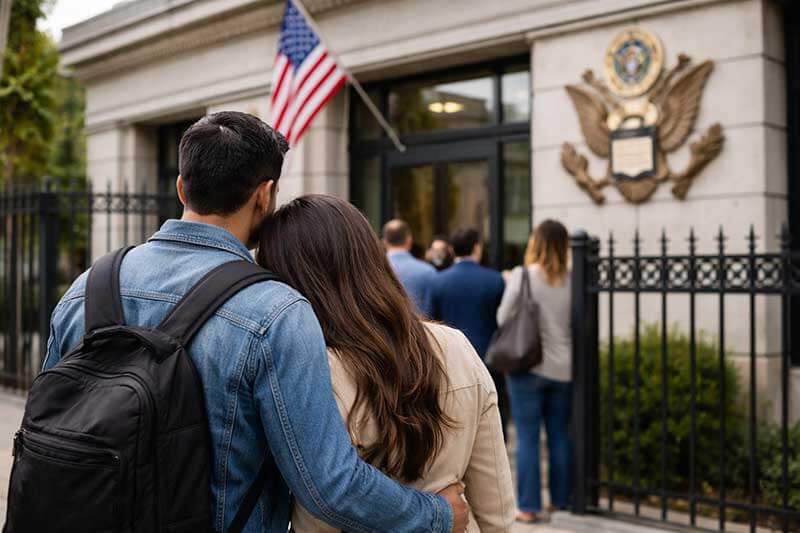
For many families, this pause hits harder because it means more time apart. The most common scenario is a valid family petition that is already far along but slows down right when it was supposed to be finalized at the consulate.
Family cases that may be affected include:
- Spouses who expected to reunite soon;
- Adult children over 21 in categories with long backlogs; and
- Parents and siblings of U.S. citizens who were already in the final stage.
If your case is based on a family-based petition, the key is to confirm whether your current stage depends on the consulate and which documents must be kept valid during the wait.
In marriage-based cases, many questions arise precisely while the case has not yet reached the interview. It helps to understand the marriage-based green card interview questions that commonly trigger delays or requests for evidence.
Practical example: a couple with an approved petition and a consular appointment coming up may see final visa issuance paused. If they already planned a move, work, or school, it is wise not to lock in those decisions until they have real confirmation of the case status.
How the suspension affects employment-based visas and work-related processes
In employment cases, the pause often affects the consulate’s final stage. Even if the employer is ready and the main paperwork has already moved forward, the bottleneck can appear when the visa must be issued.
This can include, for example:
- PERM labor certification approvals that were ready for the consular phase;
- EB-2 or EB-3 cases that were only waiting for the interview; and
- Workers with a planned start date who are now left in limbo.
Typical consequences include:
- Delays in starting the job;
- Risk of losing the opportunity if the employer cannot wait; and
- A need to rethink timelines and, in some cases, overall strategy.
Practical example: a worker has a signed offer and a case that is nearly complete, but visa issuance stops at the consulate. If the employer must fill the role immediately, it is important to review real options and not assume the pause will end quickly.
Affected countries: the full official list according to the Department of State
The Department of State published an official update stating that immigrant visas will not be issued to nationals of 75 countries while the pause remains in effect.
You can review the official reference in the Department of State’s official announcement on the immigrant visa pause.
According to that official information, the measure is presented as an operational pause in immigrant visa issuance for certain nationalities, not a definitive cancellation of every case.
| Afghanistan | Albania | Algeria |
| Antigua and Barbuda | Armenia | Azerbaijan |
| Bahamas | Bangladesh | Barbados |
| Belarus | Belize | Bhutan |
| Bosnia and Herzegovina | Brazil | Burma (Myanmar) |
| Cambodia | Cameroon | Cape Verde |
| Colombia | Côte d’Ivoire | Cuba |
| Democratic Republic of the Congo | Dominica | Egypt |
| Eritrea | Ethiopia | Fiji |
| Gambia | Georgia | Ghana |
| Grenada | Guatemala | Guinea |
| Haiti | Iran | Iraq |
| Jamaica | Jordan | Kazakhstan |
| Kosovo | Kuwait | Kyrgyzstan |
| Laos | Lebanon | Liberia |
| Libya | Moldova | Mongolia |
| Montenegro | Morocco | Nepal |
| Nicaragua | Nigeria | North Macedonia |
| Pakistan | Republic of the Congo | Russia |
| Rwanda | Saint Kitts and Nevis | Saint Lucia |
| Saint Vincent and the Grenadines | Senegal | Sierra Leone |
| Somalia | South Sudan | Sudan |
| Syria | Tanzania | Thailand |
| Togo | Tunisia | Uganda |
| Uruguay | Uzbekistan | Yemen |
If your country is on the list, here is the most important point: your case may still move forward on paperwork or review, but the final issuance of the visa can be halted while this policy remains in effect.
What it means to be on this list and what exceptions may exist
Being on the list does not mean you will never be able to immigrate. It means that, while this policy remains in place, immigrant visa issuance is paused for those nationalities under this measure.
In practice, this often means:
- The visa is not issued while the policy remains active;
- Timelines stretch out and it becomes harder to plan travel, a move, or work; and
- When the policy changes, priorities, exceptions, or requirements may also change.
The official update itself mentions special situations, such as certain dual nationality cases. That is why, before assuming there is nothing to do, it helps to review the file carefully and strategically.
Legal options while visa processing is paused
The pause complicates the consular stage, but it does not mean everything is closed. In many cases, there are still ways to protect the process while you wait.
Depending on your situation, some options that may be relevant include:
- Evaluating whether there is a viable strategy inside the U.S., when the law allows it;
- Seeking an employment authorization document (work permit) in cases where you are eligible; and
- Analyzing whether a waiver of inadmissibility may be needed if there is a separate legal barrier.
The key is not to act blindly. What helps in one case can become a serious mistake in another.

Risks of traveling or changing status during the suspension
When there is a pause, the biggest danger is acting out of anxiety. Traveling or trying to change status without weighing the consequences can leave someone outside the United States far longer than expected.
Before making any move, it helps to be clear about the requirements to enter the United States and how your immigration history may affect a future admission.
Also, because the official justification is tied to the risk of using public benefits, it is important to understand the public charge rule and how certain factors may be evaluated.
Practical example: someone leaves the country thinking they will finish the process through a U.S. consulate, but visa issuance freezes and they end up stuck outside the U.S. Another person, with a different profile, may have an internal option. The difference is often in the case’s legal details.
What to do if your immigrant visa is delayed or put on hold
If your case is paused, the most important thing is to stay in control of the file and proceed calmly.
These steps often help:
- Confirm what stage your case is in and which agency has it, whether USCIS, the NVC, or the consulate;
- Save all communications, emails, appointments, case numbers, and confirmations;
- Keep your information updated, including your address, phone number, and family situation; and
- Be prepared for potential requests for additional information.
If you receive a Request for Evidence (RFE), responding correctly and on time can help prevent bigger delays once the system starts moving again.
It is also smart to verify information with official sources, including USCIS processing times.
When the pause could be lifted and possible scenarios
Because this is an administrative measure, it can change quickly or last longer than expected. For now, there is no clearly defined official end date.
The most likely scenarios include:
- A gradual restart by country or by case type;
- Priority for certain cases for operational or humanitarian reasons; and
- New screening steps or requirements when visa issuance resumes.
For official changes and new updates, the most reliable reference point remains the Department of State’s official U.S. visas portal.
Frequently asked questions about the immigrant visa pause
Does the pause cancel my case?
No. In many cases, what stops is the final issuance of the visa at the consulate. The underlying petition does not automatically disappear on its own.
Does it affect tourist or student visas?
Not directly. The measure focuses on immigrant visas, meaning visas that lead to lawful permanent residence. Temporary visas follow different rules.
If my country is on the list, does that mean I can no longer immigrate?
Not necessarily. Being on the list means delays and blocks while the policy remains in effect, not that your case is permanently lost.
What should I do if I already had an interview scheduled?
It is best to wait for official communication from the consulate and avoid rushed decisions. The sensitive point is not always the appointment itself, but whether the visa can be issued at the end while the pause remains active.
What if my case is family-based, but I am in the U.S.?
You may have an internal option, such as adjustment of status, but that depends on your history, how you entered, and your current situation. That analysis must be done case by case.
When to speak with an immigration lawyer in New Jersey and next steps
It is wise to seek legal guidance before making major decisions, especially if you are in any of these situations:
- Your country appears on the official list and your case depends on the consulate;
- Your file was far along and you need to confirm which step has been paused;
- You are considering traveling, leaving the U.S., or changing status; or
- You received notices, requests, or signs of significant delay.
The pause in immigrant visa issuance does not erase rights, but it does change timelines, decisions, and strategy.
What matters most is confirming whether your case depends on the consulate, keeping your documentation organized, and avoiding impulsive moves while the policy remains in place.
If your case is affected, speaking with our immigration attorneys can help you protect your strategy and avoid mistakes that later cost time, money, and opportunities.
Let us know about your case We can help you