

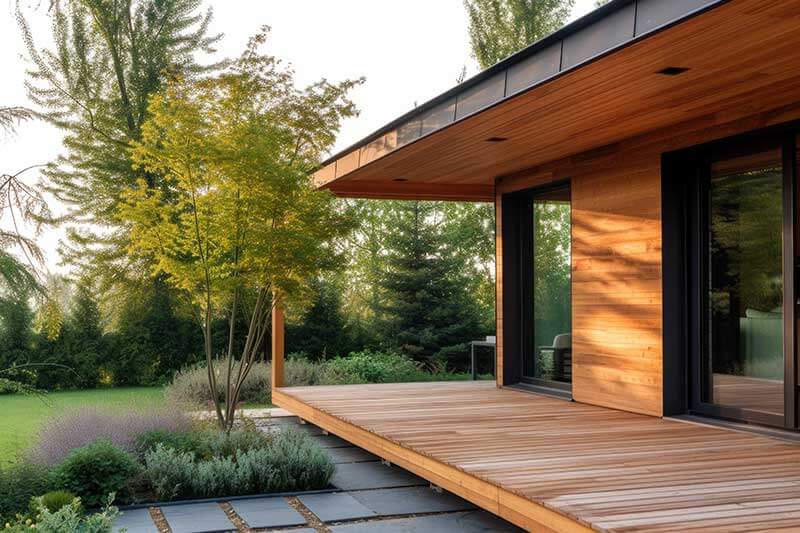
The total price of building a deck can vary greatly because the wood deck cost in New Jersey in 2026 is influenced by several state-specific factors, such as:
- Labor that is more expensive than the national average,
- Municipal permits that are almost always required, and
- A cold, humid climate that makes it necessary to choose more resistant materials.
In addition, construction costs have increased slightly this year due to higher material prices and specialized labor.

In many projects, labor currently represents between 50% and 70% of the total cost, which is why wood deck cost in New Jersey is usually higher than the averages published at the national level.
In fact, the average cost ranges between $35 and $85 per square foot for a simple deck attached to the house.
In the following sections you will see how much a wood deck really costs in NJ, the main factors that affect its price and how to avoid common mistakes when planning the project.

FULL LEGAL REPRESENTATION AND COUNSELING
FLAT FEE RATE
On this page
Main factors that affect the cost of a wood deck in New Jersey
The final price of a deck depends on the material, size, height and design. These are the elements that tend to increase or reduce wood deck cost in New Jersey the most:
Primary material
The most common materials include:
- Pressure-treated wood: This is the most economical option, with prices starting around $35–$40 per square foot installed by a licensed contractor.
- Premium woods (cedar or ipe): These offer better aesthetics but require more maintenance and have higher costs. Ipe, in particular, can reach higher price ranges due to its hardness and durability.
- Composite or PVC: Widely used in New Jersey for its moisture resistance, with prices typically ranging from $50 to $70 per square foot installed.
Size and shape
A rectangular deck attached to the house is the most economical option. Wraparound designs, curved layouts, multi-level decks or those that follow the natural grade of the yard require more labor and increase costs.
Height above ground
Starting at 30 inches (76 cm), NJ building codes require a guardrail, stairs and a permit.
That extra structure and the need for reinforced footings can add up to an additional 15% to the final cost.
Permits and plans
Most municipalities require a permit when the deck is attached to the home or exceeds a certain height.
In Rockaway Township, for example, you must submit plans and wait for approval before building.
Finishes and extras
Decorative railings, LED lighting, built-in benches or a connection to a pool can add between $1,000 and $5,000 or more, depending on the quality and complexity.
Price per square foot in NJ (2026): realistic ranges for wood, composite and PVC
As mentioned, the average wood deck cost in New Jersey typically starts above $35 per square foot, depending on the material and design complexity.
The latest data from local contractors and the Remodeling Cost vs. Value Report show the following:
Estimated price range by material
| Type of material | Cost per square foot | Maintenance | Estimated return on investment (ROI) |
| Pressure-treated wood | $35–$45 | High | 65–95% |
| Cedar or redwood | $45–$60 | Medium | 85–92% |
| Composite | $50–$70 | Low | 60–85% |
| PVC or vinyl | $60–$85 | Very low | 75–83% |
Composite decking is especially popular in New Jersey due to its resistance to moisture, mold and temperature changes. However, it often delivers a slightly lower return on investment compared to natural wood.
For example, a 200 ft² deck in pressure-treated wood may cost around $8,000, while the same project in PVC can easily exceed $12,000.
If the homeowner wants to maximize resale value, it is often wise to choose mid-range materials with good durability and maintain the deck properly until the time of sale.

To understand how these costs affect the overall value of the property, you can review our article on selling a house in New Jersey, where we explain the main factors that influence appreciation and how the home is presented.
Permits and building codes for decks in New Jersey (when you do and don’t need them)
In New Jersey, most municipalities require a building permit before constructing a deck.
The requirement depends mainly on the height, location and whether the structure is attached to the home.
When a permit is required
- If the deck is attached to the house. Decks connected to the main structure almost always require a permit, regardless of height.
- If it exceeds 30 inches (76 cm) in height. Above that point, the codes require a guardrail, stairs and structural plans.
- If it has railings, stairs or an elevated structure. For taller decks, the guardrail must be at least 36 inches high under the code.
- If it includes a roof, enclosure or electrical service. In these cases, additional structural and electrical permits are required.
When a permit may not be necessary
- If the deck is freestanding, low and under 200 ft². This applies as long as it does not exceed 30 inches in height and is not attached to the home.
- If it is not covered or attached to the main house. Without a roof, mandatory railings or structural connection, some municipalities treat it as “minor work.”
Although there are exceptions, each municipality applies its own criteria. For example, the official guide for Somerville, NJ states that any deck over 30 inches requires a permit and prior inspection (Somerville Deck Permit Guide).
Legal basis: Uniform Construction Code (UCC)
Municipal codes are based on the New Jersey Uniform Construction Code, available on the NJ Department of Community Affairs (DCA) website.
There you will find structural standards, railing requirements, plan and inspection rules, and the types of materials that are allowed.
Permit costs
Municipal fees usually range from $75 to $250 for smaller projects. However, in some municipalities (such as Newark or Jersey City), fees may be higher due to mandatory structural review.
Building without a permit can lead to fines, inspection delays or even an order to dismantle the deck.
If you are considering building a deck or selling a house with recent improvements, our residential real estate attorneys in NJ can:
- Review the documentation, and
- Ensure everything complies with state and municipal rules.
Wood deck vs. composite deck in a cold, humid climate

In New Jersey’s humid, changeable climate, choosing the right material is just as important as the design.
The main differences between a wood deck and a composite deck involve durability, maintenance needs and long-term cost.
Natural wood: warmth and higher ROI
- Decks built with pressure-treated wood or cedar offer a warmer, more natural appearance.
- They usually perform well at resale, with an average return of 65–95%, depending on the type of wood and region, since the initial cost is lower than composite materials.
- However, they require yearly maintenance such as deep cleaning, sealing and protection against mold, moisture and insects.
Composite material: less maintenance, higher upfront cost
- Composite or PVC decks have a higher initial cost but stand out for their durability and low maintenance.
- They are ideal for homeowners who want a surface that resists moisture without the need for repainting or sealing.
- Their life span is usually around 25–30 years, with strong performance during the cold, wet winters in northern New Jersey.
Which one makes more sense in New Jersey?
It depends on the homeowner’s goal:
- If you want immediate resale value, pressure-treated wood often delivers the best ROI.
- If you prioritize durability and low maintenance, composite is usually the best long-term investment.
Before deciding, it helps to review how exterior improvements impact value through a home appraisal, since these projects can directly influence market price.
You can learn more in our article on New Jersey home appraisals, where we explain how renovations affect a property’s final selling price.
How much value does a deck add to a New Jersey home? (ROI according to Cost vs. Value)
The Cost vs. Value Report 2025 confirms that in the Mid-Atlantic region, decks offer an exceptionally high return on investment.
In New Jersey, a wood deck project recovers approximately 95% of the initial investment when the property is sold. A composite deck, meanwhile, tends to recover around 89%.
This means that a $20,000 deck can increase the home’s value by between $17,800 and $19,000, depending on maintenance, location and design quality.
In suburban neighborhoods with large yards, the return can approach the top of that range.
Factors that impact ROI
Poor maintenance will reduce the final return.
- Design and premium finishes: Exterior lighting, modern railings and sturdier structures all increase perceived value.
- Timing of the sale: Selling in spring or summer makes it easier to showcase the outdoor area, which can positively impact the price.
- Market trends: The rise of remote work has increased demand for functional outdoor spaces, boosting the perceived value of decks in NJ.
Comparison with other improvements
In New Jersey, a well-maintained deck often offers a higher return than many minor interior remodels, making it one of the most valuable exterior improvements.
In addition, perceived value increases when the home has an up-to-date certificate of occupancy in New Jersey, which is required to sell the property without delays.
Hidden costs: railings, stairs, lighting, maintenance and insurance

When calculating wood deck cost in New Jersey, it is important to factor in additional expenses that often go unnoticed. These extras can represent between 10% and 25% of the total budget.
Railings and stairs
Railings are mandatory if the deck exceeds 30 inches (76 cm) in height. Each section can cost between $40 and $80 per linear foot, depending on the material and design.
On top of that, stairs usually add another $800 to $1,500 to the project.
Lighting and electrical work
Installing recessed lights or exterior LED strips improves safety and appearance but can add $500 to $1,200.
If the deck includes outlets, light fixtures or ceiling fans, a mandatory electrical inspection will be required.
Annual maintenance
Wood decks need cleaning, sanding and sealing every one to two years, which usually costs about $1 to $2 per square foot. Composite decks require less maintenance, but still need regular cleaning to prevent mold buildup.
Insurance and liability
Some insurers require that the deck be included in the homeowner’s policy, especially if it is elevated or frequently used for gatherings. Confirming this before building helps avoid surprises.
Before starting the project, it is advisable to confirm that the contractor has both a valid license and liability insurance.
If you have questions about the contract or scope of work, you may consult with real estate litigation attorneys in New Jersey who can review and negotiate the terms.
Concrete patio vs. wood deck: which option makes more sense?
Many homeowners are unsure whether to build a wood deck in New Jersey or a concrete patio.
Both improve the outdoor space, but they offer different advantages depending on the budget and intended use.
Advantages of a concrete patio
The main advantages of a concrete patio include:
- Lower initial cost: A standard concrete patio usually costs between $5 and $15 per ft². Stamped, colored or textured concrete can reach around $20 per ft². Even so, this is still cheaper than a deck, which in New Jersey typically ranges between $35 and $85 per ft², depending on material and design.
- Low maintenance: It usually only requires occasional cleaning and periodic sealing.
- Realistic ROI: Simple patios on flat lots tend to recover about 50% to 60% of the amount invested. (The idea of ROI close to 100% was too optimistic for 2025 according to recent reports.)
Advantages of a wood or composite deck
On the other hand, decks offer:
- Greater visual appeal and perceived value: Decks immediately enhance the aesthetics and functionality of the outdoor space.
- Ideal for sloped or uneven lots: The structure can be raised on posts where concrete would require costly grading.
- Ability to create levels, railings and elevated views.
- Higher ROI: In New Jersey and the broader Mid-Atlantic region, a well-designed deck typically recovers between 65% and 95% of the invested amount, depending on the material.
What to choose in New Jersey
- In urban areas with limited space, a concrete patio is generally more practical and economical.
- In suburban homes with large or sloped yards, a deck is often more functional, attractive and offers better returns.
- A combined patio + deck design (lower and upper level) often maximizes both usability and curb appeal.

Homeowners planning exterior remodels can also review our article on New Jersey flood insurance, which is especially useful for properties exposed to moisture or partially open basements.
How to choose a deck contractor in NJ (license, plans and insurance)
One of the most common mistakes when building a wood deck in New Jersey is hiring without verifying licenses and insurance. In this state, all contractors must be registered with the New Jersey Division of Consumer Affairs and carry liability insurance.
Basic steps before hiring
- Verify the contractor’s license. You can do this through the state’s official search tool: NJ Division of Consumer Affairs – Home Improvement Contractors, where you can confirm whether the license is active.
- Request signed plans. If the deck requires a permit, the municipality will ask for plans with structural details.
- Confirm insurance coverage. The policy should cover property damage and workplace accidents.
- Ask for local references. This helps confirm that the contractor understands the codes in your municipality.
- Sign a clear contract. If you have questions about clauses or penalties, you can consult our land use attorneys in New Jersey.
Warning signs
- Bids that are significantly lower than others.
- Refusal to sign a written contract or provide a license.
- Demanding full payment before work begins.
Hiring correctly is key to avoiding disputes, penalties or delays in the project’s final approval.
FAQs about the cost of building a wood deck in New Jersey
Below are the most common questions about wood deck cost in New Jersey and practical answers to help you make informed decisions.
What is the average cost per square foot?
In 2026, the typical range is between $35 and $85 per square foot, depending on the material, height and design complexity.
Do I need a permit for a small deck?
In most municipalities the answer is yes, especially if the deck is attached to the home or exceeds 30 inches (76 cm) in height.
Low, freestanding decks under 200 ft² may be exempt, but it is always best to confirm this with your local building department.
How long does a deck last in New Jersey’s climate?
A pressure-treated wood deck can last between 10 and 15 years with proper maintenance. Composite or PVC decks typically last 25–30 years.
What is the average return on investment (ROI)?
According to the Cost vs. Value Report 2025, ROI in New Jersey generally ranges between 60% and 95%, depending on the material, maintenance and design quality.
Well-maintained wood decks tend to fall near the top of that range, while composite or PVC decks usually sit slightly lower.
What happens if I build without a permit?
The municipality may impose fines, require you to dismantle the deck, deny the final certificate of occupancy or delay the sale of the property.
Are there grants or financing programs?
Some institutions offer loans or grants for exterior improvements. You can review our information on the NJ first-time homebuyer program, which includes options that may be useful when making home-related upgrades.
How much does a 12×16 deck cost in New Jersey?
A standard 12 × 16-foot deck (approx. 19 m²) in pressure-treated wood with basic railing usually costs between $9,000 and $13,000.
If it is built with composite or PVC, the price can rise to $15,000–$20,000.
How to protect your investment in a deck in New Jersey
Building a wood deck in New Jersey is an improvement that adds comfort, outdoor living space and resale value.
Realistic prices in 2026 range between $35 and $85 per square foot, and the return can reach between 89% and 95%, depending on the material and the condition of the deck.
The key is to plan properly:
- Choose the right material for New Jersey’s climate,
- Obtain all required municipal permits,
- Hire licensed professionals, and
- Keep everything documented.
This helps you avoid penalties, protect the property and maximize your investment. To review construction contracts, resolve questions about permits or regularize improvements before selling, you can rely on our commercial real estate attorneys in New Jersey.
If you are ready to build or need to legalize an existing deck, contact us. We will help you do it safely, in compliance with the law and with the greatest possible benefit for your home.
FULL LEGAL REPRESENTATION AND COUNSELING
FLAT FEE RATE


