

An E-2 visa lawyer helps nationals of treaty countries, such as Spain, evaluate and document an investment to develop and direct a business in the United States. The review covers eligibility, business structure, committed capital, source of funds, and filing strategy.
At Curbelo Law, attorney Carolina T. Curbelo advises investors and small business owners on E-2 matters from New Jersey. Preparing a case involves much more than completing forms. It requires connecting the actual investment with corporate, financial, and operational documents that tell a coherent story to USCIS or the consulate.
Let us know about your case We can help youOn this page
How an E-2 visa lawyer can help with your investment
The lawyer’s primary role is to identify weak points before they become an eligibility or evidentiary problem. In an E-2 case, this means reviewing both the applicant’s immigration circumstances and the economic reality of the business.
- Eligibility: verify nationality, business ownership, and the ability to develop and direct the enterprise.
- Investment: analyze whether the capital is actually committed and substantial in relation to the cost of the business.
- Source of funds: document where the money came from and how it reached the U.S. business.
- Business: demonstrate that it is real, active, and capable of meeting the non-marginality requirement.
- Case file: coordinate corporate documents, transfers, contracts, licenses, the business plan, and other evidence.
- Process: determine whether consular processing or a change of status within the United States is appropriate and prepare for the interview when applicable.
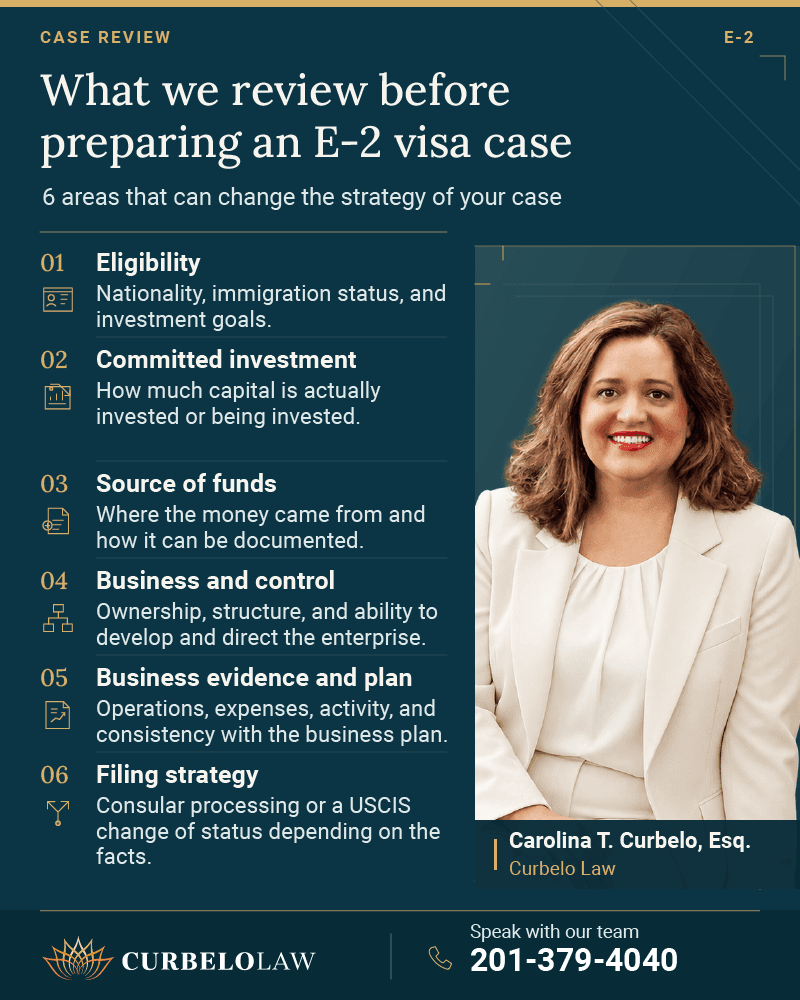
At Curbelo Law, an important initial question is whether the money is simply available or has already been genuinely committed to the business. Having funds in a personal account does not by itself mean the applicant is “in the process of investing.” The case must demonstrate risk, commitment, and a clear connection between each expenditure and the business.
E-2 visa requirements to review before investing
The E-2 visa is a nonimmigrant classification for nationals of treaty countries who invest a substantial amount of capital in a U.S. enterprise and come to develop and direct it. There is no universal minimum investment amount established by law.
- The principal applicant must be a national of a country eligible for E-2 classification.
- The investment must have been made or be actively in the process of being made.
- The funds or assets must be at commercial risk and under the investor’s control.
- The enterprise must be real, active, and for profit, rather than a passive or merely speculative investment.
- The investment must be substantial in relation to the cost and nature of the business.
- The enterprise cannot be marginal. It must have the present or future capacity to generate more than a minimal living for the investor and family or make a significant economic contribution.
- The investor must be in a position to develop and direct the enterprise, generally through at least 50% ownership or sufficient operational control.
- The investor must intend to depart the United States when E-2 status ends.
There is no fixed minimum investment for an E-2 visa
The Department of State applies an E-2 investment proportionality test. The lower the total cost of establishing or purchasing the business, the greater the percentage of that cost that generally needs to be committed. For this reason, claiming that every E-2 case requires a specific amount such as $80,000, $100,000, or $200,000 can be misleading.
The right question is not simply, “How much am I going to invest?” but rather, “How much does it actually cost to get this business operational, and how much of that cost is already committed?” That analysis differs between a low-cost consulting business, a restaurant, a franchise, and the purchase of an operating company.
Source and path of funds: evidence that must connect from beginning to end
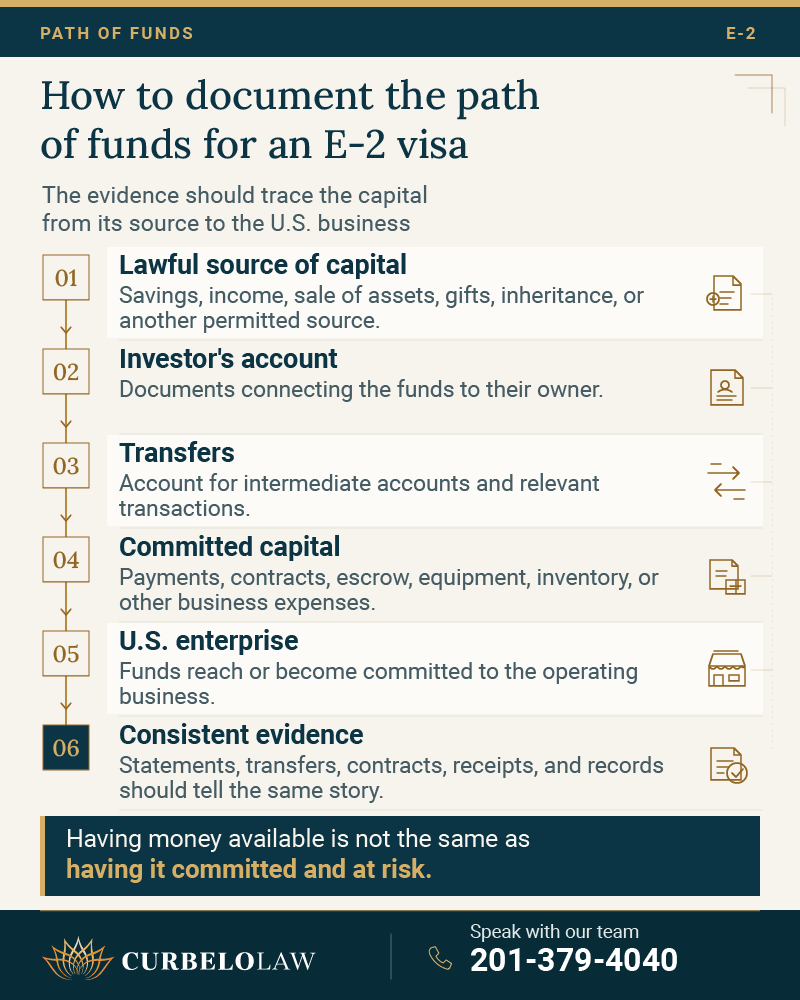
The case should be able to explain the lawful source of the capital and trace its path to the investment. Depending on the facts, the funds may come from savings, business income, the sale of assets, gifts, inheritances, or loans secured by personal assets.
When reviewing this issue, Curbelo Law does not look only at the final account balance. We compare bank statements, transfers, purchase agreements, tax documents, and other supporting records to identify gaps in the paper trail. If the money passed through several accounts or individuals, it is advisable to clarify that chain before filing the case.
How Curbelo Law prepares an E-2 visa case
Preparation should bring immigration and business issues together into one coherent case. Carolina T. Curbelo advises small business owners, professionals, and investors on business immigration matters, including E-1 and E-2 cases, and her New Jersey practice also includes real estate transactions for investors.
- Define the strategy: review nationality, current location, investment objectives, timing, and travel needs.
- Review the structure: verify ownership, control, formation documents, and the nationality of the enterprise when applicable.
- Trace the capital: organize the source of funds, transfers, and expenses to show that the investment is committed and at risk.
- Prove that the business is operating: coordinate contracts, licenses, leases, invoices, bank accounts, purchases, payroll, or other applicable evidence.
- Review the business plan: align projections, hiring, and growth with the actual evidence concerning the company.
- Prepare the filing: organize the case for USCIS or the consulate and prepare the applicant to explain the investment, business, and role.
The business plan should match the actual evidence
An E-2 business plan should not be a generic presentation disconnected from the rest of the case. Its projections should be consistent with the capital invested, operating costs, premises, contracts, anticipated staffing, and the business’s ability to satisfy the non-marginality requirement.
One point we review particularly closely is whether the projections are consistent with the supporting documents. If the plan anticipates hiring employees, opening a location, or reaching a certain level of sales, the available evidence should show why those projections are reasonable and how they correspond to the capital already committed.
Change of status in the U.S. or consular processing
The appropriate route depends on where the applicant is located and the applicant’s current immigration status. Obtaining E-2 classification within the United States is not the same as receiving an E-2 visa in a passport for travel and admission.
- Outside the United States: the E-2 visa is generally processed through a U.S. embassy or consulate, following the specific instructions of that post.
- Inside the United States: if the person maintains a status that allows a change of status and otherwise qualifies, the applicant may request E-2 classification from USCIS using Form I-129.
An approved change of status from USCIS does not place an E-2 visa in the person’s passport. If the person leaves the country and needs to return in E-2 status, the individual will generally need to apply for an E-2 visa at a consulate. Certain admissions, including the Visa Waiver Program, also do not permit a change of status.
For more information about this distinction, review our guide explaining how consular processing works. The choice should take into account current immigration status, travel needs, and the business timeline.

Common documents for an E-2 application
There is no identical document package for every investor. An E-2 visa lawyer should identify which document proves each requirement and organize the evidence into categories such as these:
- Nationality: passport and applicable documentation for the applicant.
- Business: certificate of formation, operating agreement, shares or membership interests, and ownership documents.
- Investment: transfers, checks, invoices, receipts, contracts, equipment purchases, and other expenditures.
- Source of funds: bank statements and documents explaining how the capital was obtained.
- Operations: licenses, permits, lease agreements, business bank accounts, contracts, invoices, payroll, or marketing materials, depending on the case.
- Business plan: operational description, market analysis, financial projections, and employment projections when relevant.
- Family: passports and civil documents for the spouse and derivative children.
Which countries qualify for the E-2 visa?
Only nationals of countries that qualify for E-2 classification may serve as principal applicants. Spain, Mexico, Argentina, Colombia, Chile, Italy, France, Germany, Japan, and Canada are some examples, but the official list can change.
Before investing, confirm your nationality on the Department of State’s official list of treaty countries. The nationality of the enterprise may also be relevant when the applicant is an E-2 employee.
Family, employment, and duration of E-2 status
The spouse and unmarried children under age 21 may accompany or later join the principal E-2 holder in derivative E classification. The nationality of the dependents does not necessarily have to match that of the principal investor.
- An E spouse may be authorized to work incident to status and, when applicable, use an I-94 with the E-2S code as evidence of employment authorization together with the documentation required for Form I-9.
- Derivative children may study, but they do not receive employment authorization simply because they are E-2 dependents.
- Each admission in E-2 status may provide up to two years of authorized stay, although the validity of the visa stamp in the passport depends on the reciprocity schedule for the person’s country of nationality.
- Extensions of stay may be granted in increments of up to two years as long as the requirements continue to be met.
It is important not to confuse the visa expiration date with the I-94 expiration date. The first indicates how long the visa may be used to seek admission, while the second controls the period of authorized stay following admission.
Does an E-2 visa lead to a Green Card?
Not directly. E-2 is a temporary nonimmigrant classification, but a person may eventually obtain permanent residence through another basis if the applicable requirements are met. The strategy should be reviewed before assuming that an E-2 investment will automatically turn into a Green Card.
Depending on the person’s profile, options may exist through employment, family, or investment. You can review our guide on how to get a Green Card and, for investments involving a specific immigrant pathway, see how the EB-5 program works.

How much does it cost to apply for an E-2 visa?
The total cost depends on the capital invested, the filing route, the applicant’s nationality, and the professional work required. The consular application fee for E visa categories is currently $315. An issuance or reciprocity fee may also apply depending on the applicant’s nationality.
If the case is filed with USCIS from within the United States, the fees depend on the forms and characteristics of the filing and should be verified against the current fee schedule before the package is submitted. Legal fees are separate. Our guide on how much an immigration lawyer costs explains the factors that typically affect those fees.
Difference between the E-1 and E-2 visas
E-1 classification is based on substantial international trade between the United States and the treaty country, while E-2 classification is based on a substantial investment in an enterprise that the applicant develops and directs. The same business may involve both trade and investment, but the appropriate category depends on the facts and evidence.
If your activity is better suited to trade than investment, review our page about working with an E-1 visa lawyer.
Frequently asked questions about E-2 investments
Can I buy a franchise or an existing business?
Yes. An E-2 case may be based on a new enterprise, the purchase of an existing business, or a franchise, provided the requirements concerning investment, control, active operations, and non-marginality are satisfied. In a business purchase, the contracts and the way the funds are committed should be carefully coordinated with the immigration strategy.
Is buying property in the United States enough for an E-2 visa?
No, not by itself. The investment must be tied to a real and active commercial enterprise that produces goods or services. Purchasing a home or passively holding property in the hope that it increases in value does not satisfy that requirement merely because of the amount invested.
What happens if the business changes after approval?
Material changes in ownership, structure, duties, or business activity can affect E-2 classification and should be reviewed before they are implemented. Not every change requires the same action, so the new circumstances should be compared with the facts and conditions on which the status was granted.
Curbelo Law’s experience with E-2 investors in New Jersey
Attorney Carolina T. Curbelo is the founder and principal attorney of Curbelo Law in Ridgewood, New Jersey. Her published practice combines business and employment-based immigration with representation of real estate investors, providing particularly relevant context when an E-2 project involves contracts, leases, or a commercial operation in the state.
- Business immigration: Carolina advises small business owners, professionals, and investors on E-1, E-2, and other employment and investment categories.
- Investment context: her real estate practice includes buyers, sellers, and investors in residential and commercial transactions throughout New Jersey.
- Case strategy: the analysis connects immigration requirements, business structure, the flow of funds, and operational documents rather than treating each piece separately.
Before committing a significant investment, we can review the proposed structure, source of funds, business evidence, and intended immigration route to identify issues that may be worth correcting before the application is filed.
If you are considering an E-2 investment, contact Curbelo Law to discuss your circumstances and the documents available. An E-2 visa lawyer can help you determine what needs to be proven, what may still be missing, and what step is appropriate for your case.
Let us know about your case We can help you

