


If you have been the victim of certain crimes, a U visa lawyer can review whether the crime, the harm you suffered, your cooperation with law enforcement, and your immigration history meet the requirements for U status. An attorney can also help you identify the certifying agency and prepare the evidence before filing Form I-918 with USCIS.
The U visa is a federal immigration benefit. In New Jersey, however, the I-918, Supplement B certification may depend on the police department, prosecutor’s office, or another agency involved in the case. Filing a petition does not guarantee approval or automatically stop removal proceedings.
Let us know about your case We can help youOn this page
How a U Visa Lawyer Can Help You in New Jersey
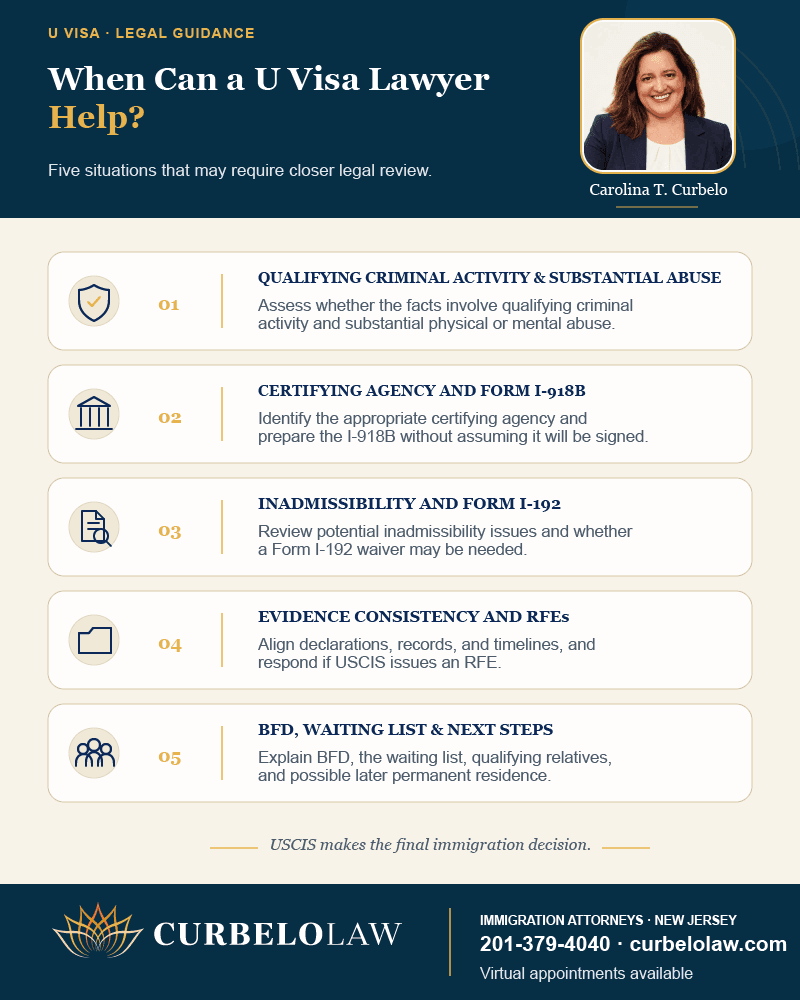
Before filing a petition, it is important to review the facts, evidence, immigration history, and the agency that may be able to certify the case. An attorney can identify potential inadmissibility or evidentiary issues and distinguish between what a certifying agency decides and what USCIS ultimately decides.
- Eligibility: review the qualifying criminal activity, substantial physical or mental abuse, the information you possess, and your helpfulness to law enforcement.
- Certification: identify the agency that may consider the I-918B and prepare the request without assuming that the agency is required to sign it.
- Evidence: organize official reports, medical or therapy records, messages, photographs, statements, and a consistent timeline.
- Immigration history: review entries, departures, arrests, prior orders, and possible grounds of inadmissibility before filing.
- Case follow-up: distinguish between a bona fide determination, the waiting list, employment authorization, final approval, and a future adjustment of status.
I-918B Certification in New Jersey
New Jersey Attorney General Directive 2018-6 requires state, county, and local law enforcement agencies to have procedures for processing T and U certification requests within 120 days. That deadline does not require an agency to sign the certification. The New Jersey State Police, for example, explains that it has no legal obligation to complete the certification and that only USCIS can grant or deny U status.
The New Jersey Department of Labor may also issue a certification when the criminal activity is related to a law enforced by the department and occurred in an employment context. The certifying agency and the applicable procedure depend on the facts of the case.
What Is a U Visa in the United States?
A U visa is a nonimmigrant status for victims of certain criminal activities who have suffered substantial physical or mental abuse and who possess information about the crime. They must also have been helpful, be helpful, or be likely to be helpful to law enforcement in the detection, investigation, or prosecution of that activity.
The U visa was created by the United States Congress in 2000 to help crime victims and encourage them to assist government agencies with criminal investigations without fear of being deported from the country.

In the U.S., immigration laws frequently intersect with criminal laws. In our section on crimmigration, you can learn more about this area of law.
Types of U Visas
Types of U visas include:
- U-1: Victims of qualifying crimes who meet the requirements.
- U-2: Spouses of the principal U-1 beneficiary.
- U-3: Children of the principal U-1 beneficiary.
- U-4: Parents of the U-1 beneficiary when the principal beneficiary was under 21 years old at the time the petition was filed.
- U-5: Unmarried siblings under 18 years old of the U-1 beneficiary when the principal beneficiary was under 21 years old at the time the petition was filed.
Benefits and Limitations of a U Visa
A U visa provides several benefits to eligible foreign nationals, but it is important to distinguish between a pending petition and U status that has already been granted.
- A principal beneficiary with approved U status is authorized to work for the duration of that status.
- Apply for lawful permanent residence (a Green Card) after maintaining U status for the required period and meeting the other requirements.
- Certain family members who were not victims of the crime may be eligible for derivative U status.
- U status is generally granted for up to four years, although it may be extended in specific circumstances.
- There is an annual cap of 10,000 principal U-1 statuses. Derivative family members do not count toward that cap.
Complications may arise because of a criminal record or violations of U.S. immigration laws. If there is a ground of inadmissibility, our guide to a waiver of inadmissibility provides general context, although Form I-192 in a U visa case requires a case-specific analysis.
What You Need to Qualify for a U Visa
To be eligible for a U visa, you must meet the following criteria:
- Be a direct victim or, in certain circumstances, an indirect victim of qualifying criminal activity.
- Have suffered substantial physical or mental abuse as a result of the crime.
- Possess relevant information about the crime.
- Have been helpful, be helpful, or be likely to be helpful in the detection, investigation, or prosecution of the crime.
- The criminal activity must have occurred in the United States or violated an applicable U.S. law.
- Be admissible or, when permitted by law, obtain a waiver of the applicable ground of inadmissibility.
Qualifying criminal activities include domestic violence, sexual assault, rape, stalking, kidnapping, extortion, felonious assault, human trafficking, torture, obstruction of justice, and witness tampering, among others. Being the victim of one of these crimes is not enough by itself. The other requirements must also be met.
If you are in removal proceedings, do not assume that filing Form I-918 will stop them. Our guide on how to stop removal proceedings explains other procedural options that may be relevant depending on the case.
How to Apply for a U Visa With USCIS
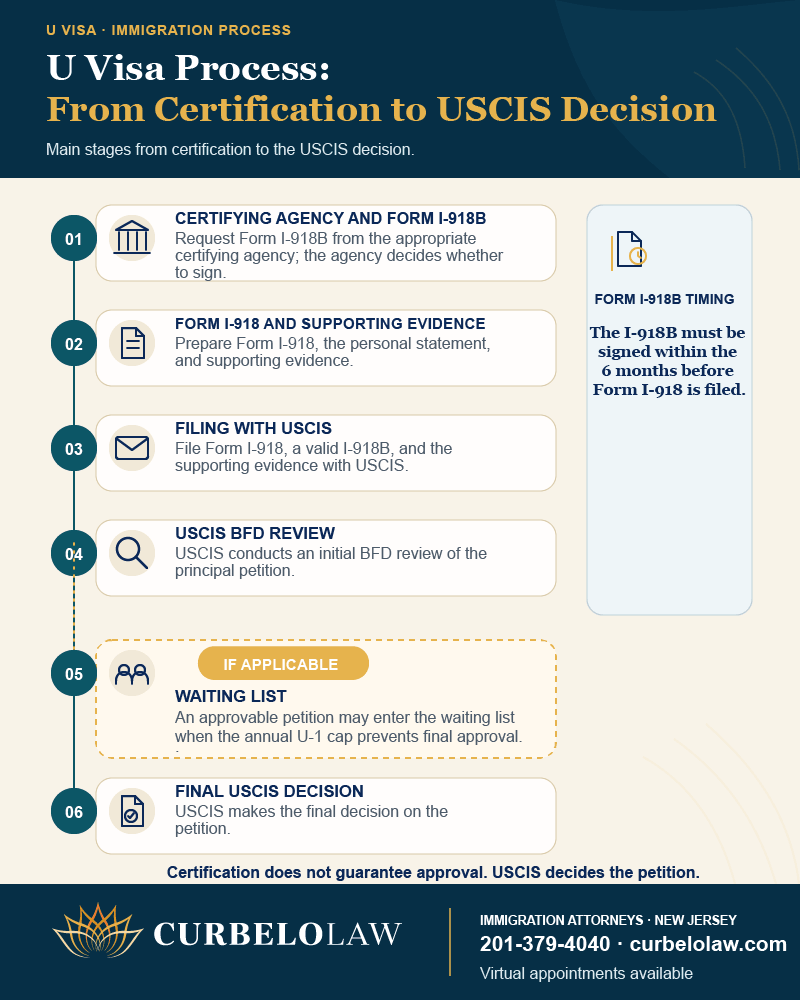
To apply for a U visa, you must submit the following documents to USCIS:
- Form I-918, Petition for U Nonimmigrant Status.
- Supplement B, U Nonimmigrant Status Certification for Form I-918, signed by an authorized certifying official.
- Evidence demonstrating that you meet each eligibility requirement.
- A personal statement describing the criminal activity of which you were a victim.
- If a ground of inadmissibility applies, Form I-192, when appropriate.
Supplement B is valid for six months from the date it is signed. If USCIS does not receive Form I-918 within that period, the person must obtain a new certification. The certification is required for the principal petition, but it does not require USCIS to approve U status.
A U visa lawyer can review whether the certification, personal statement, and supporting evidence tell a consistent story before the filing is submitted.
Family Members Who May Apply for Derivative U Status
Certain family members of foreign nationals with U status may be eligible for derivative U status. Therefore, if you are the principal beneficiary, you may petition as follows:
- Under 21 years old when filing: you may petition for derivative status for your spouse, children, parents, and unmarried siblings under 18 years old, or
- 21 years old or older when filing: you may petition for derivative status for your spouse or children.
Once these requirements are met, you must file Supplement A, Petition for Qualifying Family Member of U-1 Recipient, with USCIS. This may be filed at the same time as your petition or at a later date.

Certain family members may apply for derivative U status, but who qualifies depends on the principal beneficiary’s age and the family relationship.
Fees for the Main Forms
The current USCIS fee schedule lists a $0 fee for Form I-918, Supplements A and B, and, for U petitioners including derivatives, Form I-192. Before filing any additional form, it is advisable to review the USCIS fee schedule because fees may change.
How Long a U Visa Takes and What Happens While You Wait
There is no single timeframe that can predict when a U visa will be approved. The annual cap and reviews that occur before a final decision can result in lengthy waits. A pending petition is not the same as U status and does not automatically grant employment authorization.
If USCIS determines that a petition is bona fide and favorably exercises its discretion, it may grant deferred action and employment authorization. Petitioners who do not receive an EAD through that review continue toward waiting-list adjudication. If the petition is approvable except for the annual cap, USCIS may place the petitioner on the waiting list and grant deferred action.
For example, if USCIS needs more information, it will issue a Request for Evidence (RFE). The notice will explain what documentation is missing and the deadline for responding.
How to Check Your Case Status
You can check an individual case using the official USCIS Case Status Online tool with your receipt number. The information in that tool reflects the case record, but it does not confirm in advance when a decision will be made.

U status is generally granted for up to four years, but an extension may be requested in certain circumstances.
Once U status is approved, permanent residence is not automatic. It may be requested later if the requirements for continuous physical presence, cooperation, and the other adjustment criteria are met.
Difference Between a U Visa and a T Visa
The main difference is that a U visa is for victims of certain crimes, while a T visa is intended for victims of severe forms of human trafficking. If trafficking is the central issue, see our T visa lawyers and our explanation of human trafficking and migrant smuggling.
How to Apply for a Green Card After U Status
You may complete the adjustment of status process to become a lawful permanent resident if you meet, among other requirements, the following:
- You have been physically present in the United States for a continuous period of at least 3 years since your admission in U status, and
- You have not unreasonably refused to provide assistance to law enforcement in the investigation or prosecution of the criminal activity.
In addition, USCIS requires continuous physical presence to be maintained through the decision on the adjustment and requires that continued residence be justified on humanitarian grounds, to ensure family unity, or in the public interest. For a general explanation of the purpose of this process, you can review how to obtain a Green Card.
Curbelo Law Can Review Your U Visa Case in New Jersey
Both U visa and T visa cases can be complex because each person’s circumstances are different.
The process requires specific documents and evidence to establish each requirement. It is important to review the certification, personal statement, and the rest of the evidence for consistency before filing.
A U visa lawyer at Curbelo Law can review eligibility, certification, evidence, and possible inadmissibility issues before you decide how to proceed. No attorney can guarantee that an agency will sign Form I-918B or that USCIS will approve the petition.
You can send us a message today through our contact form or call us, and our Latina attorneys will review your inquiry and assist you. There is no obligation, and speaking with our team may help you better understand your options.
At Curbelo Law, we have more than 10 years of experience with immigration matters. Speak with our team of Latino professionals in Spanish or English today, or learn more about our immigration lawyers in New Jersey.
Let us know about your case We can help you“`