

If your immigration situation depends on an abusive family member, a VAWA lawyer can evaluate whether you may self-petition without that person’s participation. Carolina T. Curbelo and her bilingual team serve clients from Ridgewood, New Jersey, nationwide and internationally, and will agree with you on a safe way to communicate.
VAWA allows certain spouses, children, and parents of U.S. citizens, as well as spouses and children of lawful permanent residents, to file Form I-360 on their own. Approval of that petition can open a path to permanent residence, but it does not by itself grant a Green Card or automatically authorize you to remain or work in the United States.
Many people search for this relief as a “VAWA visa,” but that term can be misleading because VAWA is not a temporary visa. VAWA allows certain individuals to file an immigration self-petition. Obtaining permanent residence requires an additional process and meeting its own requirements.
Let us know about your case We can help youOn this page
How a VAWA lawyer can help you present your case
Carolina Curbelo and her team begin by evaluating whether VAWA fits your situation and which risks should be reviewed before filing documents. Their assistance includes three specific tasks:
- Evaluate the strategy: review the family relationship, the abusive family member’s status, shared residence, the facts involving the abuse, and any immigration or criminal history that could affect the case.
- Prepare the evidence: organize your personal declaration and the available documents to establish each requirement, even when there were no physical injuries or police report.
- Coordinate the filings: establish a safe mailing address, prepare the I-360, respond to USCIS, and review any pending adjustment application or immigration court matter before changing strategy.
Who can file a VAWA self-petition?
You may qualify for a VAWA self-petition if you have one of the family relationships recognized by law and experienced battery or extreme cruelty:
- Spouse or former spouse: of a U.S. citizen or lawful permanent resident. You must show that the marriage was entered into in good faith. After a divorce connected to the abuse, there is generally a two-year period to file; rules also apply when a U.S. citizen spouse dies or the abuser loses qualifying status.
- Son or daughter: of a U.S. citizen or lawful permanent resident. Rules may also apply to stepchildren, adopted children, and young people who turned 21 before filing the petition.
- Parent: of a U.S. citizen son or daughter who is at least 21 years old and committed the abuse. Having a lawful permanent resident child is not enough for this category.

In addition to the relationship and abuse, USCIS examines whether you lived with the family member during the qualifying relationship and whether you have good moral character. You do not have to continue living with the abuser when you file the petition.
Good moral character may be documented through a personal declaration and, depending on the case, police clearances or background checks from the places where you lived. If you have had an arrest or another relevant incident, it should be reviewed before filing the I-360. USCIS evaluates the facts and the available evidence.
Although the law includes the word “Women” in its title, men who have experienced abuse may also qualify if they meet the requirements.
If you have unmarried children under age 21, review whether they may be included as derivative beneficiaries. This is possible in some self-petitions filed by spouses or children, but not when someone files VAWA based on abuse by an adult U.S. citizen son or daughter. The rules regarding age and family circumstances depend on the individual case.
What types of abuse and evidence does USCIS consider?
To qualify for a VAWA self-petition, you must show that you were subjected to battery or extreme cruelty. This may include physical violence, threats, and psychological or sexual abuse.
It is also important to review whether the family member threatens to report you to immigration authorities, prevents you from working or seeing your family, controls money, or monitors your movements. These examples do not by themselves establish extreme cruelty. The context, their effect, and the pattern of conduct matter.
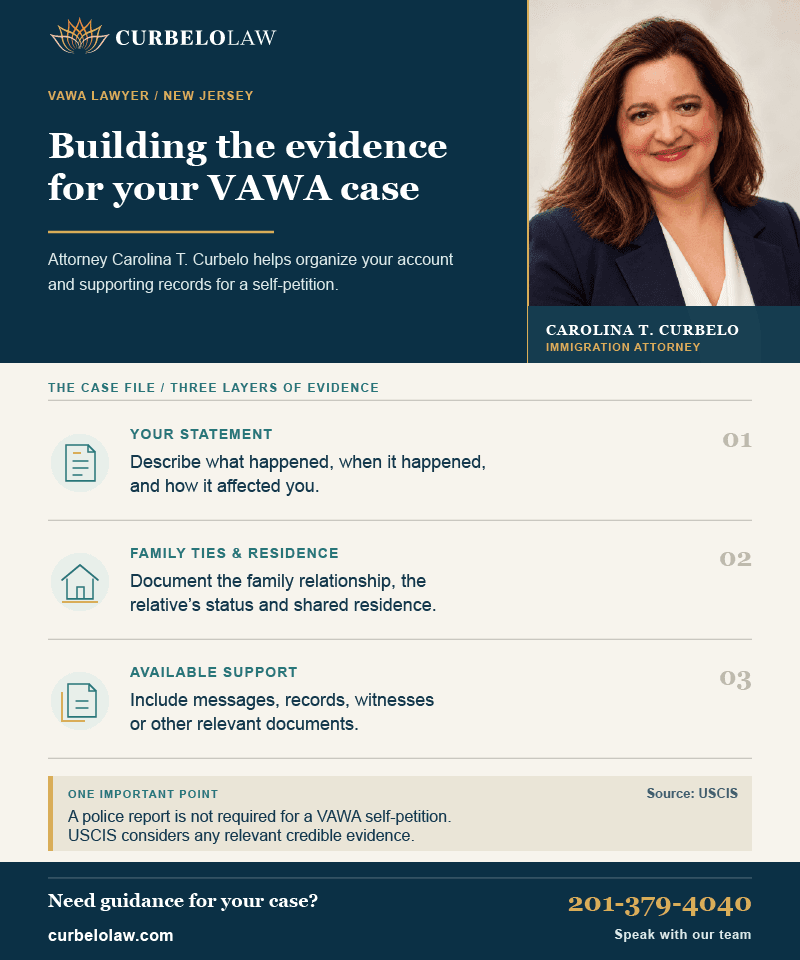
A police report is not required to file the I-360. You may submit a detailed personal declaration and, depending on what is available, messages, medical records, documents showing shared residence, protection orders, or statements from other people.
USCIS considers any relevant credible evidence, but determines how much weight to give it. The guidance updated in December 2025 explains the evidence of shared residence and, when applicable, a good-faith marriage. Therefore, even when evidence of abuse exists, the other I-360 requirements must also be established.
Carolina and her team’s experience includes VAWA cases involving psychological abuse. When a case involves control, humiliation, or financial threats, they organize the timeline and available evidence to document the abuse without relying on physical injuries.
On the Curbelo Law client reviews page, Yesenia Torres shares that USCIS approved her VAWA self-petition and expresses her appreciation for the care provided by Carolina and her team. Her experience is one example of the dozens of VAWA cases with favorable outcomes handled by the firm. You can also read other real client reviews involving immigration matters on that page.
Results may vary depending on the facts and legal circumstances of each case. We understand that taking this step can be difficult. Our bilingual team can listen to you, review your options, and establish a safe way to communicate.
How to file Form I-360 and when to apply for permanent residence
- Prepare the self-petition: file Form I-360 with evidence of the relationship, the family member’s status, shared residence, abuse, and good moral character, as applicable.
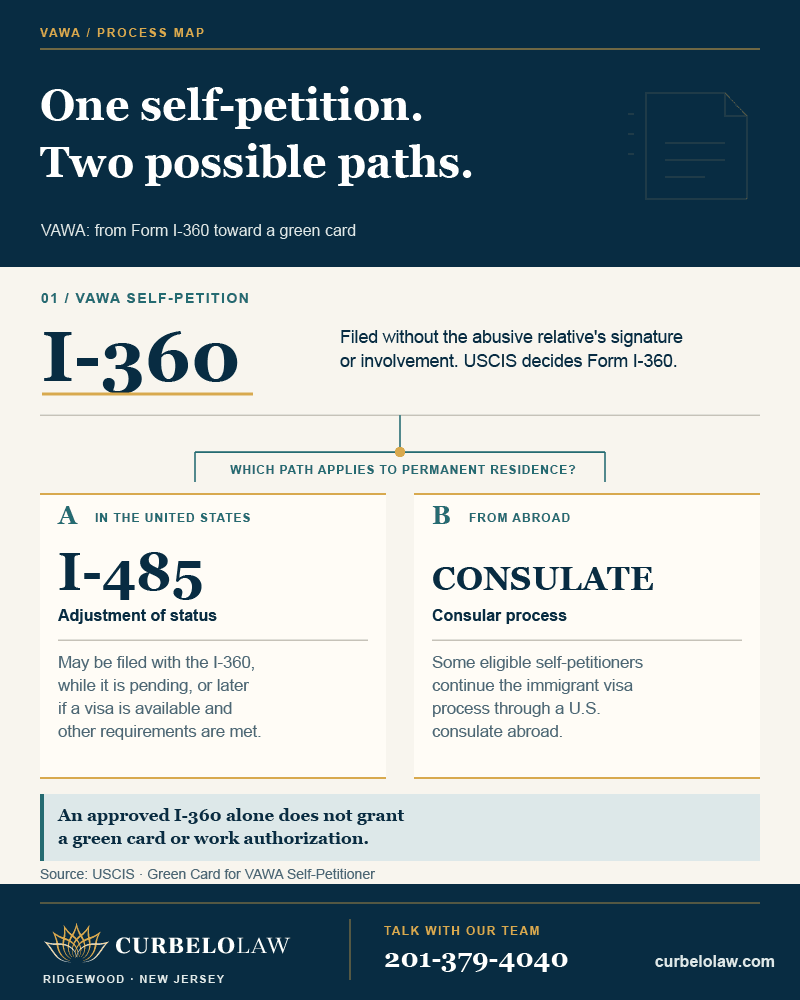
- Review the path to a Green Card: if you are in the United States and meet the requirements for adjustment of status, Form I-485 may be filed together with the I-360 in certain cases or at a later time. Visa availability depends, among other factors, on whether the abusive family member is a U.S. citizen or lawful permanent resident. From outside the United States, some eligible individuals proceed through consular processing.
- Respond to notices: a request for evidence or an interview requires reviewing what has already been submitted and responding within the deadline USCIS provides. Approval of the I-360 establishes the immigration classification, but permanent residence requires a separate decision and has its own requirements.
If you live outside the United States, you may also be able to file a self-petition if the abuse occurred in the United States, or if the abusive family member works for the U.S. Government or is a member of the U.S. uniformed services. The later permanent residence process may require consular processing. Living abroad, by itself, is not enough to qualify.
If you entered without being inspected by immigration authorities, a VAWA lawyer can review the special rules that allow certain self-petitioners to apply for adjustment of status and any other grounds of inadmissibility. That manner of entry does not by itself prevent you from filing the self-petition.
If you have a pending I-485 based on an I-130 petition filed by the abusive family member, you may be able to ask USCIS to hold the adjustment application while you file the VAWA self-petition and evaluate changing its underlying basis. The request is subject to conditions and deadlines. Review any USCIS communication promptly.
Confidentiality, work permits, and processing times
The self-petition does not require the abusive family member’s consent or participation. USCIS confidentiality protections for VAWA self-petitioners include special safe-address procedures. It is important to provide the legal team with a safe way to contact you and keep your address updated according to the special procedures that apply.
If you want to explore the possible consequences for that person, see whether VAWA affects the abuser. The abuser’s circumstances should not be confused with the confidentiality protections provided to the person filing the self-petition.
- Status and deportation: even while your VAWA self-petition is pending, it does not automatically give you lawful immigration status or stop deportation on its own.
- Work permit: filing the I-360 alone also does not authorize you to work. An approved self-petition may provide access to employment authorization. A pending I-485 may allow you to apply for it with Form I-765 if you meet the applicable requirements.
- Preliminary notice: if you filed the petition in the United States, USCIS may issue a prima facie determination. Depending on the program, it may help you apply for certain public benefits. It is not approval of the I-360 and does not by itself grant permanent residence or employment authorization.
Processing times vary from case to case. Check the official USCIS processing times tool or our USCIS processing times guide for the relevant form and category. The I-360 processing time is not necessarily the same as the time required for permanent residence. Approval of the self-petition also does not guarantee approval of the I-485.
Deportation, travel, and interviews in a VAWA case
If you are in removal proceedings, a pending or approved self-petition does not automatically stop the case. It may be necessary to evaluate options before the immigration court, including VAWA cancellation of removal if you meet its requirements.
Carolina represents clients before both USCIS and the immigration courts. Her team can review how the two cases interact and which authority has jurisdiction to decide each request. Any additional court action depends on the circumstances of the case.
Before traveling, review our explanation about traveling outside the United States with a VAWA case. A pending I-485 and travel without the proper authorization can have serious consequences. Even with travel authorization, other immigration risks should be evaluated.
If USCIS schedules you for an interview, learn what a VAWA Green Card interview may involve. Carolina and her team can review your declaration, documents, and possible questions with you so that you can explain the facts honestly without memorizing a story.
Carolina Curbelo’s experience with VAWA cases
Attorney Carolina T. Curbelo founded Curbelo Law and is the daughter of Cuban refugees. She has worked in immigration law for more than a decade. Her practice includes VAWA and representation before USCIS and the immigration courts, a useful combination when a self-petition overlaps with removal proceedings.
If you already have an adjustment application, a USCIS appointment, or an immigration court hearing, tell your VAWA lawyer during the first consultation. It may change the strategy and the deadlines that need to be reviewed.
Curbelo Law serves clients from Ridgewood, New Jersey, including clients in other states and, when appropriate, abroad.
What options are available if VAWA does not fit your case?
If you do not qualify for VAWA, you may explore other options available for your case. Depending on the facts, our U visa lawyers for crime victims or T visa lawyers for trafficking victims can evaluate alternatives with different requirements. Mentioning these programs does not mean that you meet their eligibility requirements.
If you are in immediate danger, call 911. For support and safety planning in New Jersey, the state domestic violence hotline is available 24 hours a day at 1-800-572-7233. For immigration guidance, contact Curbelo Law from a phone or email account that only you can access.
Let us know about your case We can help you