

If your company conducts international trade between the United States and a treaty country, an E-1 visa lawyer can help you evaluate whether the business structure, ownership nationality, and transactions meet the requirements.
Curbelo Law advises traders, companies, and employees from its Ridgewood, New Jersey office who need to prepare or review an E-1 application.
The E-1 visa does not require a minimum investment. The key is to demonstrate real, continuous, and substantial international trade conducted principally between the United States and the treaty country. The strategy varies depending on the company, the applicant, and whether the person is inside or outside the U.S.
Let us know about your case We can help youOn this page
How an E-1 visa lawyer in New Jersey can help you
A lawyer’s role involves more than completing forms. The first step is to determine whether the facts and documents establish each element of E-1 classification and then organize the application coherently for USCIS or the appropriate U.S. consulate.
At Curbelo Law, we begin by separating three questions: whether the applicant’s and company’s nationality qualify under an E-1 treaty, whether the trade already exists and can be documented, and whether the proper path is a consular application or a change or extension of status within the United States.
- Eligibility: we review nationality, company ownership, and the applicant’s role.
- Trade: we analyze volume, frequency, continuity, and the percentage of transactions between the two countries.
- Evidence: we compare contracts, invoices, payments, accounting records, and corporate documents.
- Procedure: we determine what must be filed with the consulate and when a USCIS filing is appropriate.
In an E-1 case, having many pages of documents does not replace clear evidence. The priority is for company ownership, trade figures, contracts, invoices, and payments to describe the same business activity and make it possible to trace transactions between the United States and the treaty country.
What benefits does the E-1 visa offer in the United States?
The E-1 visa offers several advantages, including:
- Living and working temporarily in the United States for the company and activity authorized under E-1 classification.
- Traveling outside the United States and seeking readmission as long as you maintain the required documentation and remain admissible.
- Eligibility for a qualifying spouse and dependent children to obtain E-1 status.
The validity period of the visa stamp in the passport depends on the reciprocity schedule applicable to the applicant’s nationality. In addition, the authorized period of admission in the United States and extensions of status are separate concepts from visa validity.
What do E-1 and E-2 mean on a visa?
E-1 and E-2 visas are 2 types of U.S. visas for nonimmigrants, and they differ as follows:
- E-1: For treaty traders who engage in substantial trade between the U.S. and their treaty country.
- E-2: For investors who develop and direct an enterprise in which they have invested, or are actively in the process of investing, a substantial amount of capital.
Both categories require the applicant’s nationality to correspond to a country eligible for the applicable E classification.
If the facts fit an investment case better than a trade case, you can review our page about an E-2 visa lawyer. Choosing the proper category depends on the business activity and available evidence, not simply on the type of company.
If your activities are limited to meetings, contract negotiations, or other temporary business visits without working in the United States, it is important to distinguish E-1 classification from the B-1 business visitor visa. B-1 classification is not a substitute for E-1 when the facts require treaty trader classification.
What are the requirements for an E-1 visa?
The requirements for E-1 classification in the United States vary depending on whether the applicant is a treaty trader or an employee:

Requirements for a treaty trader
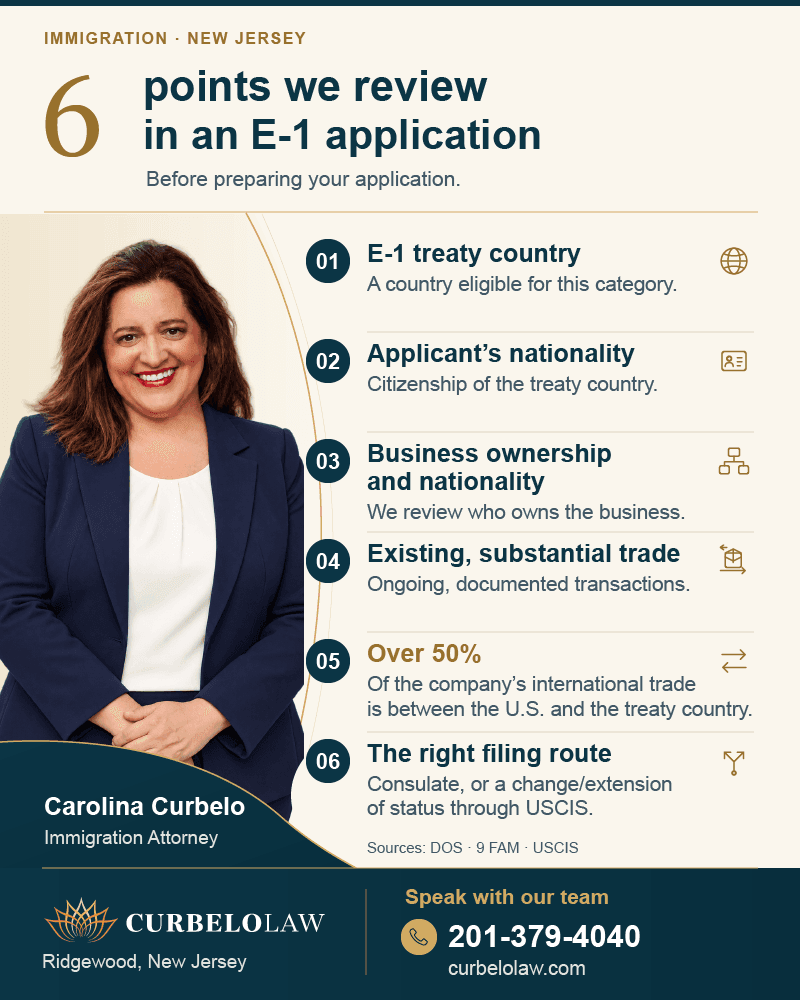
- The applicant must be a national of a country with which the United States maintains a treaty of commerce and navigation.
- The applicant must engage in substantial trade between the U.S. and the treaty country.
- More than 50% of the trader’s international trade must be between the U.S. and the treaty country.
In addition, the company must have the nationality of the treaty country. In general, this means that at least 50% of the business must be owned by nationals of that country.
Requirements for an employee of a treaty trader
- The employee must have the same nationality as the treaty trader.
- The employee must perform executive or supervisory duties or possess skills essential to the operation of the business.
If the employer is a company or organization, it must satisfy the treaty nationality requirement: at least 50% of the ownership must belong to nationals of the relevant treaty country. It is also necessary to review whether the employer maintains the required E status when present in the United States.
What essential skills must an employee have to qualify?
To qualify for E-1 classification in the United States, an employee must demonstrate:
- Executive or supervisory duties: for example, exercising control and responsibility over the company’s overall operations or a major component of the business.
- Special qualifications: the employee must possess skills or aptitudes that are essential to the efficient operation of the business. Experience, the uniqueness of the skills, and their availability in the United States may be relevant.
How long can I stay in the United States with an E-1 visa?
Qualifying treaty traders and employees may be granted an initial period of stay of up to 2 years.
Extensions of stay or changes of status may be granted in increments of up to 2 years each.
There is no maximum number of extensions as long as the requirements continue to be met. However, the E-1 applicant must maintain an intention to depart the United States when the status ends.
How to apply for an E-1 visa
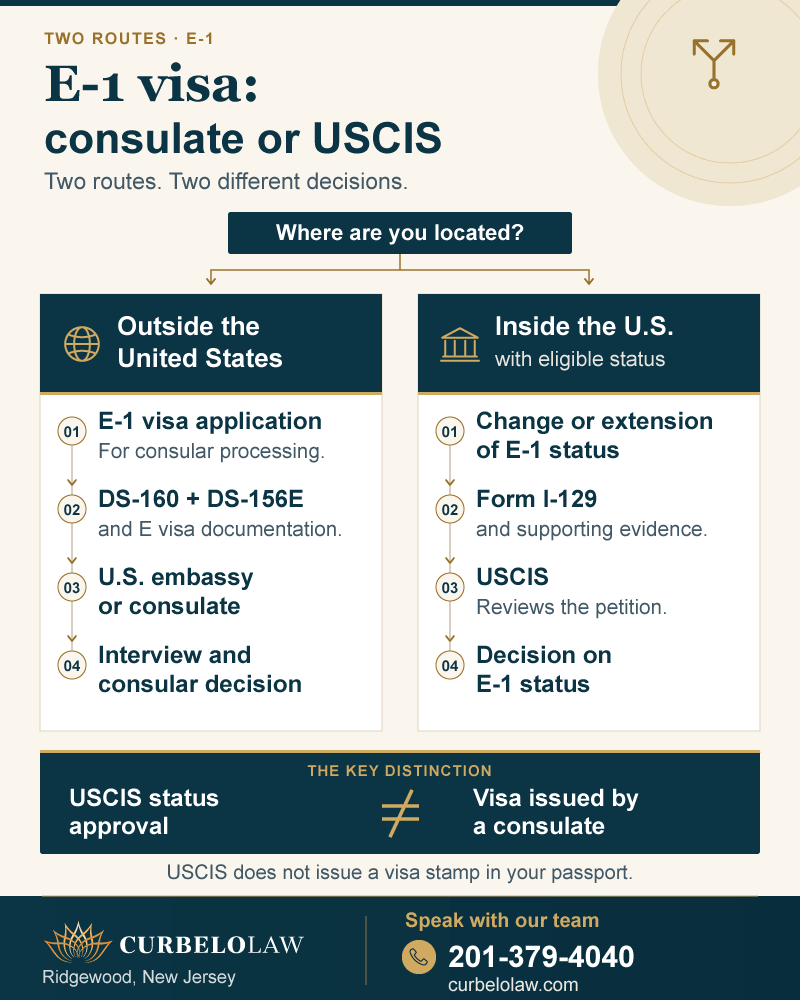
The process depends on where the applicant is located. If the applicant is outside the United States, the visa is generally requested directly through a U.S. embassy or consulate. If the applicant is already in the U.S. and maintains an eligible status, the person may request a change to E-1 status or an extension through USCIS using Form I-129.
Consular application from outside the United States
- Verify eligibility: confirm the treaty, nationality, ownership, trade, and the applicant’s role.
- Prepare the case file: organize evidence of the company and its international trade.
- Complete the forms: the Department of State requires Form DS-160 and, for principal E-1 applicants, Form DS-156E.
- Follow the consulate’s instructions: additional documents and filing procedures may vary by consular post.
Before filing, review the Department of State’s official guidance on E visas and the website of the applicable U.S. embassy or consulate.
Change or extension of status within the United States
If a treaty trader is in the United States in lawful nonimmigrant status, the trader may be able to file Form I-129 to request E-1 status.
Likewise, if a prospective employee is already in the U.S. in lawful nonimmigrant status, the employer may file Form I-129 to request a change to E-1 status for that employee.
USCIS approval of a change of status is not the same as a visa issued by a consulate. If the person later needs to travel and reenter the United States, it is important to determine whether an E-1 visa must be obtained abroad. This distinction between a visa and status is one of the first issues we evaluate before choosing the appropriate path for a case.
What documents do I need to apply for an E-1 visa?
To apply for an E-1 visa, you will need to gather and prepare documents before your interview. An E-1 visa lawyer can help connect each piece of evidence to the requirement it is intended to prove. The exact list depends on the consulate, the company, and the applicant.
- Valid passport: make sure it meets the validity requirements applicable to your case.
- Form DS-160: retain the confirmation page for the form.
- Form DS-156E: the Department of State requires this form for principal E-1 visa applicants.
- Ownership and nationality: corporate documents, stock certificates, and evidence identifying the ultimate owners.
- Trade: contracts, invoices, purchase orders, proof of payment, and accounting records, among other relevant evidence.
- E-1 employee: job description, organizational chart, and evidence of the employee’s duties or special qualifications.

What qualifies as trade and substantial trade?
Trade is the international exchange of goods, services, or technology between the U.S. and the treaty country. It may include, among other activities, tourism, transportation, and technology services.
Substantial trade refers to the volume of trade needed to ensure a continuous flow of transactions between the two countries.
This means there is no specific requirement for the value or volume of each individual transaction, but there must be a series of continuous transactions over time.
- Contracts and orders: identify what is being sold or provided and the parties involved.
- Invoices and payments: help trace the value and consideration involved in each transaction.
- Accounting records: make it possible to compare trade with the U.S. against total international trade.
- Shipping or customs records: may support the movement of goods when those records are part of the business model.
In addition, the trade must already be underway and identifiable or traceable. The Foreign Affairs Manual explains that E-1 classification is not granted simply to seek a future trading relationship. More than 50% of the total volume of the relevant international trade must occur between the United States and the treaty country.
In Curbelo Law’s professional review, a total sales figure is not enough by itself. Depending on the business, we look for a documentary trail that makes it possible to reconstruct the transactions.
Can family members qualify for E-1 status?
In general, family members may qualify. The spouse and unmarried children under age 21 of a principal E-1 holder may be eligible for derivative E-1 classification.
They do not need to have the same nationality as the principal E-1 holder. Spouses whose Form I-94 reflects E-1S spousal classification are employment authorized incident to status. Dependent children are not employment authorized based solely on E-1 dependent status.
Which countries have an E-1 treaty with the United States?
The Department of State maintains an updated list of countries that have qualifying treaties with the United States. Examples include Argentina, Chile, Spain, and Mexico.
It is important to check the current list before preparing an application to confirm eligibility. Citizenship, not simply the country of residence or birth, is determinative for the principal applicant.
Terms and changes that may affect E-1 status
A treaty trader or employee may work only in the activity approved under the E-1 classification.
- Related company: an E-1 employee may work for a parent company or subsidiary if the applicable requirements concerning the business relationship, duties, and terms of employment are met.
- Substantial change: a merger, acquisition, sale of a division, or other significant modification may require USCIS approval.
- Minor change: not every modification requires a new filing, but it is important to determine first whether it affects the terms or conditions of the status already granted.
Before implementing a significant corporate change, it is important to review how it may affect the company’s nationality, the relationship between entities, the principal trade, and the employee’s role. A change that is commercially neutral may still alter an immigration element that was previously established.
Why work with Curbelo Law on an E-1 application
Carolina T. Curbelo is the founder of Curbelo Law and practices from Ridgewood, New Jersey. Her practice includes advising small business owners, professionals, and investors on business and employment-based immigration matters, including the E-1 and E-2 categories. You can learn more about Attorney Carolina T. Curbelo and her professional credentials.
For more than 10 years, we have assisted individuals and businesses with immigration matters. In trade and investment cases, the first step is to understand the specific circumstances, review the business structure, and determine whether the selected classification matches the facts and documentation.
Do I need a lawyer to apply for an E-1 visa?
The law does not require you to hire an attorney. However, E-1 classification may require reconstructing international trade, analyzing the ownership of multiple entities, choosing between consular processing and a USCIS filing, and preparing different evidence depending on the business. If you are looking for an E-1 visa lawyer in New Jersey, Curbelo Law can evaluate your circumstances and explain the next steps.
Talk to Curbelo Law about your E-1 case
The first step is to understand the specific circumstances of your case and determine whether you qualify for this visa or whether another option may be more appropriate. We will review your nationality, company ownership, transaction history, and current immigration situation before defining a strategy.
From our Ridgewood office, we handle federal immigration matters for clients in New Jersey and, when the case allows, in other states or abroad. Contact Curbelo Law to schedule a consultation.
Let us know about your case We can help you