


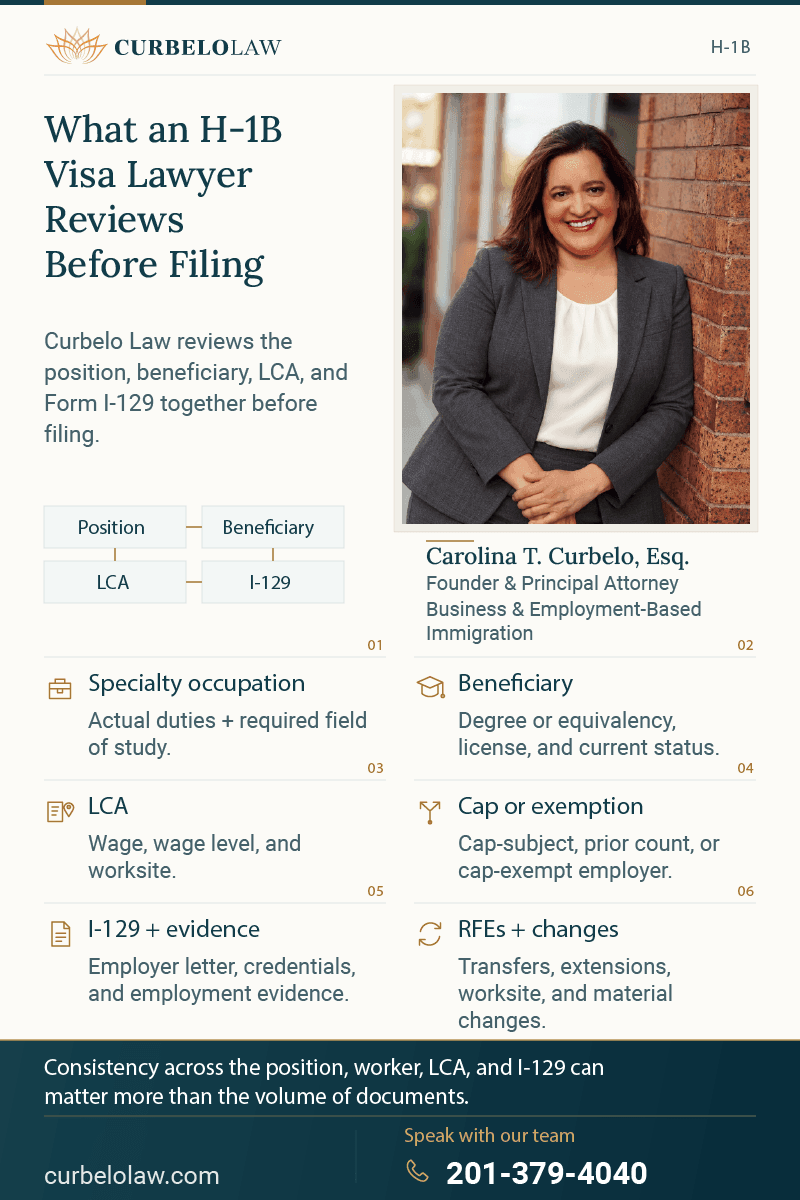
The H-1B visa allows a U.S. employer to temporarily hire a professional for a specialty occupation. An H-1B visa lawyer can review whether the position, the worker, the LCA, and the I-129 petition align before filing.
The analysis includes the actual job duties, the beneficiary’s education, the wage and work location, the annual cap, current immigration status, and the date employment could begin.
The program changed in 2026: for FY2027, cap-subject selection is weighted by wage level, and USCIS has already reached the cap. In addition, the additional $100,000 payment remains affected by litigation, so the rule in effect at the time of filing should be confirmed.
Let us know about your case We can help youOn this page
What an H-1B visa lawyer can do for your case
A lawyer’s role is to turn the job offer, the worker’s profile, and the immigration rules into a coherent filing strategy. At Curbelo Law, the analysis can cover both the employer’s side of the case and the professional’s immigration situation.
- Eligibility of the position and worker: determine whether the duties qualify as a specialty occupation and whether the beneficiary’s degree, experience, or license has the required relationship to the position.
- Cap or exemption: determine whether the case requires annual registration and selection, whether the worker has already been counted against the cap, or whether the employer may be cap-exempt.
- Wage and LCA: review the required wage, area of employment, work locations, and the obligations the employer attests to before the Department of Labor.
- I-129 petition: organize the employer letter, job duties, credentials, immigration history, and evidence connecting the position to the beneficiary’s education.
- RFEs, transfers, and changes: evaluate requests for evidence, changes of employer, extensions, concurrent employment, or material changes to the position.
- Next immigration steps: distinguish between a change or extension of status within the United States, consular processing, and longer-term immigration planning.
Curbelo Law’s approach: before preparing an H-1B petition, it is helpful to separate four questions: what the position actually requires, what the worker can document, what wage and work location will be reported, and what immigration status the worker currently holds. An inconsistency among those elements may matter more than the number of documents submitted.
Attorney Carolina T. Curbelo has more than a decade of experience handling immigration matters, and her practice includes business and employment-based immigration. In an H-1B visa petition, that experience makes it possible to review the employer’s needs, the professional’s credentials, and the overall consistency of the USCIS filing together.
What is the H-1B visa and what are its requirements?
The H-1B visa is a nonimmigrant classification that allows U.S. companies to temporarily hire foreign professionals in specialty occupations. There are different variations of this classification depending on the type of employment:
- H-1B (or “general”): For jobs in specialty occupations that require at least a bachelor’s degree or equivalent experience.
- H-1B2: For individuals who will work on cooperative research and development projects administered by the U.S. Department of Defense or under government-to-government agreements.
- H-1B3: For fashion models of distinguished merit and ability.
- H-1B1: A special classification for nationals of Chile and Singapore working in specialty occupations under applicable trade agreements.
For H-1B, H-1B2, and H-1B3 classifications, the employer files the petition with USCIS, not the worker. The H-1B1 classification for nationals of Chile and Singapore follows different filing rules.
For the H-1B specialty occupation classification, it is not enough for the beneficiary to have a college degree. The analysis separates two issues:
- The position: its actual duties must require highly specialized knowledge and directly related education under the applicable rules.
- The worker: the beneficiary must document the degree, experience, equivalency, or license required to perform the occupation.
When evaluating a position, our team does not focus only on the job title. We compare the duties, required education, credentials, and how the employer documents the connection between them. A valid degree does not, by itself, turn every job into a specialty occupation.
Hypothetical example: if a company wants to sponsor an “operations analyst” whose duties involve data, finance, and project management, we would review the job description, organizational chart, and the relationship between each duty and the required academic specialty. If the position accepts unrelated degrees, that weakness should be addressed before filing.
LCA, wage, and work location
For an H-1B visa, the position must satisfy basic requirements:
- It must be a specialty occupation requiring the application of advanced theoretical and practical knowledge.
- It must require at least a bachelor’s degree or its equivalent through experience.
- For the H-1B2 and H-1B3 subcategories, the position must satisfy the additional criteria specific to each classification.
In addition, the employer must file a Labor Condition Application (LCA) with the U.S. Department of Labor (DOL). In this filing, the employer agrees to pay the foreign worker the higher of the actual wage or the prevailing wage.
| Concept | Definition | Who determines it |
| Actual wage | Compensation paid to company employees with similar duties and experience. | The employer. |
| Prevailing wage | Market wage for the position in the geographic area, or the applicable collective bargaining wage. | Department of Labor (DOL). |
The LCA also includes obligations concerning working conditions and notice to employees. In practice, we review the wage, duties, and work location together: the employer letter, LCA, and I-129 should describe the same employment.
If the work will be remote, hybrid, or performed at a client site, we determine which location must be covered by the LCA and whether a change requires a new LCA, new notice, or an amended petition. We do not treat a different work location as a simple administrative change when it alters the facts on which the H-1B petition was approved.
H-1B cap and weighted selection beginning in fiscal year 2027
Most initial cap-subject H-1B petitions compete for 65,000 regular cap numbers and an additional exemption of up to 20,000 for certain beneficiaries with advanced degrees from U.S. institutions. USCIS announced on July 17, 2026, that it had received enough petitions to reach both fiscal year 2027 limits.
Beginning February 27, 2026, selection was no longer purely random. The final weighted selection rule retains the beneficiary-centered system but gives registrations associated with higher wage levels more opportunities for selection.
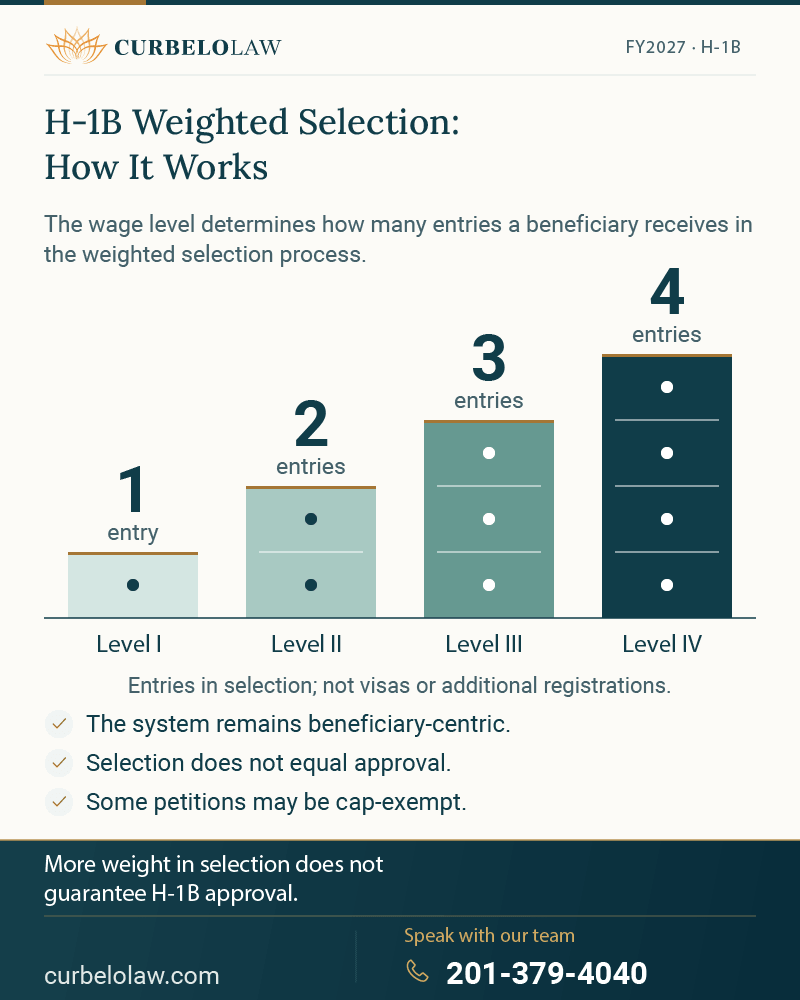
Selection allows the employer to file a cap-subject petition, but it does not approve the H-1B petition or independently authorize employment. In addition, certain institutions of higher education, affiliated entities, and research organizations may qualify to file cap-exempt petitions. Whether the worker has already been counted against the cap may also matter.
Practical decision: do not assume that every new H-1B job must wait for the next selection process. Before registering a worker, we review whether the case is actually cap-subject, the wage level that applies to the position, and whether there is a valid basis for a cap exemption or prior cap count.
H-1B process: registration, LCA, I-129, and USCIS review
The H-1B visa process follows a specific sequence:
- Job offer: A U.S. employer offers a specialty occupation position.
- Electronic registration, if applicable: for a cap-subject petition, the employer must register the beneficiary and receive a valid selection before filing the complete petition.
- Labor Condition Application (LCA): The employer files it with the Department of Labor for certification.
- I-129 petition: The employer completes the form and submits the required supporting documentation.
- USCIS review: The agency evaluates the petition and may issue a Request for Evidence (RFE).
- Consular application, if applicable: If the worker is outside the United States, the worker must complete Form DS-160, pay the applicable fees, and attend a consular interview.
- Admission to the United States: A CBP officer decides admission, and Form I-94 reflects the authorized period of stay.
- Beginning employment: The beneficiary starts working on the authorized date in accordance with the petition and the beneficiary’s immigration circumstances.
Selection through the registration process is not the same as approval and does not independently authorize employment. Likewise, approval of the petition does not replace any consular or admission steps that apply to the case.

Form I-129 and documents to review
Form I-129, Petition for a Nonimmigrant Worker, is the core form used for H-1B petitions.
Before filing, always use the current edition of Form I-129 and its instructions. USCIS may reject a filing that uses an edition it no longer accepts or that does not include the correct fees.
Reference table of common Form I-129 supporting documents
These are some common documents and the role they typically serve in an H-1B petition:
| Document or supporting item | Purpose |
| Form G-28 | Notice of legal representation. |
| Selection notice | Confirms that the beneficiary was selected through the registration process. |
| H-1B supplements | Classification-specific information based on the type of H-1B petition. |
| Certified LCA (ETA 9035) | Evidence of wage compliance before the DOL. |
| Employer letter | Explains the duties, wage, and requirements of the position. |
| Eligibility documents | Degrees, licenses, or experience establishing the beneficiary’s qualifications. |
In addition to the applicable passport, I-94, and I-797 documents, we compare the employer letter, LCA, and I-129. The duties, wage, work location, start date, and position requirements should describe the same employment. If the work will take place at an outside location or the position is difficult to classify, the organizational chart, supervision structure, project or client documents, and academic credentials may also matter.
We do not look for sheer document volume. Each piece of evidence should answer a specific issue. If USCIS questions the relationship between the job duties and the degree, for example, additional corporate documents do not replace a clear explanation of why the position requires that specialty.
RFE in an H-1B petition: what a lawyer would review
An RFE does not mean USCIS has denied the petition. Curbelo Law has also published experience responding to NOIDs in H-1B matters, and we apply the same analytical approach to an RFE: first identify the specific requirement USCIS is questioning and compare it with what was already submitted.
If the issue concerns the specialty occupation, we review the duties and academic requirements. If it involves the work location or control of employment, we review contracts, supervision, and the project. If it concerns wages, we examine the LCA and the classification used. The response should explain which evidence addresses each issue rather than simply adding documents.
H-1B visa costs and processing times in 2026
There is no single price. Government filing fees depend on the type and size of the employer, the type of petition, and additional fees that apply only in certain situations. Legal fees and other expenses, such as credential evaluations, are separate.
| Item | Amount or general rule |
| Electronic registration for a cap-subject H-1B | $215 per registered beneficiary |
| Form I-129 for H-1B | $780 for paper filing or $730 online; $460 for qualifying small employers and nonprofit organizations |
| Asylum Program Fee | $600 for a regular petitioner; $300 for a small employer; $0 for a qualifying nonprofit organization |
| Fraud Prevention and Detection Fee | $500 when applicable, including certain initial petitions or changes of employer |
| ACWIA fee | $750 for certain employers with 25 or fewer employees; $1,500 for certain employers with more than 25 employees, subject to specific exemptions |
| Public Law 114-113 | $4,000 when applicable to certain petitioners with 50 or more employees and a high proportion of H-1B/L-1 workers |
| Optional premium processing | $2,965 for H-1B |
Before paying, consult the USCIS fee schedule and current instructions. Premium processing does not guarantee approval. For an eligible H-1B petition, it requires USCIS to take adjudicative action within the applicable premium processing period, which is currently 15 business days.
About the additional $100,000 payment: the presidential proclamation was extended in September 2026, but a federal court struck down the implementation policy in June, and other litigation has continued to block its application. It should not automatically be added to every H-1B petition. Check current USCIS guidance and any applicable court order on the day of filing.
Processing times and premium processing
Processing times vary by service center, workload, and type of processing. For that reason, it is more accurate to check the USCIS processing times tool for the applicable form and category than to promise a fixed number of months.
- LCA: the Department of Labor indicates that it reviews a complete LCA for certification within approximately seven business days.
- Regular processing: processing times vary and may change throughout the year.
- Premium processing: for an eligible H-1B petition, USCIS must take adjudicative action within 15 business days. That action may be an approval, denial, RFE, or NOID.
An RFE can stop the premium processing clock and start a new period when USCIS receives the response. In addition, approval of the petition does not by itself resolve every consular, admission, or employment authorization step that may apply to a particular case.
Changing employers, modifying the position, or losing your job
An “H-1B transfer” generally means that the new employer files its own petition. If the worker meets the portability requirements, the worker may begin the new employment when the new nonfrivolous petition is properly filed with USCIS, or on the requested start date if later, without necessarily waiting for approval.
- Change of employer: review the I-94, status history, termination date, and new job offer before determining the start date.
- Concurrent employment: working for more than one employer may be possible, but each job needs its own proper basis for employment authorization.
- Material changes: a significant change in duties or work location may require a new LCA and an amended petition.
The receipt notice may help document that USCIS received the case, but it does not replace a portability analysis. A petition rejected by USCIS is not in the same position as a properly filed and pending petition.
What happens if you lose your job: grace period of up to 60 days
Current regulations allow certain individuals in H-1B status a discretionary grace period of up to 60 consecutive days after employment ends, or until the end of the authorized validity period, whichever comes first. DHS may shorten or eliminate the period in an individual case, and the grace period does not independently authorize employment.
In September 2026, DHS published a proposal to eliminate this grace period. A proposed rule does not change the current rule unless and until a final effective rule is published.
- A new employer may file an H-1B petition and, if the portability rules are satisfied, the worker may obtain authorization for the new employment while the petition is being adjudicated.
- Depending on the facts, it may be possible to request another status before the authorized period expires. For some individuals, an F-1 student visa may be an option to evaluate, but it is not an automatic solution.
- If there is no valid filing that permits the person to remain, it may be necessary to prepare to leave the United States before triggering additional immigration consequences.
When employment ends, an H-1B visa lawyer should review the actual termination date, the I-94, any pending petition, and the new job offer before assuming that the worker has a full 60 days available.
Employer obligations after H-1B approval
Approval does not end H-1B compliance obligations. A practical problem can arise when human resources changes the position, location, or hours first and seeks legal review afterward. Before implementing a significant change, the new facts should be compared with the approved LCA and I-129.
- Public Access File: the employer must maintain the documents that H-1B regulations require to be made available to the public.
- Changes in employment: a significant change in duties, wage, or work location may require review of the LCA or the filing of an amended petition.
- Corporate changes: certain reorganizations may require additional documentation to maintain compliance.
For the employer’s records, we also review whether the Public Access File contains the LCA, wage rate, basis for the prevailing wage, and evidence of the required notice. For companies with multiple sponsored workers, ongoing review helps prevent an internal HR decision from contradicting what was reported to the government.
H-4 family members and the path to a Green Card
The spouse and unmarried children under age 21 of the principal H-1B worker may obtain H-4 status. H-4 status does not itself provide employment authorization, although certain spouses may apply for an EAD using Form I-765 if they meet the applicable requirements.
H-1B status is generally granted in periods of up to three years and, as a general rule, is subject to a six-year limit, although exceptions may allow additional time. The exact dates on the I-94 and I-797, as well as an employment-based permanent residence process, can change the analysis of an extension.
Does H-1B lead to a Green Card?
It is not possible to obtain a Green Card directly through H-1B status, but H-1B can be part of the path toward permanent residence. The most common process includes these stages:
- PERM labor certification filed by the employer with the Department of Labor.
- I-140 petition filed with USCIS, establishing that the worker meets the requirements of the offered position and that the employer can pay the offered wage.
- Adjustment of status using Form I-485 if the worker is lawfully in the United States and the priority date is current, or consular processing if the worker is abroad.
H-1B permits dual intent, which means an employment-based permanent residence process can coexist with H-1B status when the applicable requirements are met. For many workers, PERM labor certification is part of that planning.
Alternatives when the H-1B visa is not the right fit
The H-1B visa is not always the best option. The comparison depends on the professional’s background, relationship with the employer, company structure, and the work that will be performed in the United States.
| Option | When it may be worth evaluating |
| H-1B | Specialty occupation with employer sponsorship and applicable wage/LCA requirements |
| O-1 visa | A professional with extraordinary ability or achievements who may satisfy the criteria for that classification |
| L-1A visa | Executives or managers who meet the requirements for a transfer within a qualifying related organization |
| L-1B visa | Employees with specialized knowledge in a qualifying intracompany transfer |
A useful comparison is not limited to asking which visa “seems easier.” The analysis should consider whether the profile legally qualifies, when the work could begin, what evidence is available, and what immigration objective the employer and professional are trying to achieve.

Frequently asked questions about the H-1B visa
How long does the H-1B visa last?
Initial approval may be granted for up to three years and, as a general rule, H-1B time is limited to six years, with exceptions for certain workers who are progressing through employment-based permanent residence processes.
Can I change from F-1 OPT to H-1B?
Yes, it may be possible if an employer files the required registration and petition and the worker maintains a valid basis for status and employment. Cap-gap rules and OPT dates should be analyzed based on the specific case rather than assumed to apply automatically.
H-1B visa lawyers in New Jersey for employers and professionals
Curbelo Law, based in Ridgewood, New Jersey, advises clients on business and employment-based immigration. In an H-1B visa case, the goal is to identify before filing any inconsistency involving the position, wage, immigration status, or documentation that could become an issue during adjudication.
During a consultation, an H-1B visa lawyer can analyze which path applies, which documents are missing, and which deadlines affect the employer and worker. The attorney can also evaluate a transfer, extension, RFE, change of status, or consular strategy based on the facts.
- Job description, wage, work location, and proposed start date.
- Resume, degrees, academic transcripts, and professional licenses.
- I-94, I-797 notices, and documentation of current immigration status.
- Any RFE, NOID, rejection, or prior decision related to the petition.
- Information from the employer about its workforce and any prior history of H-1B petitions when relevant to filing fees or the type of petition.
You can learn more about Carolina T. Curbelo and the firm’s immigration practice before scheduling your consultation.
Let us know about your case We can help you