

The R-1 visa allows certain religious workers to temporarily perform qualifying duties in the United States for a nonprofit religious organization or a qualifying affiliated organization.
In this guide, we explain who may qualify, the evidence USCIS typically requires, the process, costs, duration, and recent federal changes affecting religious workers.
Let us know about your case We can help youOn this page
R-1 visa: what it is and who can apply
Religious ministers and other workers performing a religious vocation or occupation may travel to the United States or, in certain cases, change or adjust their status to carry out these duties, provided they meet the applicable immigration requirements.
What the R classification means for temporary religious work
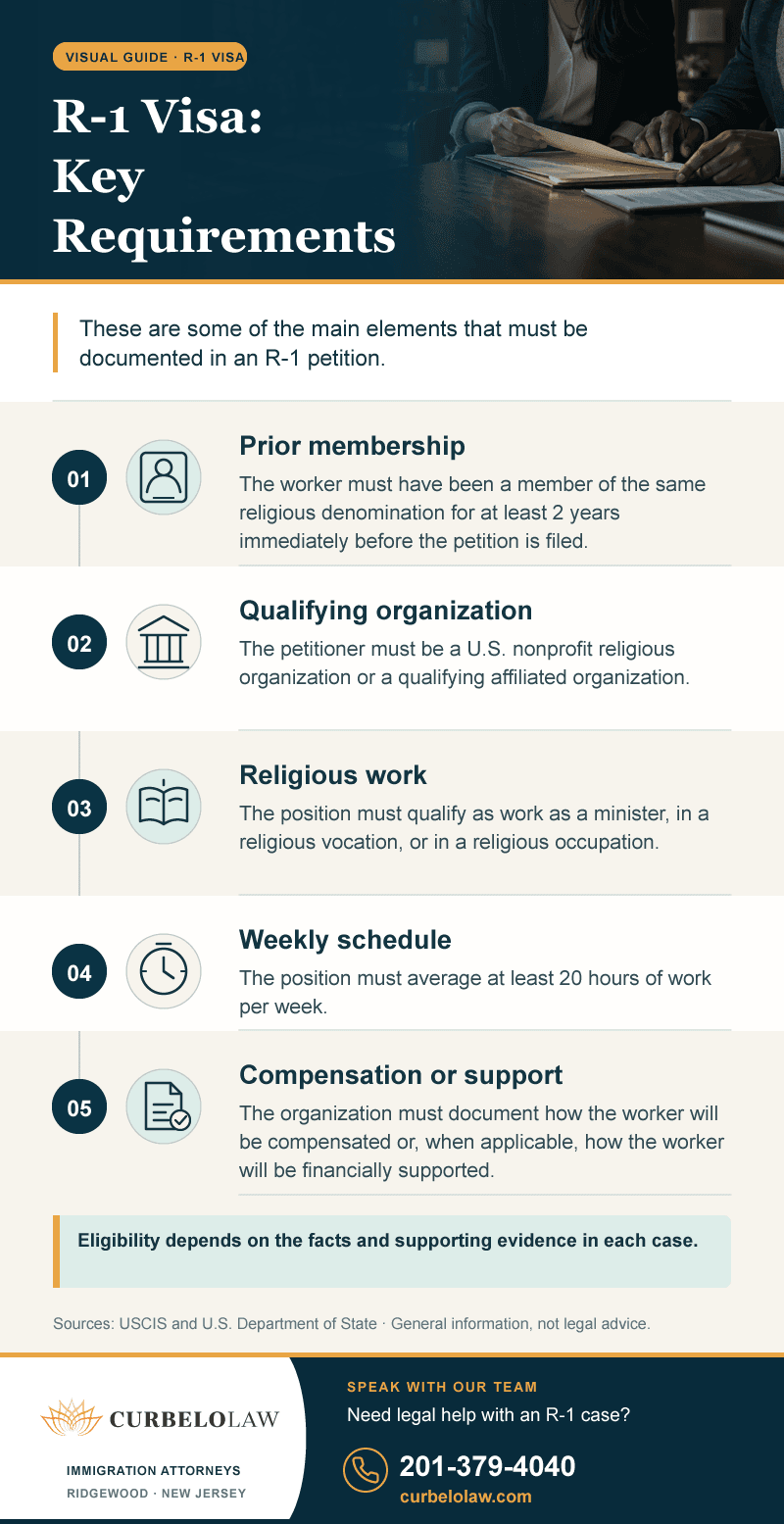
The R visa is one of the U.S. nonimmigrant visa classifications available to foreign nationals who will temporarily perform qualifying religious work in the United States. The position may be part-time, but it must average at least 20 hours of work per week.
Simply being a member or devotee of a religion, or working within a church, temple, mosque, synagogue, or other religious entity, is not enough. The duties of the position must genuinely qualify as religious work.
In addition, the worker must intend to leave the United States at the end of the temporary stay, although an extension or change of status may be requested when the applicable requirements are met.
Minister, religious vocation, or religious occupation
- Minister: The individual must be fully authorized and trained by the denomination to conduct religious worship and perform duties normally associated with members of the clergy.
- Religious vocation: This involves a formal and lifelong commitment to a religious way of life, as may be the case for nuns, monks, religious brothers, or religious sisters.
- Religious occupation: The duties must primarily relate to a traditional religious function and to the practice or transmission of the denomination’s religious beliefs.
Primarily administrative or support duties, such as cleaning, maintenance, office work, fundraising, or soliciting donations, do not qualify on their own as a religious occupation. Limited and incidental administrative tasks may, however, be part of a position whose primary function is religious.
R-1 and R-2: the classifications you should know
- R-1: For religious workers entering the United States temporarily to perform a qualifying religious vocation or occupation.
- R-2: For the spouse and unmarried children under age 21 of an R-1 holder.
Current regulations do not establish an R-3 category for part-time religious workers. R-1 classification itself can cover a position averaging at least 20 hours per week.
Practical benefits and limitations of R status
Some of the main benefits and features of this classification include:
- You may work legally for the religious employer and under the conditions of the approved petition.
- Your spouse and unmarried children under age 21 may accompany you or join you in R-2 classification.
- Initial admission may be granted for up to 30 months and, if you remain eligible, you may request an extension for up to an additional 30 months.
- Some religious workers may have a separate path to permanent residence if they meet the requirements of the corresponding immigrant category.
Can you get a Green Card after an R-1 visa?
Yes, in certain cases. Some ministers and other religious workers may be eligible for an EB-4 immigrant category, but R-1 status does not automatically become permanent residence.
Depending on the case, it may be necessary to file Form I-360, wait until an immigrant visa is available and, when applicable, file an adjustment of status application.
Permanent residence for religious workers: Separate immigrant categories exist for ministers (SD) and certain non-minister religious workers (SR). Availability of the SR category depends on current legislation and visa availability, so both should be checked before filing the case.
Can I work with an R visa?
An R-1 holder may work in the religious duties and for the employer or employers authorized by the petition. This status cannot be used to perform other unauthorized employment.
R-2 dependents are not authorized to work simply because they hold that classification, and their period of stay is tied to that of the principal R-1 holder.
Some members of religious denominations may be eligible for a B-1 visa for certain temporary religious activities. The Department of State recognizes, among other circumstances, certain conventions, ministerial tours, pulpit exchanges, or missionary and volunteer activities. A B-1 visa should not be used as a substitute for religious employment that requires R classification.
Who may qualify and what each party must demonstrate
The petition must establish the eligibility of the sponsoring organization, the religious worker, and the offered position.
Requirements for the sponsor
- Be a bona fide nonprofit religious organization in the United States, or a nonprofit organization affiliated with a religious denomination that meets the applicable rules.
- Have a valid religious purpose and demonstrate a genuine religious presence in the United States.
- Document how it will pay the worker’s salary or provide other compensation or support.
- Demonstrate the applicable tax-exempt status and, when required, affiliation with a religious denomination.
- Identify the position, its duties, the work hours, and the physical address where the beneficiary will work.
In our experience with R-1 petitions, we pay particular attention to whether the job description, work hours, compensation, and organizational documents tell the same story. The record should consistently show who will employ the worker, what religious duties the worker will perform, and under what conditions.
Requirements for the religious worker
- Have been a member of the same religious denomination for at least the 2 years immediately preceding the filing of the petition.
- Intend to depart the United States at the end of the temporary stay.
- If serving as a minister, be duly authorized to perform the duties of a minister within that denomination.
- If performing a religious vocation or occupation, be qualified under the applicable standards of the denomination.
- Work in the religious position for an average of at least 20 hours per week.
How the I-129 petition is filed and the visa is processed
The U.S. organization must file Form I-129 with USCIS on behalf of the religious worker and demonstrate that the organization, the beneficiary, and the position meet the criteria for the requested classification.
The applicable requirements and evidence are explained in the USCIS Policy Manual.
Proof of tax-exempt status
The organization must provide evidence of the applicable tax-exempt status. If it operates under a group tax exemption or as an affiliated organization, it must also establish the corresponding relationship with the religious denomination.
Evidence of compensation and self-support
The petitioner must provide verifiable evidence showing how the religious worker will be compensated. The documentation may include a salary and other forms of compensation, such as housing or meals, depending on the actual structure of the position.
When the beneficiary will be self-supporting as part of an established missionary program, the petitioner must demonstrate, among other elements:
- The existence of an established program for temporary, uncompensated missionary work.
- The presence of missionary programs in the United States and abroad.
- The beneficiary’s acceptance into the program.
- The religious duties and responsibilities associated with the missionary work.
Evidence of personal savings, housing and meals provided by host families, church donations, or other verifiable means may also be relevant. This exception is limited and does not make every volunteer position eligible.
Evidence of membership and qualifications
The employer must establish the beneficiary’s religious membership and qualifications for the offered duties. For a minister, relevant evidence may include a certificate of ordination, the denomination’s requirements, and proof that the worker satisfies those requirements.

How much does the R-1 visa cost in 2026?
In 2026, the filing fee for Form I-129 for an R petition is $510. An organization that qualifies as a nonprofit pays $0 for the Asylum Program Fee, although other fees may apply depending on the filing.
When the worker needs to apply for a visa at a U.S. consulate, the application fee is currently $205. Depending on the applicant’s nationality, a reciprocity-based visa issuance fee may also apply.
Premium processing is optional. For Form I-907 requests filed on or after March 1, 2026, the fee applicable to R-1 petitions is $1,780, and USCIS must take adjudicative action within 15 business days. That action may be an approval, a denial, a request for evidence, or a notice of intent to deny, so premium processing does not guarantee approval.
What happens after USCIS approves the petition?
Once USCIS approves the I-129, the process is not necessarily over. If the beneficiary needs a visa to travel, the consular post will subsequently determine whether the person is eligible to receive it.
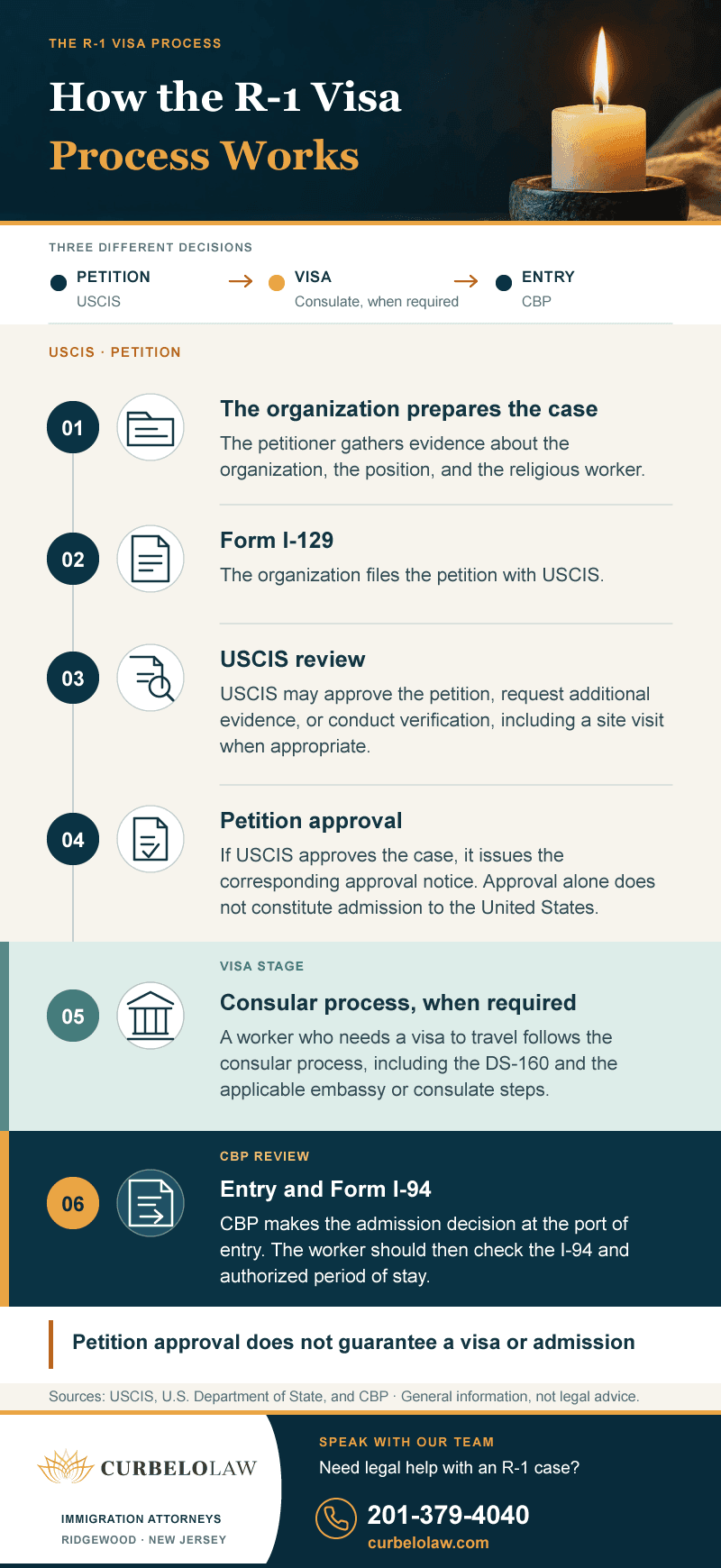
In addition, U.S. Customs and Border Protection (CBP) decides at the port of entry whether the traveler may be admitted. Therefore, an approved I-129 petition, an issued visa, and admission to the United States are related but separate stages.
If the person is outside the United States, they will generally need to complete the DS-160 and follow the instructions of the U.S. embassy or consulate. You can learn more about this stage in our guide to consular processing for a visa application. After entering the United States, it is advisable to review the I-94 record to confirm the authorized period of stay.
Temporary intent and immigrant petitions
Although R-1 is a temporary status, USCIS may not deny an R petition, an application for admission, a change of status, or an extension solely because a permanent labor certification or an immigrant visa petition has been filed or approved.
Changing employers, work locations, or employment conditions
If the worker will provide services for a different or additional religious employer, that organization must file a new I-129 petition and obtain the required approval before the worker begins that employment.
An amended petition may also be required when there are material changes to the work location, duties, hours, or other conditions described in the petition. In addition, the petitioner must notify USCIS within the applicable period if the worker leaves the employment before the end of the authorized period or begins working fewer than the required number of hours.
How long can I stay in the United States in R-1 status?
Initial admission may be granted for up to 30 months. If the worker remains eligible, an extension of up to another 30 months may be requested, subject to a general maximum of 5 years, or 60 months, in R-1 classification.
2026 change: As of January 16, 2026, the former requirement to remain physically outside the United States for one year before seeking a new R-1 admission after reaching the 5-year maximum was eliminated.
The worker must still depart after reaching the applicable maximum period of stay, but there is no longer a minimum one-year period that must be spent outside the country. Returning in R-1 classification will require a newly approved petition and, when applicable, a new visa.
What is a USCIS site inspection for religious workers?
USCIS may conduct site inspections before or after deciding a petition. The organization must provide a physical address where the beneficiary will work and be prepared to support the information submitted in the petition.
During an inspection, USCIS may verify the existence and activities of the organization, the work schedule, compensation, the worker’s duties, and other documents related to the petition.
Practical experience also matters at this stage. When preparing an R-1 petition, our team reviews the record not only with the initial filing in mind, but also considering whether the organization could consistently explain and support the information submitted if USCIS requests additional evidence or verifies the worksite.
What happens if my religious worker visa is denied?
If USCIS denies the petition, it is important to review the decision notice and the specific reason for the denial before deciding on the next step. Depending on the decision, options may include a motion, an appeal, a properly supported new filing, or an evaluation of another immigration category.
A consular visa refusal is different from a denial of the I-129 petition. Not every refusal has the same form of review, and refiling does not automatically resolve the underlying issue.
Curbelo Law’s experience with religious workers
Real experience with R-1 cases: Attorney Carolina T. Curbelo has successfully helped with dozens of R-1 visa cases for religious workers. That experience allows the team to analyze a petition not only from the standpoint of the formal requirements, but also in terms of how the organization, the position, the hours, the compensation, and the supporting evidence must fit together.
Carolina is the founder and principal attorney of Curbelo Law and has more than a decade of experience in immigration law. She is admitted to practice in New Jersey and before federal courts, is a member of the American Immigration Lawyers Association (AILA), and serves clients in both English and Spanish.
During a consultation about an R-1 petition, we can review whether the sponsoring organization and proposed position fit this classification, what documentation should be gathered, which aspects of the record may require a stronger explanation, and how to prepare for the next step. We can also provide guidance regarding Form I-129, requests for evidence, extensions, changes of employer, and consular processing when applicable.
Curbelo Law serves clients from Ridgewood, New Jersey. Because immigration is a federal matter, the firm may also represent certain cases for clients in other states or abroad when the type of proceeding allows it. Our New Jersey immigration lawyers can evaluate the facts and documentation of your case before filing a petition or responding to USCIS.
Past results do not guarantee the outcome of a future case. Each R-1 petition depends on its specific facts, the sponsoring organization, and the available evidence.
Let us know about your case We can help you