
It is important to understand that USCIS processing times are not the same for every immigration case. So, how long does USCIS take to review a case? There is no single timeframe. Processing time depends on the form filed, the immigration category, and the office responsible for handling the case.
Although USCIS has reduced wait times for some applications in recent years, results remain uneven in 2026. While certain applications are moving faster, others continue to face significant delays.
Start with the table to find your form and category. Then, we explain how to check the timeframe for your own case and what to do if it is delayed.
Let us know about your case We can help youOn this page
What should you know about USCIS processing times in 2026?
Before estimating how long your case may take, keep in mind that:
- Processing times are estimates: they may change based on workload, application type, and other factors.
- Not all cases move at the same pace: the form, category, and processing office matter.
- Premium processing changed in 2026: fees increased on March 1 for eligible categories.
- A delay may require follow-up: check whether you are already eligible to submit a case inquiry to USCIS.
Processing time and fee table by form
USCIS processing times change frequently. This table provides a general reference for 2026. The timeframe for your case depends on the category, office, biometrics, interview, background checks, and requests for evidence.
How to read the table: the number of months reflects cases that have already been completed. It does not indicate how much time remains on your case. To determine whether you can already submit an inquiry about a delay, check your receipt date using USCIS’s current processing time tool.
The fee column shows the cost of filing the form with USCIS. The I-907 requires a separate optional fee. When a form has categories with different fees, this is explained in its row. “Online” means filing electronically; “paper” means submitting a printed application. Check the exact amount in the official G-1055 fee schedule before paying.
| Form and application | Processing time | 2026 USCIS fee |
|---|---|---|
| I-130 Family petition | 12.9 months: immediate relative. Other categories vary. | $625 online / $675 on paper. |
| I-485 Green Card from within the U.S. | 6.0 months: family-based; 5.9: employment-based. | $1,440: general filing fee; exceptions apply. |
| I-765 Work permit | 5.8 months: pending adjustment; 0.7: pending asylum; 3.9: other categories. | General: $470 online / $520 on paper. With certain pending I-485 applications: $260. Initial asylum/TPS: additional federal fee of $560; the total depends on your category. |
| I-131 Travel document | 6.0 months: advance parole. Other uses vary. | $630 on paper: general advance parole; other categories vary. |
| I-90 Replace or renew a Green Card | 7.1 months. | $415 online / $465 on paper. |
| N-400 Citizenship through naturalization | 7.2 months: general application. | $710 online / $760 on paper; a reduced fee may be available. |
| N-600 Certificate of Citizenship | 5.5 months. | $1,335 online / $1,385 on paper. |
| I-751 Remove conditions on residence | 22.7 months. | $700 online / $750 on paper. |
| I-129F Fiancé(e) petition | 8.0 months: USCIS stage only. | $675 on paper. |
| I-129 Temporary worker petition | 5.2 months without premium processing. | Filing fee depends on classification and employer; premium processing is additional. |
| I-140 Immigrant worker petition | 3.7 months without premium processing. | $715 plus an Asylum Program Fee of $0, $300, or $600, depending on the employer; premium processing is additional. |
| I-539 Change or extension of status | Varies by category and service center. | $420 online / $470 on paper: general fee; certain categories have exceptions. |
| I-134 Declaration of Financial Support | No separate timeframe: filed in connection with another process. | No general filing fee for Form I-134. |
| I-134A Support for certain programs | No general timeframe; first verify whether the program is accepting applications. | Depends on the program; do not confuse it with Form I-134. |
| I-589 Asylum application | There is no single wait time; EOIR is involved in immigration court cases. | $100 when filing; $102 annual fee in 2026 when applicable. |
| I-601A Provisional waiver | 24.3 months: USCIS stage only. | $795: general filing fee. |
| I-601 Waiver of inadmissibility | Varies by ground and office. | $1,050: general filing fee; possible exceptions. |
| I-212 Permission to reapply for admission | Varies by case and office. | $1,175: general filing fee; possible exceptions. |
| I-360 VAWA VAWA self-petition | Varies; it may take years. | No filing fee for a VAWA self-petition. |
| I-360 SIJS Special Immigrant Juvenile petition | Varies; does not include state court proceedings or visa availability wait times. | $0 base filing fee + $250 additional federal fee. |
| I-918 U visa petition | 19.3 months: initial bona fide determination; final visa issuance can take years. | No fee for the principal petition. |
| I-914 T visa petition | 28.7 months: completed cases. | No fee for the principal petition. |
| I-821 TPS application | 13.0 months overall; depends on the country. | $510: initial registration in 2026; $30 biometrics fee if applicable. Check re-registration and work authorization fees separately. |
| I-821D DACA renewal | 3.5 months: renewals. | $555 online / $605 on paper, including the required I-765. |
| I-864 Affidavit of Support | Reviewed with the I-485 or during consular processing. | No separate USCIS fee when filed with Form I-485; consular fees may apply. |
| I-290B Appeal or motion | Varies; AAO appellate review has a goal of 180 days after receiving the complete record. | $800: general fee; exceptions may apply. |
| I-824 Action on an approved petition | 7.1 months. | $590: general filing fee. |
| G-1145 Electronic receipt notification | Not a case: it only provides notice that the filing was accepted. | No fee. |
| I-907 Request premium processing | USCIS must take action within 15, 30, or 45 business days depending on the category. | $2,965 / $2,075 / $1,780 depending on the category; added to the main filing fee. |
| PERM DOL labor certification | 336-day average analyst review time in August 2026; this is not a USCIS process. | Not a USCIS fee; this process is handled by the employer. |
Source for the processing times: USCIS historical data for fiscal year 2026 through July 31. Fees: USCIS G-1055 and current 2026 notices. The I-918 timeframe reflects the bona fide determination, not final approval of a U visa. The PERM average comes from the Department of Labor.
How to check the timeframe for your own case
First, find your form in the table and review the category listed in the same row. For example, 12.9 months for an immediate-relative I-130 means that half of those completed cases were decided within that amount of time or less. An I-130 in another category may take much longer.
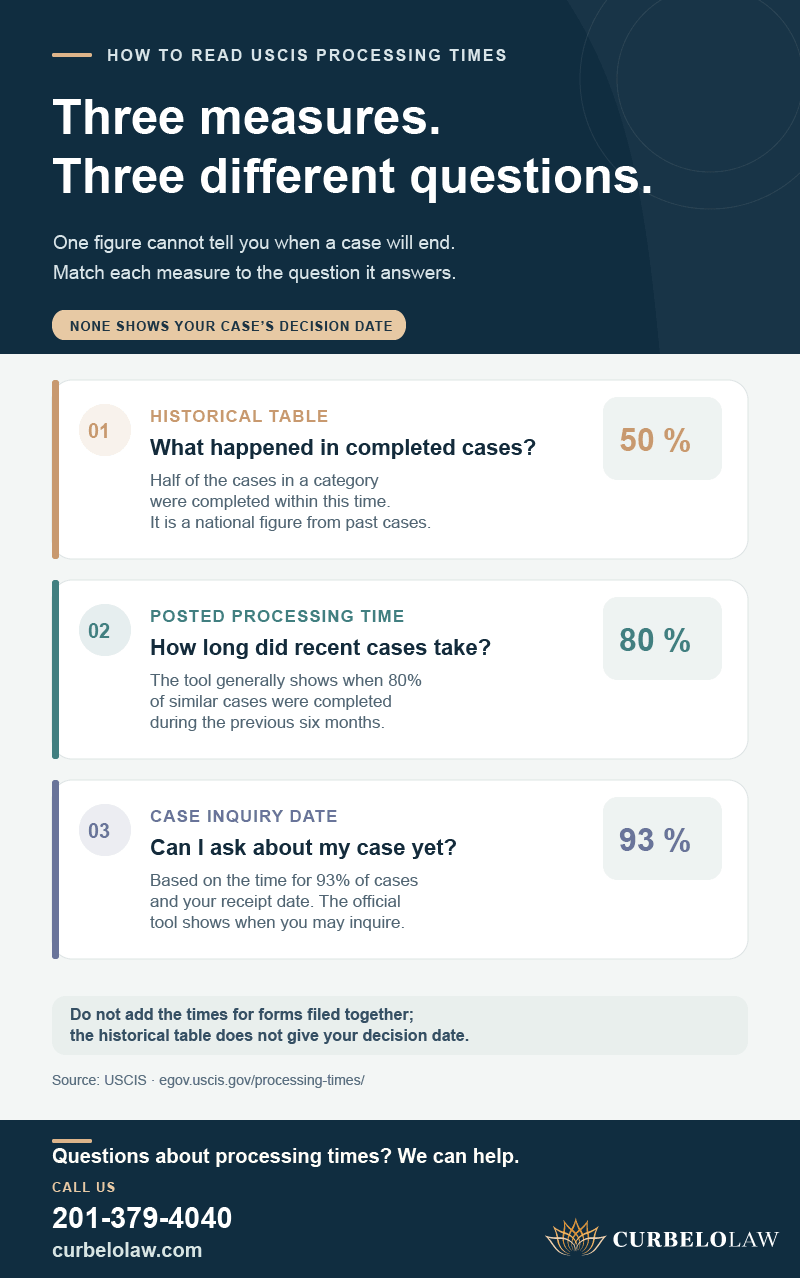
If you already have a receipt notice, the next step is to open the current USCIS processing time tool, select your category and office, and use your receipt date to determine whether you can already submit an inquiry about a delay. The current tool uses a different calculation from the historical data in the table, so the figures may not match. Checking your case status or processing times is free.
Is USCIS processing cases faster in 2026?
USCIS data shows that there is no single trend in 2026. Some forms improved compared with 2025, while others are taking longer. For example:
- I-130 for immediate relatives: decreased from 14.4 months in 2025 to 12.9 months in 2026.
- I-129F: increased from 7.7 to 8 months, so it has remained relatively stable.
- I-90: increased from 4.1 to 7.1 months.
- N-400: increased from 5.6 to 7.2 months.
- I-129 without premium processing: increased from 3.5 to 5.2 months.
These figures compare cases completed in 2025 with cases completed through July 2026. They do not predict when a pending application will be decided.
What can affect the wait time for your case?
Even when two people file the same form, their cases may move at different speeds. Factors that can affect processing include:
- Case type and complexity: some applications require more evidence or additional review.
- Immigration category: the same form can have different processing times depending on the basis for filing.
- Workload and processing office: case volume and transfers between centers can affect processing speed.
- RFEs, interviews, or additional checks: any of these steps can extend the wait.
- Visa availability: cases subject to the Visa Bulletin may involve a separate wait.
USCIS is also adjusting processing times for certain forms so they appear under Service Center Operations (SCOPS), which can process cases at multiple locations based on operational needs. Follow the office or grouping shown in the processing time tool, even if your receipt notice names a specific service center.
If you are applying for permanent residence from within the country, adjustment of status with USCIS involves requirements beyond the estimated number of months. If the process continues outside the United States, review the stages of immigration consular processing.
How long do the most common immigration applications take?
I-130 and I-485: family petition and adjustment of status

For immediate relatives, the national reference figure for Form I-130 was 12.9 months. This does not necessarily represent the total length of the immigration process because additional stages may follow. It does not apply to all family-based immigration petitions with USCIS.
If the case continues outside the United States, additional stages may follow I-130 approval, including processing through the National Visa Center and consular processing. Approval of the petition does not mean permanent residence has already been granted.
In 2026, the reference figure was 6.0 months for family-based I-485 cases and 5.9 months for employment-based cases. USCIS does not include I-485 cases affected by visa retrogression in these historical figures. Check the current category and office before comparing these numbers with your case.
Form I-601A had a reference processing time of 24.3 months. If your case requires a provisional waiver, that figure covers only the USCIS stage. The consular interview comes afterward.
I-765: work permit
USCIS reported 3.9 months for “other applications” for employment authorization and 5.8 months for work permits based on a pending I-485 adjustment application. However, how long USCIS takes to approve a work permit depends on the I-765 category and the circumstances of the case. Do not use these figures to estimate the wait for asylum, TPS, OPT, or parole. You can also review the requirements to get a work permit in the United States.
Naturalization, fiancé(e) petitions, and PERM certification
For Form N-400, USCIS reported a national figure of 7.2 months in 2026. The process for obtaining U.S. citizenship may include:
- Receipt of the application.
- Biometrics, when required.
- Naturalization interview and test.
- Decision.
- Oath ceremony.
The length of each stage may vary depending on the local office and the circumstances of the case. USCIS states that after approving an application following the interview, it schedules the oath ceremony.
For Form I-129F, USCIS reported a national figure of 8 months in 2026. This timeframe applies to the USCIS stage and does not include the additional consular processing time required to obtain a K-1 fiancé(e) visa.
PERM labor certification is processed by the Department of Labor, not USCIS. As of September 2026, the average FLAG analyst review time was 336 days for cases completed in August. That average does not indicate when a pending case will be completed.
Affirmative and defensive asylum: why there is no single timeframe
The timeframe depends on the type of proceeding. Affirmative asylum is processed by USCIS, while defensive asylum is part of immigration court proceedings and follows EOIR timelines rather than USCIS processing times.
For that reason, there is no single answer to how long USCIS takes to review an affirmative asylum case. Interview availability, workload, and individual circumstances can all affect the timeframe. Review the notices in your case and the information provided by the agency handling your matter.
Pending asylum: the annual fee and the 2026 court order
A pending asylum case may also involve payment obligations under H.R. 1. In fiscal year 2026, the initial asylum filing fee is $100 and the adjusted annual fee is $102 when applicable. These fees are not an estimate of how long a case will take.
USCIS states that it will send individual notices to people required to pay the annual fee. Always verify the amount and payment method in your notice and through the official annual asylum fee portal.
If you received a payment notice: an August 5, 2026 court order halted the late-payment consequences established in USCIS’s interim rule. The agency permits payment of the annual fee after the date listed in the notice while the litigation remains pending. The order did not eliminate the obligation to pay. Check the official portal and the instructions in your notice.
How to check your case status and determine whether you can submit an inquiry

To review your case, have your receipt notice available. Your case status tells you what has happened, while the published processing time is not a promise of when a decision will be made:
- Find your receipt number and receipt date. Check your status using the official case status tool. The text displayed describes an event, not a decision date.
- In the official processing time tool, select the form, category, and office or grouping that applies based on the tool and your notice.
- Enter the receipt number or date requested when the tool offers the option to check whether you can submit an inquiry about a delay. If you are not yet eligible, keep your notices and check the information again later.
- If the tool allows you to submit an inquiry, use the official link provided by USCIS. Save the reference number and also check the messages in your account.
If the receipt notice lists the National Benefits Center (NBC) and the case is a family-based or employment-based I-485, N-400, or N-600, USCIS instructs applicants to check the applicable local field office. Some categories are grouped under SCOPS even when correspondence identifies a specific service center.
The status shown on the screen does not predict when your case will be decided. Compare the notice you received with this brief guide before taking action:
| Status you may see | What it means | What you should do |
|---|---|---|
| Case Was Received | USCIS recorded receipt of the case. | Keep your notice and receipt date. |
| Case Is Being Actively Reviewed | The case is under review; it does not mean approval is imminent. | Monitor your notices and the official processing time. |
| Request for Evidence Was Sent | USCIS issued a Request for Evidence. | Read the entire notice and note the response deadline. |
| Response To USCIS’ Request For Evidence Was Received | USCIS recorded receipt of the RFE response. | Keep proof of submission; there is no single timeframe for a decision. |
| Interview Was Scheduled | An interview has been scheduled. | Check the location, date, and instructions in the notice. |
| Case Was Approved | USCIS approved that application or petition. | Read the notice and any next steps; another stage may follow. |
| Case Was Denied | USCIS denied that application or petition. | Review the notice and any deadlines to respond or appeal. |
Receipt notice, RFE, and interview: what to expect at each stage
Receipt notice: when it arrives and what to check
The time required to issue a receipt notice can vary. Errors involving the form, filing fee, signature, or mailing can delay the initial acceptance of the case. Postal delivery alone does not mean USCIS has accepted the filing. If you do not receive a notice, check the shipment tracking and payment before filing a duplicate case. A USCIS receipt number contains 13 characters: three letters followed by 10 numbers.
How long does USCIS take to respond after an RFE?
There is no single timeframe. After receiving the response, USCIS continues reviewing the case, and the amount of time required depends on the form, the complexity of the evidence, and the office’s workload. Keep proof of delivery and comply with the deadline stated in the notice, including if you receive a NOID. If you received an RFE, our guide explains how to respond to a Request for Evidence.
Interview: when can it be scheduled?
There is no general timeframe that applies to every case. Timing depends on the type of application, the local office, appointment availability, and whether USCIS determines that an interview is necessary before making a decision. An “actively reviewed” status also cannot be used to calculate the date of an interview. Review your notices and keep your address up to date.
Some delays may be avoided if you:
- Submit a complete and signed form.
- Pay the correct fee.
- Include the required documentation.
- Respond within the stated deadlines.
- Keep your address updated with USCIS.
Premium processing: when it can help and how much it costs
Premium processing allows applicants or petitioners to request faster USCIS action only for certain categories. The Form I-907 fee is paid in addition to the filing fee for the underlying form. As of March 1, 2026, the fees and timeframes are as follows. These are business days, not calendar days.
For I-140 categories subject to a 45-business-day timeframe and eligible I-539 and I-765 categories, the clock begins when USCIS receives the form, fees, and all prerequisites required to make a decision, such as biometrics when applicable.
| Eligible filing with Form I-907 | Fee as of March 1, 2026 | USCIS action within |
|---|---|---|
| I-129 · most eligible categories | $2,965 | 15 business days |
| I-129 · H-2B or R-1 | $1,780 | 15 business days |
| I-140 · most eligible categories | $2,965 | 15 business days |
| I-140 · EB-1C or EB-2 NIW | $2,965 | 45 business days |
| I-539 · eligible F/J/M categories | $2,075 | 30 business days |
| I-765 · eligible OPT/STEM OPT | $1,780 | 30 business days |
The USCIS action may be an approval, denial, RFE, or Notice of Intent to Deny. Premium processing does not guarantee a favorable decision and does not automatically expedite an associated I-485. Check the category, fee, and timeframe on the Form I-907 page and the G-1055 fee schedule before filing. An incorrect fee can result in rejection of Form I-907.
Before paying, check the total cost of your forms and any additional charges using the official fee calculator. The amounts in the table are provided as guidance. A fee exemption, filing method, or fee change may affect the amount you owe.
What to do if your case exceeds the normal processing time
To determine whether USCIS processing times already allow you to submit an inquiry about your case, select your form, category, and office in the processing time tool. If your receipt date is eligible for an inquiry, submit it and keep the reference number.
Review your account for any pending notices and confirm that your address is current. A significant delay may also justify seeking legal advice. Do not submit duplicate applications simply because your case is taking longer than expected.
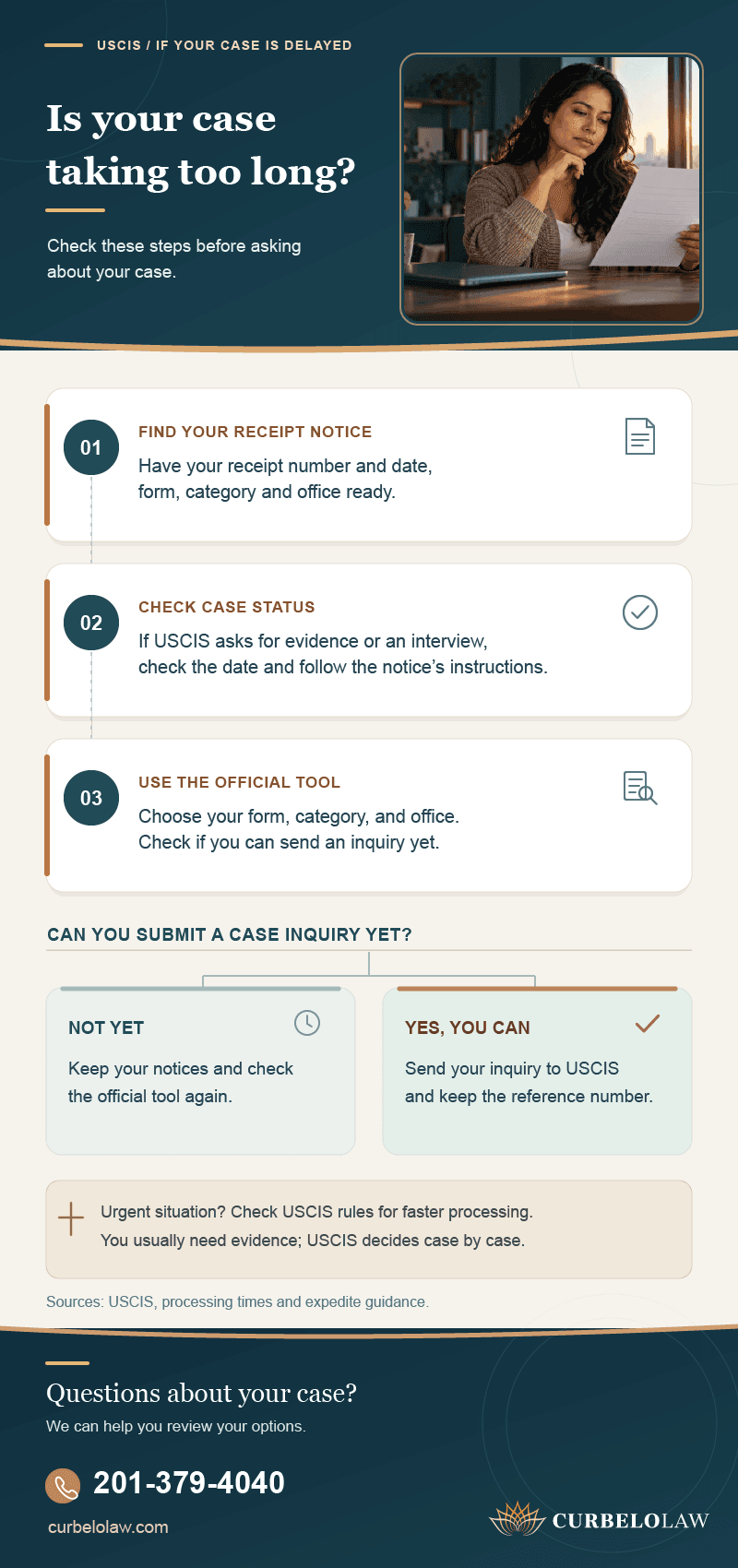
USCIS may consider expediting certain cases when circumstances include:
- Severe financial loss, when the urgent need is not the result of a delay caused by the applicant or petitioner.
- Urgent humanitarian reasons.
- Significant U.S. government interests.
- A clear USCIS error that caused the delay.
In general, an expedite request should be supported by evidence, and approval is not guaranteed. Review the official expedite request criteria. A delay by itself does not guarantee that expedited processing will be granted.
Frequently asked questions about USCIS delays
Form I-134: reviewed as part of another process
Form I-134 generally does not have a separate processing time. USCIS reviews it as part of the application or process for which it is submitted. That is why the table states that it has “no separate timeframe.” Form I-134A applies to certain support programs, which may be paused or closed, while Form I-864 is used in a different process.
How often do USCIS processing times change?
USCIS updates its processing times periodically, so it is a good idea to review the official tool while your case is pending rather than relying on an estimate you checked several months earlier.
Does waiting for a decision maintain my lawful immigration status?
It depends on the type of case. Having a pending application or petition does not always mean that you have valid immigration status. For example, a pending I-130 petition does not grant immigration status by itself. A receipt notice also does not always provide work or travel authorization.
What happens if I receive a negative decision?
Review the notice. It will indicate whether an appeal, motion, or other option is available and identify the applicable deadlines. A case inquiry about a delay is no longer the appropriate tool once a decision has been issued. Not every decision is subject to the same type of review.
AAO appeals: a different timeframe from the initial case
The Administrative Appeals Office (AAO) states that it strives to complete appellate review within 180 days after receiving the complete case record. Some cases may take longer. Review the AAO’s processing times. This timeframe does not apply to the initial petition or application.
Help with a delayed case in New Jersey
If your case is taking longer than expected, Curbelo Law can review the form, receipt date, category, processing office, and any pending notices. We can also determine whether you are already eligible to submit an inquiry to USCIS or whether there are other options worth evaluating, such as requesting expedited processing or considering possible legal action.
If you would like us to review your notices, contact our New Jersey immigration lawyers.
Let us know about your case We can help you