


Looking for an EB-1 visa lawyer in New Jersey? From its Ridgewood office, Curbelo Law evaluates whether your professional, academic, or business background could qualify you for permanent residence under the first employment-based preference category.
Attorney Carolina T. Curbelo has worked on hundreds of EB-1 cases. She advises applicants and employers on the EB-1A, EB-1B, and EB-1C categories, both in the United States and abroad.
Our goal is to determine which evidence carries real legal weight, identify potential weaknesses in the case, and prepare the I-140 petition before deciding on the next step.
Let us know about your case We can help youOn this page
How Can an EB-1 Visa Lawyer in New Jersey Help?
We start by identifying the most viable category and the evidence that could establish eligibility. We then prepare Form I-140 and coordinate the potential steps toward a Green Card. Not every accomplished professional meets the same legal standard.
- EB-1A: We assess awards, the impact of contributions, and independent evidence. Meeting three criteria does not guarantee a favorable final merits determination.
- EB-1B: We review academic achievements, experience letters, and the job offer from an eligible employer.
- EB-1C: We examine corporate ownership, ongoing business operations, and actual managerial or executive duties, rather than relying solely on organizational chart titles.
- Filing strategy: We review timing, the risk of a Request for Evidence (RFE), visa availability, and the scope of legal representation.
At Curbelo Law, we do not treat a recommendation letter, a publication, and an organizational chart as interchangeable evidence. Each document must address a specific requirement and be consistent with the other records in the petition.
EB-1 Visa Requirements
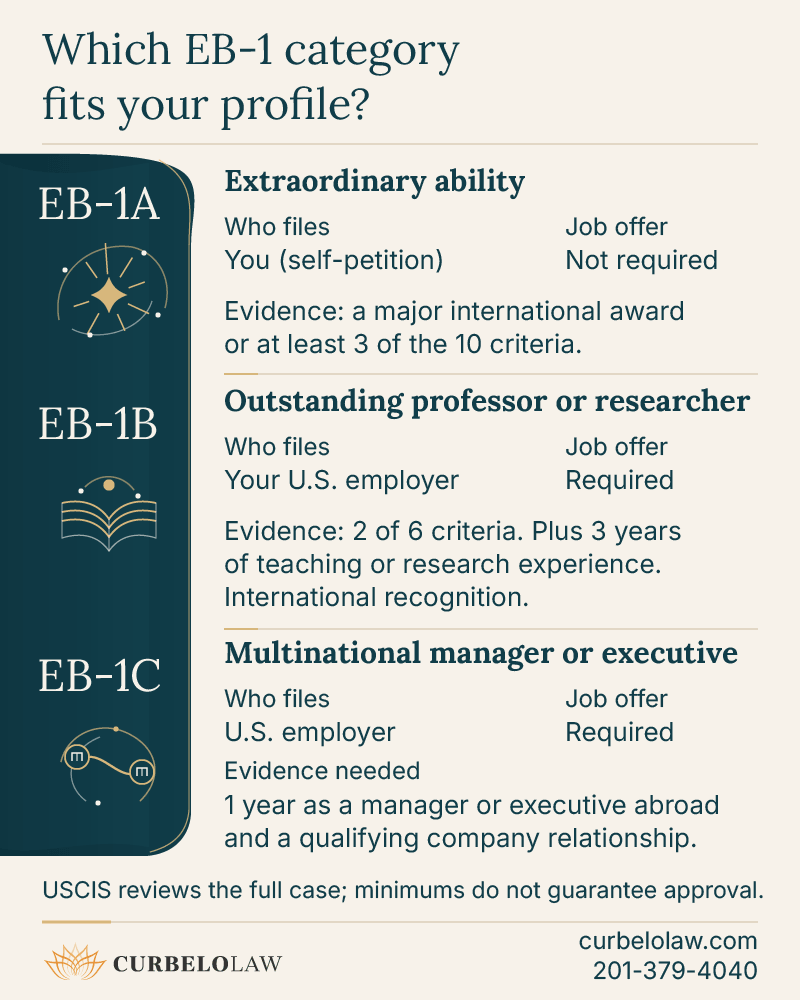
The EB-1 category includes three immigrant classifications: extraordinary ability (EB-1A), outstanding professors and researchers (EB-1B), and multinational managers or executives (EB-1C). None requires PERM labor certification. Only EB-1A allows you to self-petition without an employer.
- EB-1A: Sustained acclaim and plans to continue working in the same field, with no mandatory job offer.
- EB-1B: International recognition, qualifying experience, and an eligible job offer from an institution or employer.
- EB-1C: Qualifying executive or managerial experience abroad and an eligible corporate relationship with the U.S. entity.
Proving Extraordinary Ability
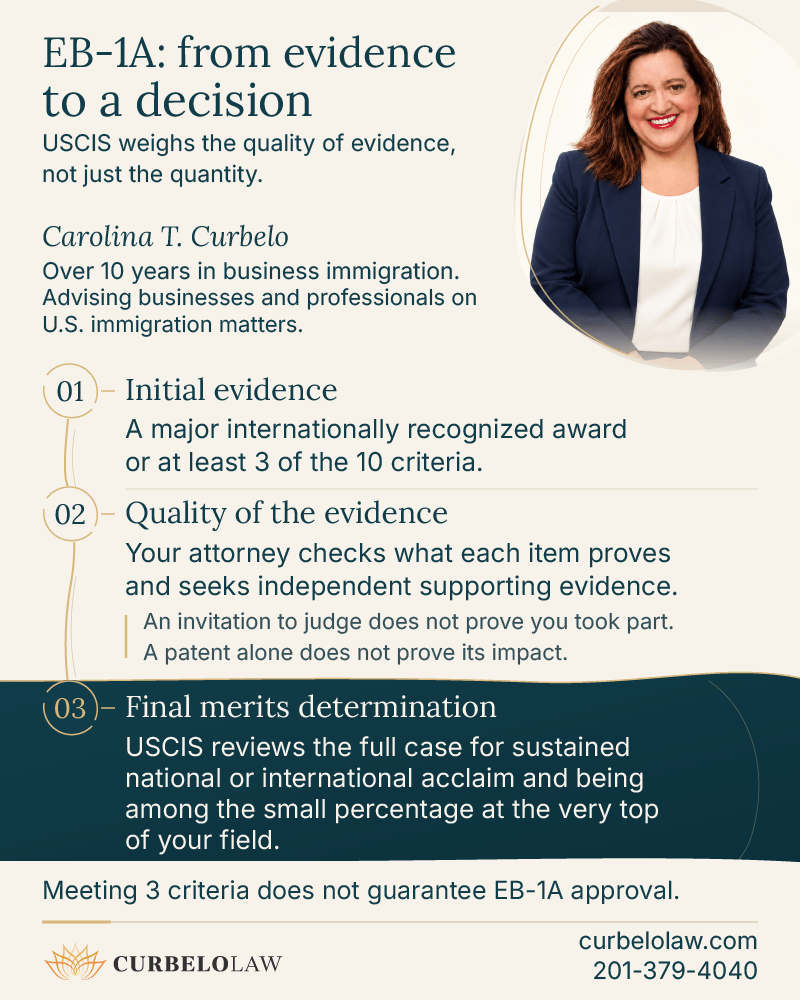
For EB-1A, USCIS requires either a major internationally recognized award or evidence satisfying at least three of the ten regulatory criteria. USCIS then evaluates the record as a whole to determine whether the applicant has sustained national or international acclaim and is among the small percentage at the very top of the field.
- Nationally or internationally recognized prizes or awards for excellence.
- Membership in associations that require outstanding achievements judged by experts.
- Published material about the applicant and their work in professional or major media.
- Actual participation as a judge or reviewer of the work of others.
- Original contributions of major significance to the field.
- Authorship of scholarly articles in relevant publications.
- Display of work at artistic exhibitions or showcases.
- A leading or critical role for organizations with distinguished reputations.
- A significantly high salary or other remuneration compared with others in the field.
- Commercial success in the performing arts.
The regulations allow comparable evidence when a particular criterion does not readily apply to the occupation. Applicants must also document their intention to continue working in their area of expertise in the United States.
What Carolina would distinguish: Publishing an article is not the same as being the subject of published material. Being invited to review others’ work does not prove that the review took place. For original contributions, we look for verifiable results and outside recognition, not just praise.
Hypothetical example: A researcher submits five letters stating that she is a leader in her field, but none identifies any external results. Before filing, we would ask the authors to explain what problem she solved, who applied her contribution, and what independent record confirms it. If that evidence is missing, it may be better to strengthen the case first.
Proving Eligibility as an Outstanding Professor or Researcher
EB-1B requires at least three years of qualifying teaching or research experience, international recognition, and an eligible U.S. job offer. The employer must file the petition.
In this category, you must meet at least two of the following six eligibility criteria:
- Major prizes or awards for outstanding achievement in the academic field.
- Membership in associations that require outstanding achievements.
- Material published by others about the applicant’s research.
- Professional participation in judging the work of others in the same or an allied academic field.
- Original scientific or scholarly research contributions.
- Authorship of scholarly books or articles in appropriate publications.

The offer must be for a tenured or tenure-track teaching position, or a permanent research position, as applicable. Certain private employers must employ at least three full-time researchers and have documented accomplishments. This condition does not apply to every university.
We review employment letters with detailed dates and duties, the actual nature of the position, and the identity of the petitioner. An HR letter confirming only a job title may not establish three years of qualifying research experience, especially when some of that experience was gained during graduate studies.
Qualifying as a Multinational Manager or Executive
EB-1C is intended for certain executives and managers of related multinational companies. It requires at least one year of qualifying employment abroad within the applicable statutory period, a U.S. company that has been doing business for at least one year, and an eligible managerial or executive position.

In an EB-1C case, we distinguish managing an essential function from personally performing day-to-day operational tasks. We compare corporate agreements, ownership percentages, payroll records, organizational charts, and the individuals responsible for hiring, budget, and strategic decisions.
Hypothetical example: A company founder holds the title of CEO but also serves customers and performs most of the technical work. Before recommending EB-1C, we would examine how responsibilities are allocated and whether the primary duties are genuinely managerial or executive.
If you already hold an L-1A visa for managers and executives, you may be able to reuse previously submitted documentation, but L-1A approval does not guarantee EB-1C approval. The companies and job duties must be evaluated again under the immigrant classification standard.
How to Get an EB-1 Visa
To obtain EB-1 classification, you or your employer must file Form I-140 with the appropriate supporting evidence. Then, if an immigrant visa is available and you meet the other requirements, you may pursue permanent residence through adjustment of status or consular processing.
- First, choose the subcategory: EB-1A allows self-petitioning; EB-1B and EB-1C require a U.S. petitioner.
- Next, document your claims: Recognition, research, experience, corporate relationships, and job duties, as applicable.
- Finally, evaluate the path to permanent residence: Priority date, immigration status, location, and family circumstances.
For EB-1B and EB-1C, we also examine the employer’s ability to pay the offered wage from the priority date until permanent residence is granted. An EB-1 visa lawyer should evaluate this requirement against tax returns, annual reports, or audited financial statements. The job offer alone is not enough.
How to File an EB-1 Petition
The petitioner must complete and sign Form I-140, pay the correct filing fees, and provide the required initial evidence for the category. A complete filing does not eliminate the possibility of a Request for Evidence.
- Complete and sign Form I-140.
- Submit eligibility documents and, when applicable, evidence of the employer’s ability to pay.
- Check the current filing fees and form editions before submission.
What Happens After Filing?
USCIS may approve, deny, or issue a Request for Evidence (RFE). The I-140 decision is separate from the subsequent permanent residence process. Biometrics appointments and interviews are not automatic steps in every I-140 petition.
An RFE questioning original contributions is not necessarily resolved by submitting more resumes. We first identify USCIS’s specific concern and look for relevant evidence of actual impact rather than resubmitting documents the agency has already considered.
Once USCIS approves the petition, you may apply for lawful permanent residence if an immigrant visa is available under the Department of State’s Visa Bulletin.
Before filing Form I-485 or beginning immigrant visa processing, we review the Visa Bulletin, the country of chargeability, and the chart USCIS authorizes for adjustment of status. Visa availability must be checked for the relevant month.

Approval of Form I-140 does not grant a Green Card by itself. The final stage requires visa availability and eligibility for adjustment of status or consular processing.
The appropriate route depends on your location: adjustment of status in the United States, if you qualify, or consular processing from abroad. In certain cases, Form I-485 can be filed concurrently with Form I-140 if permitted and a visa is available.
Can My Family Accompany Me on an EB-1 Visa?
Yes. Your spouse and unmarried children under 21 may qualify as derivative beneficiaries if they meet the applicable requirements. It is important to review each child’s age and the effects of potential waiting periods before planning family applications.
How Long Does It Take to Get an EB-1 Visa?
The timeline depends on the EB-1 category, the processing method for Form I-140, and visa availability. A quick decision on the petition does not necessarily mean you will receive a Green Card quickly.
USCIS offers premium processing through Form I-907: 15 business days for EB-1A and EB-1B, and 45 business days for EB-1C. USCIS must take action within the applicable period, but that action may include an RFE or a denial.
Check USCIS processing times for regular petition processing. Premium processing does not advance Visa Bulletin cutoff dates or replace adjustment of status or consular processing timelines.
How Much Does It Cost to Apply for an EB-1 Visa?
The base Form I-140 filing fee is $715, and an Asylum Program Fee generally applies depending on the type of petitioner. Optional premium processing has cost $2,965 since March 2026. Permanent residence processing and attorney fees are calculated separately.
The cost of applying for an EB-1 visa depends on several factors, including:
- Form I-140 petition: $715 plus an Asylum Program Fee of $600 for standard petitioners, $300 for qualifying small employers or self-petitioners, or $0 for certain nonprofit employers.
- Optional premium processing: $2,965, with no guarantee of approval.
- Permanent residence: Form I-485 or consular fees and related expenses, depending on the process, age, and family circumstances.
- Legal representation: Attorney fees based on the category, documentation, and services retained.
Before paying, check the official USCIS fee schedule. We do not rely on 2022 fee totals because they combine outdated filing fees with costs that do not apply to every applicant.
When Should You Consider O-1, EB-2 NIW, or EB-3 Instead?
Another category may be more appropriate if your EB-1A evidence does not yet establish sustained acclaim, your employer does not qualify under EB-1B or EB-1C, or your immediate goal is to work temporarily before seeking permanent residence.
An O-1 visa lawyer can assess temporary work options based on extraordinary ability. For permanent residence, an EB-2 visa lawyer can also evaluate the national interest waiver (NIW), which has different evidence requirements and legal standards.
When you have a job offer that does not fit an EB-1 classification, an EB-3 visa attorney may assess another path, generally involving PERM labor certification. We do not recommend a category solely because it has a higher preference ranking.
Frequently Asked Questions About Hiring EB-1 Legal Representation
EB-1A allows self-petitioning, but a preliminary evaluation can clarify which category fits, how strong the evidence is, and what comes next. These are important questions to resolve before filing or retaining counsel.
Do I Need to Hire a Lawyer for an EB-1 Petition?
No. EB-1A allows self-petitioning, and the law does not require you to hire an attorney. An EB-1 visa lawyer can help assess evidence and potential risks, particularly when an RFE is possible or you are comparing multiple classifications.
Can I Apply for EB-1A Without a Major International Award?
Yes. The alternative is to satisfy at least three regulatory criteria and pass the final merits determination. Having three types of documents is not enough unless the evidence establishes the required level of acclaim.
What Should I Ask an EB-1 Lawyer Before Hiring Them?
Ask which category the lawyer recommends, what your two weakest pieces of evidence are, who will file Form I-140, what the quoted fee includes, and how an RFE would be handled. A useful assessment should also explain when it may be better to wait and gather additional evidence.
Curbelo Law: EB-1 Immigration Counsel in Ridgewood, New Jersey
Carolina T. Curbelo handles federal immigration matters from Ridgewood, New Jersey. Her more than a decade of experience and work on hundreds of EB-1 cases inform practical guidance for professionals, researchers, and employers. The firm offers bilingual services and may represent clients in other states and abroad.
If you are looking for an EB-1 visa lawyer, our first priority is to explain which classification your documents can support, what obstacles we can identify, and what needs to be prepared before filing. Learn more about Attorney Carolina T. Curbelo and request an evaluation of your circumstances.
Let us know about your case We can help you