


An O-1 visa lawyer helps professionals with extraordinary ability assess their eligibility, gather evidence of recognition, and prepare a petition for temporary employment in the United States. This assessment covers the O-1A or O-1B classification, the petitioning employer or agent, the proposed work, and potential weaknesses in the case.
At Curbelo Law, attorney Carolina T. Curbelo provides employment-based immigration guidance from New Jersey, including representation in O-1 visa matters. Whether you are a researcher, entrepreneur, artist, athlete, or accomplished professional, we can help identify which achievements should be documented, what evidence is still missing, and whether this classification aligns with your plans in the United States.
Let us know about your case We can help youOn this page
How an O-1 Visa Lawyer in New Jersey Can Help You
Legal representation involves more than completing forms. A strong petition must explain why the beneficiary’s accomplishments carry weight in their field and how those achievements relate to the work they will perform in the United States.
- Assess your qualifications: identify which USCIS criteria may be supported by awards, publications, professional experience, contributions, positions held, or compensation, without assuming that a document automatically satisfies a criterion.
- Develop an evidence strategy: organize independent evidence, expert letters, and comparative data to establish the significance of individual achievements and the professional record as a whole.
- Review sponsorship arrangements: determine who may file Form I-129, what contract or agreement is in place, and how the proposed duties and, when applicable, itinerary will be documented.
- Prepare for potential issues: identify inconsistencies before filing, evaluate premium processing, and prepare a response if USCIS issues a Request for Evidence (RFE).
A useful assessment should lead to a practical decision: file with the available evidence, strengthen certain criteria first, correct the petitioner relationship, or consider another visa category. You do not need a Nobel Prize to qualify, but simply collecting certificates or recommendation letters is not enough.
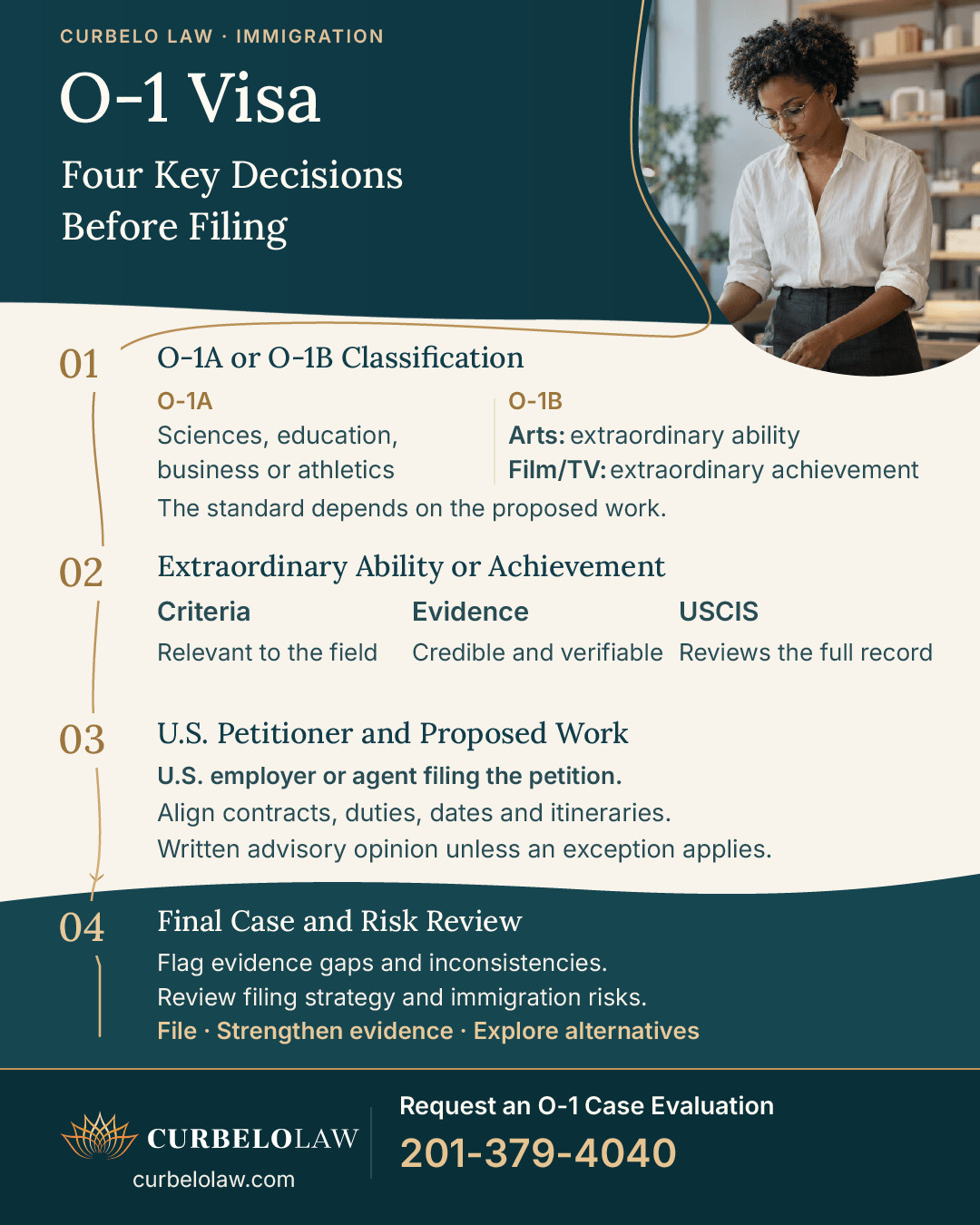
What Is the O-1 Visa and Who Qualifies?
The O visa is a nonimmigrant visa for foreign nationals with extraordinary ability in the sciences, arts, education, business, or athletics. It is also available to individuals with a record of extraordinary achievement in the motion picture or television industry. Applicants must demonstrate national or international recognition for their accomplishments.
What Are the Different Types of O Visas?
- O-1A: for individuals with extraordinary ability in the sciences, education, athletics, or business. This classification requires sustained recognition and evidence that the beneficiary is among the small percentage who have risen to the very top of their field.
- O-1B: for individuals with extraordinary ability in the arts or extraordinary achievement in the motion picture or television industry. The standards and evidentiary criteria differ from those for O-1A.
- O-2: for certain individuals providing essential support to an O-1 beneficiary in qualifying artistic, athletic, or production activities.
- O-3: for qualifying spouses and unmarried children under 21 of O-1 or O-2 visa holders.
The appropriate classification depends on the actual professional activity, not just the applicant’s job title. For example, an academic researcher with published studies is evaluated differently from an artistic director involved in prestigious productions. The P visa for certain artists and athletes is also worth considering when the planned activities are a better fit for its requirements.
O-1A and O-1B Visa Requirements: Eligibility Criteria
To qualify for an O-1 visa, the foreign national must demonstrate extraordinary ability or achievement and intend to enter the United States temporarily to work in their area of expertise. USCIS evaluates the evidence under the applicable classification and considers the petition as a whole, in accordance with the USCIS Policy Manual, Volume 2, Part M.
O-1A Visa Eligibility Criteria
The beneficiary may qualify based on a major internationally recognized award, such as a Nobel Prize. Without such an award, the beneficiary generally must provide evidence satisfying at least three of the following eight regulatory criteria, or comparable evidence where permitted:
- Evidence of high compensation compared with other professionals in the field, supported by contracts or other reliable documentation.
- Membership in associations in the field that require outstanding achievements, as judged by recognized experts.
- Receipt of nationally or internationally recognized prizes or awards for excellence in the field.
- Original contributions of major significance in the beneficiary’s scientific, scholarly, or business field.
- Published material about the beneficiary and their work in professional publications, major trade publications, or other major media.
- Authorship of scholarly articles in professional journals or other major media in the field.
- Employment in a critical or essential capacity for organizations with a distinguished reputation.
- Participation as a judge, individually or on a panel, of the work of others in the same or an allied field.

O-1B Visa Eligibility Criteria
In the arts or in motion pictures and television, the beneficiary may qualify through a significant award or nomination, depending on the applicable standard. Without that recognition, they generally must satisfy at least three of the six relevant criteria:
- Evidence of high compensation for services, supported by contracts or other reliable documentation.
- Significant recognition from organizations, critics, government agencies, or other experts, supported by specific evidence of the beneficiary’s achievements.
- Past or prospective participation as a lead or starring performer in productions or events with a distinguished reputation.
- Commercial success or critical acclaim demonstrated through reviews, box office receipts, audience figures, or other published evidence.
- Past or prospective performance in a lead, starring, or critical role for organizations with a distinguished reputation.
- National or international recognition demonstrated through reviews or significant published material about the beneficiary’s achievements.
The criteria for the arts and those for motion pictures or television must be assessed separately. A music career, an artistic project, and a television production may call for different evidence.
How to Prove Extraordinary Ability With Compelling Evidence
Submitting documents under three criteria does not guarantee approval. USCIS examines whether each piece of evidence satisfies the claimed criterion and whether the record as a whole establishes the required level of recognition. An O-1 visa lawyer should distinguish between possessing a document and proving what matters under immigration law.
- Awards: verify who grants them, how recipients are selected, and how widely they are recognized. An internal company award, by itself, does not establish national recognition.
- Published material: confirm the publication’s relevance and whether the coverage actually discusses the professional and their work. A passing mention or promotional article may carry little weight.
- Original contributions: support patents, innovations, or research with evidence of their real-world significance, such as third-party use, citations, documented impact, or industry adoption.
- Critical roles and compensation: document both the organization’s reputation and the importance of the beneficiary’s responsibilities. Compensation claims should include appropriate comparisons within the profession.
- Expert letters: explain how the writer knows the beneficiary’s accomplishments and which specific facts the letter supports. Praise without independent documentation rarely resolves an evidentiary weakness on its own.
What if Your Career Is Distinguished but the Evidence Is Still Weak?
Filing immediately is not always the best first step. For a business professional, for example, it may be important to compare a supposedly innovative contribution against evidence that it has been adopted outside the person’s own company. If the only support is an internal description, strengthening the record before filing may be advisable. This is a hypothetical example, not a Curbelo Law case.
For someone in the arts, it may instead be more useful to document the reputation of productions, the importance of the roles performed, and critical reception. The same evidence does not carry equal weight in O-1A, the arts, and motion pictures or television.
We also review the connection between the beneficiary’s achievements and the proposed U.S. employment. A distinguished career does not automatically authorize any type of job. The petition must establish specific work within the field of extraordinary ability.

Who Can Sponsor an O-1 Visa: An Employer or an Agent?
An O-1 visa requires a petitioner: a U.S. employer, a U.S. agent acting under the applicable rules, or a foreign employer acting through a U.S. agent. The beneficiary cannot file an O-1 self-petition, although certain business structures may allow an entrepreneur to work through a petitioning U.S. entity.
The O-1 is a sponsored visa classification. The petitioner files Form I-129 with USCIS, along with the required supporting documents. The petition cannot be filed more than one year before the services are needed. USCIS recommends filing at least 45 days before the intended start date to help avoid delays.
Contracts, Itineraries, and Advisory Opinions
The petition must connect the proposed employment to the beneficiary’s documented extraordinary ability. Before filing, three elements deserve particular attention:
- Contract or agreement: a written contract or a summary of the terms of an oral agreement between the petitioner and the beneficiary.
- Work and itinerary: a description of the services, dates, and events or projects, together with an itinerary when one exists or is required.
- Advisory opinion: a written consultation from an appropriate organization or expert in the field, unless a regulatory exception applies.
For professionals working with multiple clients, the analysis changes. It is necessary to examine the U.S. agent’s role, which employers the agent represents, and how each engagement is documented. If the contract describes a permanent position but the itinerary shows independent projects, that inconsistency should be resolved before filing, rather than after receiving an RFE.
Curbelo Law can guide petitioners in determining which documents actually support the proposed employment and what additional information their particular arrangement requires. To prepare for a consultation, gather an updated résumé, your best-documented achievements, and any available offers, contracts, or itineraries. The goal is not to submit more paperwork, but to present a coherent professional and contractual record.
How to Apply for an O-1 Visa: Petition and Consular Processing
The O visa application process depends on whether the beneficiary is outside the United States or may qualify for a change of status within the country. Approval of Form I-129 does not automatically result in issuance of a consular visa or guarantee admission at the border.
- Initial assessment: select O-1A or O-1B, identify the criteria supported by sufficient evidence, and confirm who will file the petition.
- Evidence preparation: gather professional achievements, letters, petitioner documentation, agreements, itineraries, and an advisory opinion when required.
- Filing: the employer or agent submits Form I-129 with the applicable fees. USCIS may approve, deny, or request additional evidence.
- Consular visa application: if a visa is required for entry, after petition approval the beneficiary completes Form DS-160, pays the consular fees, and follows the instructions of the appropriate U.S. consulate.
- Admission or change of status: when applicable, the beneficiary seeks admission with the necessary documents. Those already in the United States must assess whether they qualify to change status without departing.
For example, a student with a strong O-1 petition must still consider their current immigration status and the timing of work authorization. If you are in that situation, our guide to the F-1 student visa can help you identify additional issues to discuss.

How Much Does an O-1 Visa Cost, and How Long Does It Take in 2026?
An O-1 petition costs $1,655 in USCIS filing fees for a regular employer, excluding premium processing. Eligible small employers and nonprofit organizations may qualify for reduced fees, as shown below. O-1 visa lawyer fees are quoted separately.
Official O-1 Petition Filing Fees
| Petitioner type | I-129 + Asylum Program Fee | USCIS total |
|---|---|---|
| Regular employer | $1,055 + $600 | $1,655 |
| Eligible small employer | $530 + $300 | $830 |
| Eligible nonprofit organization | $530 + $0 | $530 |
An additional $2,965 may apply for premium processing requested through Form I-907. If the beneficiary must apply for an O visa at a consulate, the standard consular application fee is $205. Other case-specific charges may also apply. Translation costs and other expenses are calculated separately. Always check the current USCIS fee schedule before filing.
How Long Does O-1 Visa Processing Take?
Regular Form I-129 processing times vary at USCIS. With premium processing, the agency must take action within 15 business days. That action may be an approval, a denial, or an RFE. It does not mean the visa will be issued or that the beneficiary can travel within that period.
The overall timeline also depends on how long it takes to gather evidence and, if applicable, schedule a consular interview. Review USCIS processing times and plan around the actual employment start date, rather than the 15-day premium processing period alone.
O-1 Visa Validity, Extensions, and Family Members
How Long Can You Stay in the United States?
The initial O-1 period of stay is up to 3 years, based on the time needed to complete the authorized work or event. The length of an extension depends on whether the original activity is continuing or a new one is beginning.
- Continuation of the same event: extensions of up to 1 year at a time, with no fixed maximum number of extensions, provided each is justified.
- New event or activity: a new petition may be approved for up to 3 years, when appropriate.
Admission may include up to 10 days before and 10 days after the petition’s validity period, but employment is not authorized during those additional days. To determine your authorized stay, check your Form I-94 rather than relying solely on the visa expiration date in your passport.
If employment ends, current regulations provide for a discretionary grace period of up to 60 days, or until the end of the authorized validity period, whichever is shorter. This does not authorize employment without permission, and the period may be shortened. It is important to review new sponsorship or change-of-status options promptly.
Can I Change Employers or Work for Multiple Clients?
An O-1 worker may change employers while in the United States, but the new employer must file the appropriate documentation with USCIS.
If a material change occurs in the terms and conditions of employment or in the beneficiary’s eligibility, the petitioner must file an amended Form I-129 petition when required by regulation. When an agent is involved, the arrangements with the new employer must also be reviewed before the beneficiary begins that work.
Can My Spouse and Children Join Me on O-3 Visas?
The spouse and unmarried children under 21 of an O visa holder may be eligible for O-3 classification if they accompany the principal beneficiary or join them later. Their authorized stay generally follows that of the principal beneficiary, subject to the applicable restrictions.
O-3 visa holders cannot work in the United States under this classification, but they may study full-time or part-time. Eligible spouses and children may file Form I-539, Application to Extend/Change Nonimmigrant Status, with supporting evidence to request an extension of stay.
Is an O-1 Visa Better Than an H-1B, EB-1, or EB-2?
The answer depends on your qualifications and immigration goals. O-1 classification allows temporary employment in the field of extraordinary ability, but it does not grant a Green Card by itself. These alternatives have different requirements:
- H-1B: the H-1B visa for specialty occupations may be a better option depending on the position and employer, although many petitions are subject to an annual cap and selection process.
- EB-1: the EB-1 immigrant visa for extraordinary ability provides a potential path to permanent residence. Meeting three O-1A criteria does not automatically establish EB-1A eligibility.
- EB-2: EB-2 employment-based permanent residence has separate requirements and may involve labor certification or allow a waiver, depending on the case.
If your professional recognition is not yet well documented, it may be better to strengthen your evidence or consider other U.S. employment visa options. The best strategy depends on your circumstances, not just whether a classification avoids the lottery.
Why Consult Curbelo Law About Your O-1 Case in New Jersey?
Attorney Carolina T. Curbelo leads a bilingual law firm in Ridgewood, New Jersey. With more than 10 years of experience, she has successfully advised hundreds of businesses and professionals on employment-based immigration matters, including O-1 visas.
A meaningful legal assessment of your case should clarify three decisions before filing:
- What you can prove: which criteria are best supported and what independent evidence is still missing.
- Who can sponsor you: whether an employer or agent is appropriate, and which contracts and itineraries support the petition.
- When to file: whether the record is ready, which RFE risks deserve attention, and whether another immigration classification may be a better fit.
If you are looking for an O-1 visa lawyer in New Jersey, contact Curbelo Law to discuss your professional background, documentation, and next steps. Before retaining counsel, clarify the legal fees, whether representation includes a potential RFE response, and what additional expenses might arise. Call us to request a consultation today.
Let us know about your case We can help you

