


An EB-3 visa attorney helps employers and workers pursue permanent residence through employment sponsorship. The attorney evaluates the appropriate classification, labor certification when required, Form I-140, and the final path to obtaining a Green Card.
At Curbelo Law, Carolina T. Curbelo has specific experience with EB-3 cases. Based in New Jersey, we advise employers and workers throughout the United States and abroad on federal immigration matters. Our initial assessment determines whether there is a legitimate sponsoring employer, a permanent position, and documentation showing that the worker meets the job requirements.
Let us know about your case We can help youOn this page
What Does an EB-3 Visa Attorney Do for Workers and Employers?
An attorney coordinates the sponsor’s employment-related obligations with the beneficiary’s immigration petition, identifies inconsistencies, prepares supporting evidence, and guides key decisions. Legal representation is optional and does not guarantee approval.
- Before PERM: evaluate the position, actual job duties, work location, minimum requirements, and proposed compensation.
- During recruitment: review the timeline, advertisements, and recordkeeping with the employer so the employer can respond if the Department of Labor requests an audit.
- At the I-140 stage: verify that the worker’s education and experience match the job offer and assess the sponsor’s financial documentation.
- Through permanent residence: determine when adjustment of status or consular processing is feasible and how job changes or priority dates may affect the case.
For example, having two years of experience is not enough by itself. It is also necessary to establish when the worker gained that experience, what duties the worker performed, and how those qualifications can be documented against the specific requirements listed in the job offer and labor certification.
What Is the EB-3 Visa in the United States?
The EB-3 visa is an employment-based immigrant visa category for skilled workers, professionals, and other workers. In general, these petitions must be supported by an approved individual labor certification issued by the U.S. Department of Labor (DOL) using Form ETA-9089.
Certain professional nurses and physical therapists under Schedule A qualify for an exception to the standard individual PERM process, subject to specific documentation requirements. See the USCIS Policy Manual.

If you would like to learn more about employment sponsorship in the United States, read our guide to PERM labor certification.
EB-3 Visa Subcategories
The EB-3 visa has three subcategories:
- Skilled workers: Foreign workers whose jobs require at least two years of training or work experience and are not temporary or seasonal.
- Professionals: Workers whose jobs require at least a U.S. bachelor’s degree or its foreign equivalent. The position must be in a professional occupation.
- Other workers: Workers performing unskilled labor requiring less than two years of training or experience, where the work is not temporary or seasonal.
As a general rule, EB-3 requires a permanent, full-time job offer and sponsorship by a U.S. employer. It is not a self-petition category. The correct classification depends on both the position and the evidence of the worker’s qualifications.
EB-3 Visa Requirements
To qualify for this visa, you must show that you meet certain requirements. These depend on your employment subcategory. The job offer must also be genuine, and the employer must meet the applicable labor and financial requirements.

Skilled Worker
- You have at least two years of work experience, education, or training that meets the specific requirements stated in the labor certification.
- You have relevant postsecondary education, which may count as training.
- The availability of qualified U.S. workers is assessed through the applicable labor certification process.
Professional
- You have a U.S. bachelor’s degree or its foreign equivalent. A bachelor’s degree must also be the normal entry requirement for your profession.
- The position must meet the requirements of the applicable labor certification.
- Work experience and training cannot replace the university degree required for this subcategory.
- You must meet any other requirements specified in the labor certification.
Unskilled Worker (Other Worker)
- You are able to perform unskilled work requiring less than two years of experience or training, provided the job is not temporary or seasonal.
- The employer must meet the applicable labor certification requirements.
- You must meet any other requirements specified in the labor certification.
The practical challenge is not solved by choosing whichever category appears to have the fewest requirements. Carolina can compare employment letters, certificates, and degrees with the job duties and dates in the offer to determine whether the evidence is sufficient and identify inconsistencies that could trigger a request for additional documentation.
How to Get an EB-3 Visa: The Process for Employers and Workers
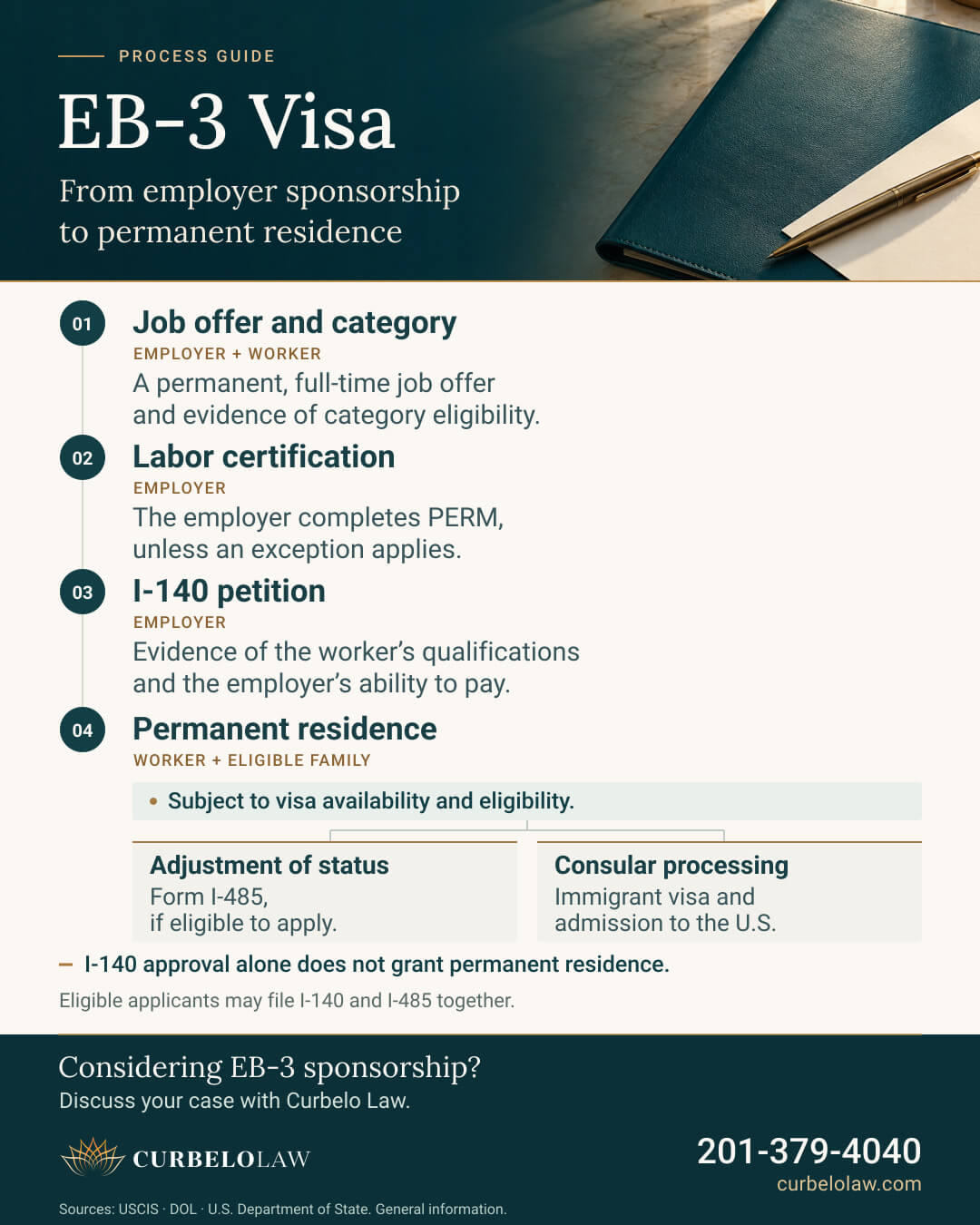
The process generally involves three legal stages: labor certification, the I-140 petition, and the final application for permanent residence. Before these stages, the employer must define the position and, when required, obtain a prevailing wage determination.
- Job offer and wages: the employer defines a permanent, full-time position, reviews its actual minimum requirements, and obtains the applicable prevailing wage determination.
- Recruitment and PERM: the employer completes the required steps to test the labor market, documents responses, and files ETA-9089 with the DOL. The application may be audited before approval.
- I-140 petition: the employer submits the valid labor certification, evidence of the worker’s qualifications, and financial documentation to USCIS. A standard PERM labor certification must be used within its 180-day validity period.
- Permanent residence: once a visa is available and the beneficiary meets the requirements, the process continues through adjustment of status in the United States or an immigrant visa application at the appropriate consulate.
As part of the process, the employer must be able to demonstrate a continuing ability to pay the offered wage from the priority date onward. To establish this, the employer may use an annual report, federal tax return, or audited financial statement.
What We Review When Responding to a PERM Audit or RFE
The labor certification record must be consistent across the job advertisement, duties, requirements, wage, location, and candidate documentation. A material change to the position may require reassessing the strategy before using an approved certification.
- DOL audit: we examine advertisements, dates, applicants, and legitimate job-related reasons for rejection. The employer retains responsibility for hiring decisions and must keep the PERM application and supporting records for five years from the filing date.
- USCIS RFE: we identify what has not been adequately established, such as qualifying experience or ability to pay, and organize a response within the stated deadline. Careful preparation does not eliminate the possibility of receiving a request for evidence.
Our guide to Requests for Evidence (RFEs) explains the consequences of submitting an incomplete or late response. If a petition is denied, the reasons and available options must be reviewed; resubmitting the same package does not resolve the problem.
EB-3 Documents to Prepare Before Filing
An EB-3 visa attorney does not prepare an identical application package for every client. The required documents depend on the subcategory, position, sponsor, and stage of the immigration process. The following groups of documents generally need review:
- Employer documents: accurate job duties, job offer, wage determination, recruitment records, and tax returns, annual reports, or audited financial statements establishing the ability to pay.
- Worker documents: passport, education and training records, degrees and credential evaluations when appropriate, employment letters with verifiable duties and dates, and professional licenses if the occupation requires them.
- Permanent residence documents: immigration history, civil records, and family information. Medical examinations, vaccinations, and, when applicable, biometrics and interviews must also be coordinated. Not all of these steps take place at the same time.
For employers hiring workers in the United States, post-hire employment verification obligations are separate from PERM. Form I-9 compliance warrants a separate review: a pending I-140 petition does not, by itself, authorize someone to begin working.
What Happens After Filing Form I-140?
USCIS may issue a receipt notice, approve or deny the petition, or request additional documentation. Approval of Form I-140 does not automatically grant a Green Card or, by itself, authorize the beneficiary to remain or work in the United States.
If the worker is in the United States and is eligible, they may apply for adjustment of status using Form I-485 when their category and priority date permit filing. Physical presence in the United States alone does not establish eligibility for adjustment.
Applicants living abroad generally proceed through consular processing, involving the National Visa Center, Form DS-260, and an interview. You can also seek help from a DS-260 immigrant visa attorney.
Can I Work While My Case Is Pending?
Only if you have valid work authorization. Workers and qualifying family members with a pending Form I-485 may apply for employment authorization in the United States, but filing for adjustment does not grant it automatically. Before traveling, each person must separately review how departure could affect the adjustment application and what travel documentation may be required.
How Long Does an EB-3 Visa Take?
There is no single processing timeline. The overall timeframe includes the prevailing wage determination, recruitment, PERM review, the I-140 decision, and, when visa numbers are backlogged, the wait for an immigrant visa. Audits and the beneficiary’s country of chargeability can also affect the timeline.
Check the DOL PERM processing times and USCIS processing times. Published timelines are estimates and do not replace an assessment of an individual case.
Does Premium Processing Speed Up the Entire EB-3 Process?
No. Form I-907 can speed up USCIS action on an eligible I-140 petition, generally within 15 business days for these classifications. It does not expedite PERM, move up a priority date, or guarantee approval. USCIS may issue an RFE or take another qualifying action within the applicable timeframe.
Priority Dates and the Visa Bulletin
The priority date for a PERM-based EB-3 case is generally established when the DOL receives the labor certification application. Visa availability depends on the subcategory and country of chargeability. In particular, the Other Workers subcategory has a smaller numerical allocation, and its cutoff dates may differ from those for professionals and skilled workers.
Check the official Visa Bulletin and the chart USCIS designates for adjustment filings that month before filing. Dates can retrogress. Acceptance of Form I-485 does not guarantee that a visa will be available for immediate approval.
How Much Does an EB-3 Visa Application Cost?
An EB-3 visa attorney should distinguish the stages of the case and who is responsible for each expense. Government filing fees should not be confused with legal fees, recruitment advertising, examinations, or translations. As a reference, the general application fees are:
- I-140: a $715 paper filing fee, plus an Asylum Program Fee of $600, $300, or $0 depending on the petitioner’s type and size.
- I-485: a general paper filing fee of $1,440 for most adults. Different situations, filing methods, and fees may apply.
- I-907: $2,965 if eligible premium processing is requested.
- Employment-based immigrant visa: $345 per applicant in consular processing fees, excluding other applicable charges.
Employers cannot pass on PERM-related costs that regulations require them to pay, including recruitment expenses and the employer’s attorney fees for that stage. Before agreeing to any payment arrangement, the scope of each service and the prohibition under 20 CFR § 656.12 should be reviewed.

Fees can change. Before paying, verify current amounts and payment methods with USCIS and the U.S. Department of State.
Request an itemized estimate for PERM, Form I-140, and adjustment of status or consular processing. At Curbelo Law, we can explain what representation includes and what is billed separately, such as services for family members, audits or RFEs, medical exams, translations, and additional permits. This helps you understand the scope of representation before retaining our firm.
Can Family Members Accompany an EB-3 Visa Holder to the United States?
Spouses and unmarried children under 21 may qualify as derivative beneficiaries, subject to visa availability and admissibility requirements. If a child is approaching age 21, the Child Status Protection Act (CSPA) should be evaluated promptly because the calculation is not simply based on the child’s age on the interview date.
- E34 and E35: spouses and children of skilled workers or professionals, respectively.
- EW4 and EW5: spouses and children of other workers, respectively.
Once permanent residence is granted, the worker and eligible derivative family members can live, work, and study in the United States. EB-3 is not a temporary two-year visa. Maintaining permanent residence and eventually applying for citizenship require meeting the conditions of each process.
Can You Change Employers During an EB-3 Application?
It depends on the stage of the case. During PERM and much of the I-140 process, the petition is tied to a specific sponsoring employer and position. A new employer will therefore generally require a different sponsorship strategy.
In certain circumstances, portability under section 204(j) of the Immigration and Nationality Act allows a worker to accept a new job offer in the same or a similar occupational classification when Form I-485 has been pending for at least 180 days and other requirements are met. Before leaving a job, an EB-3 visa attorney reviews the I-140 status, new job offer, duties, and USCIS notices. Not every job change qualifies under this rule.
What Happens if the Sponsor Withdraws the Petition?
Withdrawal may trigger automatic revocation of an approved I-140. Exceptions may apply if the petition had been approved for at least 180 days or the associated I-485 had been pending for that long, unless other grounds for revocation exist. Retaining an approved petition does not, by itself, mean it can be transferred to any job.
We compare both dates with the USCIS notices and new job offer before determining whether portability is available or new sponsorship is needed. The offer and the intention to accept it must be genuine. A worker should not plan to abandon the position based on a promise of guaranteed permanent residence.
EB-3 vs. EB-2, EB-1, and Other Work Visas
The best option is not determined solely by a degree or the apparent speed of a visa category. Other factors include sponsorship requirements, the qualifications the occupation demands, visa availability, and the worker’s current immigration situation.
- EB-2 visa lawyer: this may be appropriate for positions and applicants involving advanced degrees or exceptional ability. Certain National Interest Waiver (NIW) petitions allow self-petitioning.
- EB-1 visa lawyer: this may be an option for certain individuals with extraordinary achievements, researchers, or multinational executives.
- H-1B visa lawyer: this category provides a different, temporary immigration classification. In some cases, maintaining appropriate nonimmigrant status matters while an employment-based permanent residence case moves forward.
If the need for workers is temporary or seasonal, it is worth comparing EB-3 with the H-2B visa for temporary employment, which serves a different purpose. The goal of an initial review is to identify a legally viable path rather than start incompatible immigration processes.
Frequently Asked Questions About EB-3 Sponsorship
Can I Apply for EB-3 Without a Sponsoring Employer?
No. The standard EB-3 process requires a genuine offer of permanent employment and a petitioning U.S. employer. If you are seeking a self-petition option, you will need to determine whether you qualify under another category, such as certain EB-1 classifications or an EB-2 NIW.
Can I Apply From Outside the United States?
Yes. An employer can complete the labor certification stages and file Form I-140 even if the worker lives in another country. When the applicant is eligible and an immigrant visa is available, the case generally proceeds through consular processing.
Can a Small Business Sponsor an EB-3 Worker?
Yes, if the company offers a qualifying job and meets its obligations, including demonstrating the ability to pay the offered wage. Small businesses are not automatically excluded, but they need appropriate financial documentation and a compliant recruitment process.
How Curbelo Law Helps With EB-3 Visas in New Jersey and Across the United States
Attorney Carolina T. Curbelo has specific experience with EB-3 employment sponsorship. Our approach distinguishes between the position’s requirements, the evidence needed to establish the worker’s qualifications, and the employer’s financial and documentation obligations. Before filing, we review job duties, recruitment, employment letters, and financial evidence to identify inconsistencies and determine what supporting documents are missing.
Based in New Jersey, we handle federal immigration matters for clients throughout the United States and abroad, in both English and Spanish. If your business wants to sponsor workers or you have a specific job offer, request an evaluation to clarify the steps, outstanding documents, and path to permanent residence.
Let us know about your case We can help you