

If you are looking for an EB-2 visa lawyer, it is essential to determine whether your background supports a petition based on an advanced degree or exceptional ability, and whether you need employer sponsorship or may qualify for a National Interest Waiver (NIW). Based in New Jersey, Curbelo Law advises professionals, entrepreneurs, and businesses across the United States.
The EB-2 category provides an employment-based path to permanent residence and is governed by federal immigration law. We can represent you before USCIS even if you or your company are located in another state. Approval of an I-140 petition does not, by itself, mean you have received a Green Card.
Let us know about your case We can help youOn this page
What an EB-2 Visa Lawyer Evaluates Before Filing a Petition
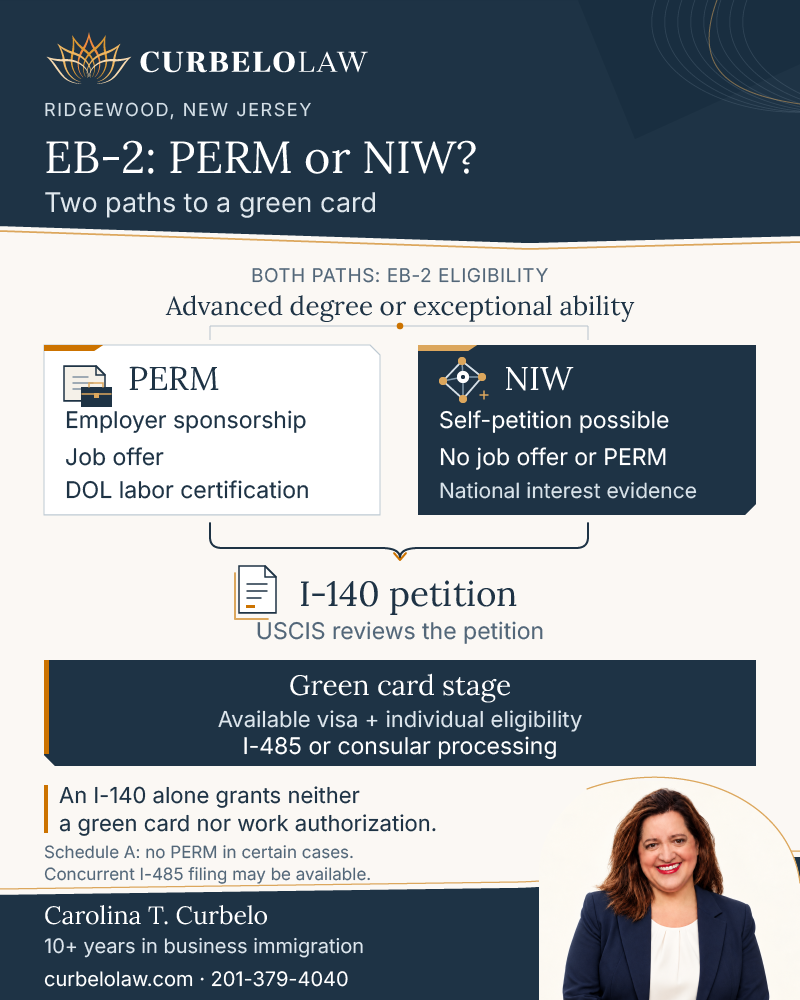
The evaluation begins with the basis for eligibility, the specific professional activity involved, and the appropriate filing route. There are two separate questions: whether the individual meets EB-2 requirements and whether to pursue an employer-sponsored petition with PERM labor certification or seek an NIW without a job offer.
- Reviews diplomas, foreign degree equivalencies, and employment letters to determine whether the applicant has an advanced degree or five years of progressive experience after earning a bachelor’s degree.
- Distinguishes professional achievements from evidence of a proposed endeavor’s actual or anticipated impact in the United States, a critical distinction for an NIW.
- Examines whether the offered position, employer, and employment records support a conventional petition or whether exploring a self-petition makes more sense.
- Checks the country of chargeability, priority date, immigration status, and eligibility for adjustment of status or consular immigrant visa processing.
What Is the EB-2 Visa and What Are Its Benefits?
The EB-2 visa is an employment-based immigration category that can lead to lawful permanent residence in the United States. It has two eligibility bases: an advanced degree or exceptional ability in the sciences, arts, or business. The NIW is not a separate third classification. It is a waiver of the job offer requirement and, consequently, PERM labor certification for applicants who already qualify under one of those two bases.
- You may obtain lawful permanent residence in the United States and later apply for citizenship if you meet the applicable requirements.
- Your spouse and unmarried children under 21 may qualify for derivative immigration benefits if they meet the applicable conditions.
- Under a National Interest Waiver, applicants can file Form I-140, Immigrant Petition for Alien Workers, with USCIS on their own behalf. This self-petition requires specific evidence addressing all three NIW criteria, in addition to EB-2 eligibility.
The EB-2 category is intended for permanent residence, unlike the temporary H-1B visa. If you first need a temporary employment option, consult our H-1B visa lawyer.
EB-2 Visa Requirements: Advanced Degree or Exceptional Ability
In most cases, the EB-2 visa requires a job offer for a specific position from a U.S. employer and PERM labor certification. An applicant who seeks and obtains a National Interest Waiver may be exempt from both requirements.
Professionals With Advanced Degrees
The advanced degree pathway includes a U.S. master’s degree, doctorate, or another degree above the bachelor’s level, or a foreign equivalent. A U.S. bachelor’s degree or foreign equivalent plus at least five years of progressive experience in the specialty after earning that degree may also qualify. Not all accumulated experience is sufficient. You must show growth in relevant responsibilities or expertise.
- Official academic transcripts, degrees, and, when applicable, a foreign credential evaluation.
- When eligibility depends on work experience, letters from current or former employers detailing duties, dates, hours worked, and professional progression.
- Evidence that the offered position actually requires an advanced degree, when using the employer-sponsored route. If the position requires a doctoral degree, you must hold a U.S. doctorate or an equivalent foreign degree.
When reviewing these letters, our EB-2 visa lawyer can compare their dates and contents against your résumé, degrees, and job requirements. A generic letter merely stating that someone “worked for five years” does not necessarily establish progressive experience. For an NIW based on an advanced degree, we also assess whether the proposed occupation qualifies as a profession under the legal definition. Holding a graduate degree does not automatically make every business activity a profession.

Individuals With Exceptional Ability
You must be able to demonstrate exceptional ability in the arts, business, or sciences. Exceptional ability means a level of expertise significantly above that ordinarily encountered in the field. Generally, applicants submit evidence meeting at least three of six regulatory criteria. USCIS also evaluates the evidence as a whole to determine whether exceptional ability has actually been established.
- Official academic records showing that you earned a degree, diploma, certificate, or similar award from a college, university, school, or other institution related to your area of exceptional ability.
- Letters from employers documenting at least 10 years of full-time experience in the occupation.
- A license to practice your profession or certification for your occupation or profession.
- Evidence that you have received a salary or other remuneration for your services that demonstrates your exceptional ability.
- Membership in one or more professional associations.
- Recognition for your achievements and contributions to your field by government entities, professional or business organizations, or peers.
In certain circumstances, comparable evidence may be submitted if a criterion does not readily apply to the occupation. Checking three boxes does not guarantee classification. The quality, relevance, and overall evaluation of the evidence matter.

The “exceptional ability” category is different from the “extraordinary ability” required for the EB-1 visa. If you have received high-level recognition, our EB-1 visa lawyer can evaluate whether that alternative is appropriate before you choose a petition.
EB-2 NIW Visa: How to Demonstrate National Interest
The National Interest Waiver (NIW) allows applicants to seek EB-2 classification without a job offer or PERM certification when they satisfy two levels of review. First, they must demonstrate EB-2 eligibility. Then they must establish the three prongs set out in Matter of Dhanasar. USCIS has clarified this analysis in its Policy Manual.
1. Substantial Merit and National Importance of the Proposed Endeavor
Working in an important industry, holding a prestigious degree, or claiming that jobs will be created is not enough. USCIS examines the proposed endeavor, its merit, and its potential effects beyond the immediate benefit to a particular client or employer. An initiative operating in a specific location may still have national importance if its broader potential impact is documented.
For an entrepreneur in New Jersey, our review would distinguish a business plan focused solely on attracting local customers from one supported by evidence of transferable innovation, substantial economic effects, or public-interest objectives. These claims must be substantiated, not merely described in aspirational terms.
2. Being Well Positioned to Advance the Proposed Endeavor
Applicants must show that they are well positioned to advance the proposed endeavor. Degrees and awards may help, but prior results, contracts, funding, institutional support, technical progress, customers, collaborators, and a reasonable implementation plan can also be relevant.
Recommendation letters can explain verifiable contributions, but they do not replace objective documentation. Before filing an NIW, it is important to identify which claim each letter supports and whether independent evidence is available to corroborate it.
3. Why Waiving the Job Offer and PERM Requirements Would Be Beneficial
The final question is why, on balance, waiving these requirements would benefit the United States. Relevant considerations may include the nature of the endeavor, the difficulty of fitting it into a traditional job position, the urgency of the contribution, or its benefits even when qualified U.S. workers are available.
A technically strong case under the first two prongs may still fall short under the third. That is why we analyze the justification for the waiver independently rather than treating it as an automatic conclusion based on the applicant’s résumé.
What Documents Strengthen an EB-2 NIW Petition?
The evidence depends on the field and the proposed endeavor. Research, engineering, healthcare, education, and business do not call for identical documentation. A well-organized petition connects each document to a legal requirement and explains its significance without overstating it.
- A precise description of the proposed endeavor, the problem it addresses, its intended beneficiaries, and anticipated outcomes.
- Relevant education, degrees, certifications, and professional experience supporting EB-2 eligibility.
- Publications, patents, contracts, technology adoption, or verifiable professional results, when available.
- Letters from experts or organizations explaining specific contributions and their significance.
- A business plan, resources, agreements, and interest from customers, partners, or investors, if the endeavor involves a business.
Hypothetical example: A researcher has a doctorate and publications in public health, but her proposed work in the United States describes only routine laboratory duties. Before pursuing an NIW, the analysis should identify a specific endeavor, its scope, and evidence of its anticipated impact. If that evidence is unavailable, an employer-sponsored pathway may warrant a separate evaluation.
How to Apply for EB-2: Employer Sponsorship With PERM or an NIW Self-Petition
Form I-140 is an immigrant petition, not a Green Card or automatic authorization to remain or work in the United States.
Employer-Sponsored EB-2 Petition
- The employer defines a permanent job offer and the position’s actual requirements and obtains a prevailing wage determination when required.
- The employer completes recruitment and applies for PERM labor certification using Form ETA-9089, when required.
- The employer files Form I-140 with the labor certification, evidence of eligibility, and documentation demonstrating the ability to pay the offered wage.
The employer must demonstrate a continuing ability to pay the offered wage from the priority date onward. To do so, the employer may use audited financial statements, tax returns, or an annual report.
For a New Jersey employer, consistency among the job advertisement, labor certification, worker’s qualifications, and offered wage can be as important as the candidate’s experience. Artificial job requirements should not be used to justify the classification.
For certain occupations, including professional nurses and physical therapists, Schedule A allows the employer to submit an uncertified labor certification application directly to USCIS. This exception still requires employer sponsorship and EB-2 eligibility.
EB-2 NIW Self-Petition
When an NIW is appropriate, the individual may file Form I-140 without a job offer or PERM certification. The applicant must demonstrate EB-2 eligibility and provide a separate, evidence-based argument addressing each of the three national interest prongs. USCIS decides based on the record and may request clarification or additional evidence.
The waiver does not eliminate all labor-related documentation. USCIS requires a completed Form ETA-9089, Appendix A, and a signed ETA-9089 Final Determination, without Department of Labor certification. These documents must be prepared in accordance with the current I-140 filing instructions.
What Happens After Form I-140 Is Approved?
Approval of Form I-140 does not confer permanent residence. That depends on visa availability, individual eligibility, and the applicable process. Eligible individuals in the United States may apply for adjustment of status using Form I-485. Those outside the United States may pursue consular processing at a U.S. embassy or consulate in their home country, subject to visa availability and consular requirements.
In either situation, it is essential to review the current Visa Bulletin, USCIS instructions on which chart may be used for adjustment filings, and any potential admissibility issues. Filing or obtaining approval of Form I-140 does not automatically resolve unlawful presence or other immigration obstacles.
How Much Does an EB-2 Petition Cost?
Costs vary depending on the EB-2 pathway, the permanent residence stage, included family members, and attorney’s fees. The following government fees are provided for reference and are subject to change:
- I-140: $715, plus the Asylum Program Fee applicable to the petitioner ($300 for self-petitioners and small employers; $600 for other employers; exemption for certain nonprofit organizations).
- Optional I-907: $2,965 for premium processing of eligible I-140 petitions, according to the USCIS fee schedule.
- I-485: $1,440 as the general filing fee for applicants age 14 or older, subject to exceptions and different fees in certain cases.
- Employment-based consular processing: $345 per immigrant visa application, excluding additional expenses such as medical examinations and documentation.
These figures should be checked against the USCIS G-1055 Fee Schedule and the Department of State’s visa fees immediately before payment. Costs associated with PERM preparation and recruitment are the employer’s responsibility under applicable labor restrictions. Responsibility for other expenses cannot be reduced to a single blanket rule.
How Long Does the EB-2 Visa Process Take, and How Does the Priority Date Affect It?
There is no single processing timeframe for EB-2 cases because the process involves several stages:
- PERM labor certification, if required.
- USCIS adjudication of Form I-140.
- Immigrant visa availability based on the priority date.
- Adjustment of status or a consular interview and processing.
Premium processing requested through Form I-907 may expedite USCIS action on the I-140 within the timeframe applicable to the category. For NIW petitions, this may be 45 business days. However, the action may be an RFE or another procedural response. Premium processing does not advance Visa Bulletin dates or guarantee approval or issuance of permanent residence.
The Visa Bulletin distinguishes between Dates for Filing and Final Action Dates. USCIS determines which chart may be used to file Form I-485, and neither chart independently guarantees permanent residence. To review USCIS adjudication timelines, see our guide to USCIS processing times. Do not confuse processing times with visa number availability.
What Happens if USCIS Issues an RFE or Questions National Interest?
A Request for Evidence (RFE) identifies issues that USCIS considers insufficiently supported and sets a deadline for responding. An RFE is not, by itself, a denial. Nor does it mean that submitting additional letters will necessarily be enough. The response must address the officer’s specific concerns.
Hypothetical example: If USCIS acknowledges the merit of an entrepreneur’s work but questions its national importance, responding with more diplomas alone does not address the problem. A more effective response would provide independent evidence, if available, of the endeavor’s scope and impact and explain how it meets the disputed criterion. If the issue is progressive experience, different employment records will be needed.
- Identify the exact requirement being questioned.
- Compare the RFE with the evidence already submitted.
- Provide relevant evidence and explain how it satisfies the applicable legal standard.
Our EB-2 visa lawyer can review the RFE alongside the existing case record, identify missing evidence, and assess whether to submit additional documents or clarify the legal arguments. The response must address the precise wording and deadline of the request, without promising a particular outcome.
Can Family Members Obtain Permanent Residence Through EB-2?
If the I-140 petition is approved, spouses and children under 21 may qualify to enter the United States in derivative immigrant classifications E22 for spouses and E23 for children. Children must remain unmarried, and protections under the Child Status Protection Act (CSPA) may require an individual assessment. I-140 approval does not replace visa availability or other immigration requirements.
Which Other Visa Categories Should You Compare With EB-2?
Choosing an immigration category is not simply a matter of picking the one that appears fastest. A professional with extraordinary achievements might consider EB-1, while someone with a job offer that does not require an advanced degree might explore EB-3. That is why consulting an EB-3 visa attorney may be useful before investing resources in PERM.
- Temporary employment: An individual with extraordinary recognition may benefit from consulting an O-1 visa lawyer. The O-1 visa’s temporary purpose and requirements differ from those of a permanent residence petition.
- Business investment: If you want to invest in and manage a business and are a national of an eligible treaty country, an E-2 investor visa lawyer can compare that temporary option with an NIW. Investment alone does not establish national interest.
Curbelo Law: EB-2 Immigration Counsel From New Jersey, Serving Clients Nationwide
Attorney Carolina T. Curbelo, founder of Curbelo Law, has practiced in New Jersey since 2010. After more than a decade focusing on business immigration and business visas, she has secured approvals in thousands of cases in these areas.
- Legal guidance for professionals, investors, and businesses.
- Membership in AILA and recognition by Super Lawyers.
- Services in English and Spanish from Ridgewood, New Jersey, for clients in any state with federal immigration matters.
- Remote coordination and secure exchange of documents and messages through our client portal.
During a consultation with an EB-2 visa lawyer at our firm, we begin by examining your degrees, employment letters, and proposed endeavor or job offer. If the evidence does not support the chosen pathway, we should assess another strategy before filing the petition.
Call us or schedule a consultation to speak with our attorney, whether you are in New Jersey or another state. In an individual consultation, we can evaluate your education, experience, professional endeavor, or job offer. Past results do not replace a case-specific evaluation or guarantee approval.
Let us know about your case We can help you