
The L-1A visa allows a company with international operations to transfer a qualifying executive or manager to the United States. It can also be used to establish a new U.S. office connected to the foreign company.
If you are looking for an L-1A visa lawyer in New Jersey, Curbelo Law can evaluate the corporate relationship, prior employment abroad, managerial or executive duties, and available evidence before filing.
The decision does not depend on the job title alone. USCIS reviews the relationship between the companies, prior employment abroad, the beneficiary’s actual duties, and the organizational structure that will relieve the beneficiary from day-to-day operational work.
Let us know about your case We can help youOn this page
L-1A visa requirements in the United States in 2026
L-1A visa requirements in the United States fall into two categories: requirements for employers and requirements for employees. We explain both below.
Requirements for employers
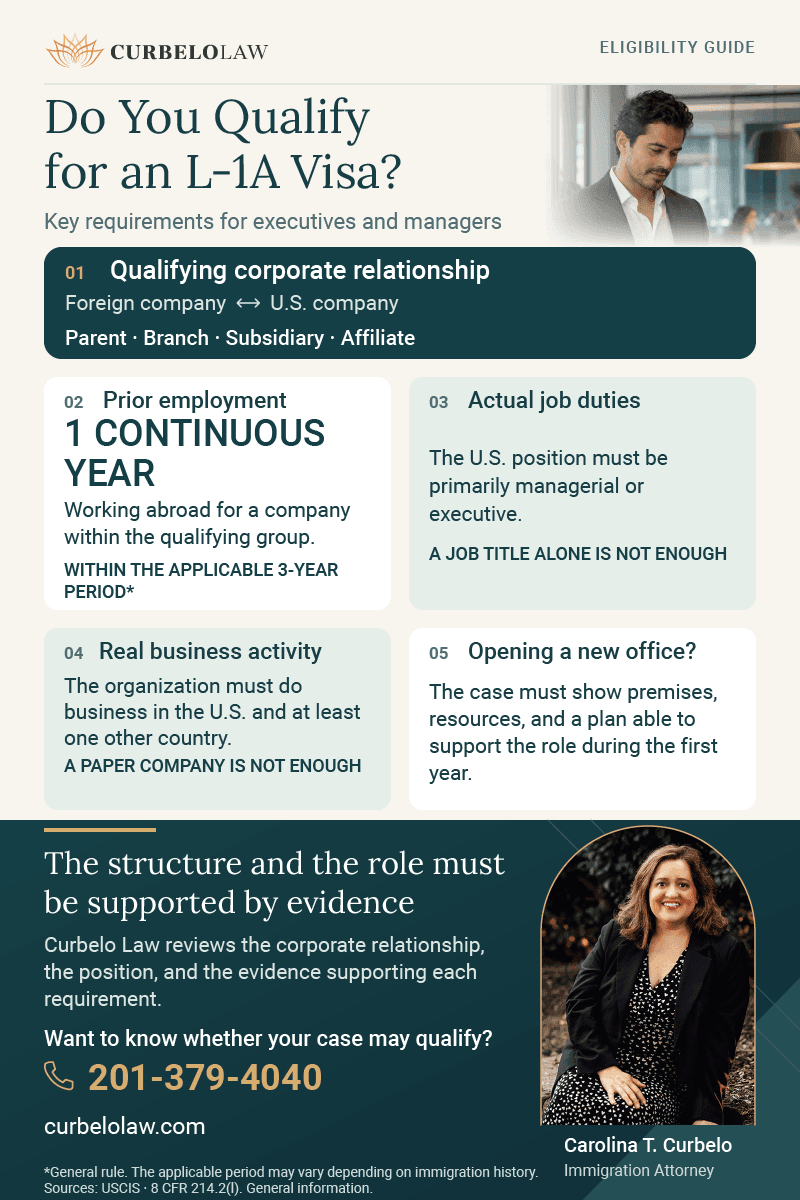
- The employer must have a qualifying relationship with a foreign company, such as a parent company, subsidiary, affiliate, or branch. These are collectively referred to as qualifying organizations.
- The employer must currently be doing business, or will be doing business, as an employer in the United States and in at least one other country. This may be directly or through a qualifying organization for the duration of the beneficiary’s stay in L-1A status in the United States.
- The business does not have to engage in international trade, but it must be a viable business.
USCIS also requires evidence that the qualifying relationship is based on ownership and control, not merely a commercial contract. The company must continue doing business in the United States and in at least one other country during the beneficiary’s L-1 stay.
In addition, if the U.S. employer is transferring the foreign employee to establish a new office, it must meet the following criteria:
- The new U.S. office must support an executive or managerial position within one year of approval of the petition.
- The employer must show that it has sufficient physical premises to establish the new office.
- The employee must have been employed as a manager or executive for one continuous year during the three years preceding the filing of the L-1A petition.
Requirements for employees
Employees must meet the following criteria to qualify for L-1A classification:
- Have worked full time for a qualifying organization abroad for one continuous year within the three years preceding admission to the United States.
- Enter the United States to provide services in an executive or managerial capacity for a branch of the same employer or one of its qualifying organizations.
What is an L-1A visa in the United States?
The L-1A visa is a U.S. nonimmigrant visa that allows U.S. employers to transfer an executive or manager from an affiliated foreign office to an office in the United States.
- The L-1A visa also allows a foreign company that does not yet have an affiliated U.S. office to send an executive or manager to the United States to establish a new office.
- The employer must file a petition with USCIS on behalf of the employee for the employee to obtain L-1A classification.
What managerial or executive capacity means for an L-1A visa
For an L-1A visa, the job title alone is not enough. USCIS examines the actual duties of the position and distinguishes between managerial capacity and executive capacity.
- Doing business: The regular, systematic, and continuous provision of goods and/or services by a qualifying organization.
- Managerial capacity: The employee’s ability to supervise and control the work of professional employees and manage the organization, department, subdivision, component, or function of the organization.
- It may also refer to the employee’s ability to manage an essential function of the organization at a high level and with broad discretion.
- Executive capacity: The employee’s ability to make decisions involving broad discretion with little supervision.
What we review to show that a position is truly managerial or executive
At Curbelo Law, we do not rely on labels such as “CEO,” “director,” or “general manager.” We compare the job description with organizational charts, payroll records, subordinate duties, third-party contracts, and the company’s actual operations to identify who performs operational tasks and whether the beneficiary manages people, an essential function, or the organization itself.
Hypothetical example: a software company names its founder “general manager” when the founder comes to the United States, but the company has only one assistant and the founder personally handles sales, customer service, and delivery of the service. In that situation, before filing, we would review which work could be delegated or outsourced, what positions will be hired, and whether the facts genuinely support a managerial or executive role.
L-1A visa for opening a new office in the United States
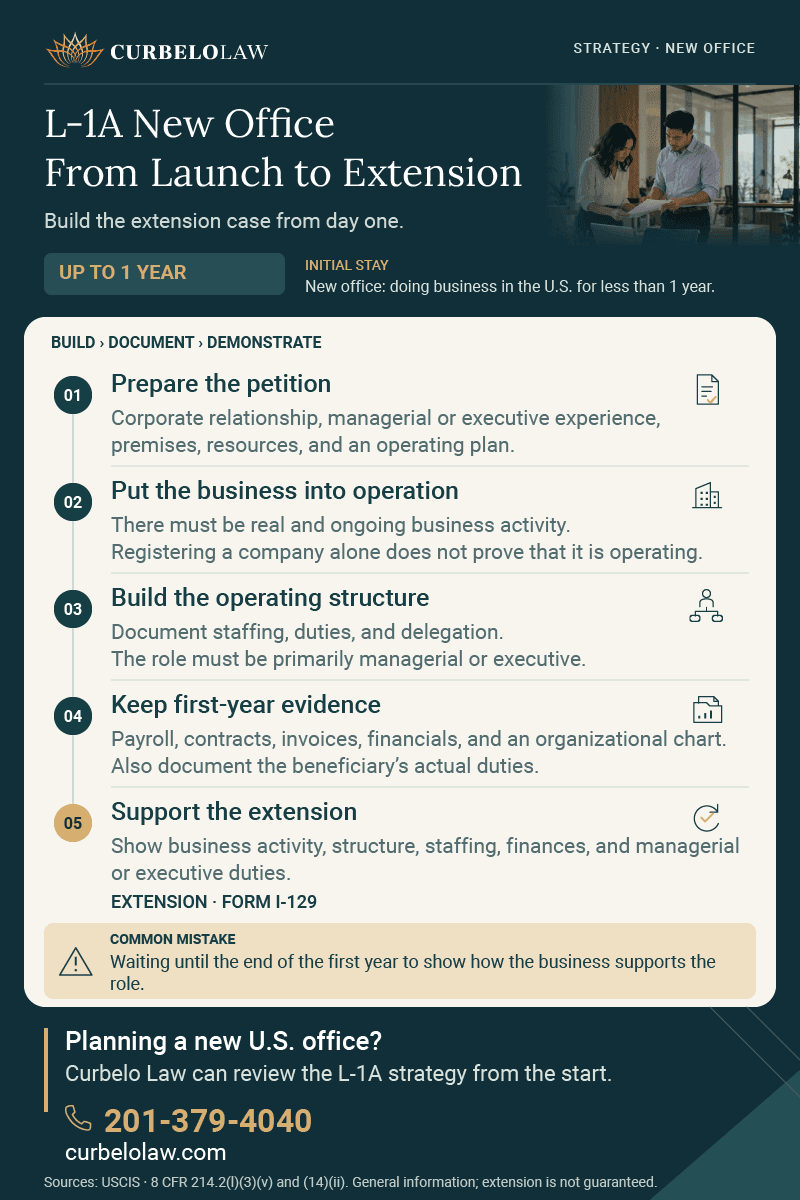
The L-1A category can be used to establish a new U.S. office connected to a foreign company. The petition must show sufficient physical premises and that, within the first year, the U.S. operation will be able to support a primarily managerial or executive position.
- Business and hiring plan: projections, funding, expected sales, and the staffing timeline should be connected to the duties that will no longer fall on the executive.
- First-year evidence: payroll, contracts, invoices, financial statements, and actual business activity will be important when requesting an extension.
- Owners: a separate legal entity, such as a corporation or LLC, may petition for an owner if the requirements are met. A sole proprietorship cannot file an L-1 petition for its own owner because there is no separate legal entity.
Our approach is to prepare a new-office case with the future extension in mind. If the business plan states that employees will be hired to relieve the manager of operational duties, the evidence from the first year should show how that structure actually developed.
An L-1A visa lawyer can review from the outset whether the hiring plan, operational structure, and anticipated documentation can support both the initial petition and a future extension.
How do you obtain an L-1A visa?
The L-1A visa application process generally involves the following steps:
- A U.S. employer must complete and file Form I-129, Petition for a Nonimmigrant Worker, with USCIS under the L classification and pay the applicable filing fees.
- USCIS reviews the petition and may approve it, deny it, or issue a Request for Evidence (RFE).
- If the beneficiary is outside the United States and the petition is approved, the beneficiary generally completes Form DS-160 and follows the applicable consular process. For more information about this step, see our guide to consular processing.
- If the beneficiary is in the United States, the strategy may involve a petition requesting a change or extension of status, depending on the facts and the person’s immigration circumstances.
Blanket L petition
Some organizations may qualify to file a blanket L petition. Approval covers qualifying entities but does not replace the individual evaluation of each beneficiary.
- Have a U.S. office that has been doing business for at least one year.
- Have three or more domestic and foreign branches, subsidiaries, or affiliates.
- Have obtained at least 10 L approvals for managers, executives, or specialized knowledge employees during the preceding 12 months.
- Have U.S. subsidiaries or affiliates with combined annual sales of at least $25 million.
- Have a U.S. workforce of at least 1,000 employees.
Approval of a blanket petition does not guarantee that an employee will receive an L-1A visa. The individual process and required documentation depend on the applicable method of processing.

Documents needed for an L-1A visa
An L-1A petition involves a range of supporting documents. The exact list depends on the corporate structure, the position, whether the case involves a new or existing office, and whether consular processing is required.
Beneficiary documents
- Most recent resume.
- Pay statements.
- Job description.
- Organizational charts showing the beneficiary’s position within the organization.
- Employment verification letter from the foreign company.
Documents from the foreign company
- Stock certificates.
- Audited accounts.
- Articles of incorporation and business licenses.
- Business transaction documents, such as contracts or letters of credit.
- Organizational chart, including the total number of employees and job positions.
- A detailed statement from an authorized representative explaining the ownership and control of the organization.
Documents from the U.S. company
- Commercial lease.
- Bank statement or proof of initial investment.
- Organizational chart showing the total number of employees and job positions.
- Business financial statements.
- Detailed description of the company’s business and business plan.
When reviewing the documentation, we want every piece of evidence to tell the same story. An organizational chart showing four subordinates under the beneficiary is less persuasive if payroll records do not show that those employees exist. Likewise, the ownership chain should be consistent with stock certificates, operating or shareholder agreements, and corporate records. This evidentiary consistency is often more important than simply accumulating documents without explaining which requirement each one proves.
An L-1A visa lawyer can help identify these inconsistencies before the case reaches USCIS and organize the evidence according to the requirement it is intended to establish.

How long does it take to obtain an L-1A visa?
There is no single processing time of 6 to 12 months that applies to every L-1A petition. Timing can vary based on factors such as:
- The service center handling the petition.
- A possible Request for Evidence (RFE).
- Appointment availability if the case proceeds through consular processing.
To understand how these timelines are checked and what they mean, our guide to USCIS processing times explains how to interpret the available information before estimating a date for your case.
To verify the current processing time for the relevant petition, it is also advisable to review the official USCIS processing times tool.
Premium processing may be requested by filing Form I-907. For L-1A petitions, the fee in effect since March 1, 2026 is $2,965. The service accelerates USCIS action on the case, but it does not guarantee approval.
How long can I stay in the United States with an L-1A visa?
The period of stay in the United States under L-1A classification varies depending on the purpose of the petition:
- Establishing a new office: L-1A classification provides an initial maximum stay of one year.
- Other qualifying employees: All other qualifying employees may receive an initial maximum stay of three years.
This classification allows requests for extensions of stay in increments of up to two additional years, until the employee reaches the maximum limit of seven years.
To extend the status of the principal L-1 beneficiary, the employer files Form I-129. Form I-539 is used by L-2 dependents requesting an extension or change of status. It is not used to request or extend the principal beneficiary’s L-1 status.
How much does an L-1A visa cost?
Fees depend on the size and type of employer, whether the fraud prevention fee applies, whether consular processing is required, and whether premium processing is requested. As of October 2026, the primary government fees are:
| Fee | Amount | When it applies |
|---|---|---|
| Form I-129, L classification | $1,385; $695 for a small employer or nonprofit | L-1 petition filed with USCIS |
| Asylum Program Fee | $600; $300 for a small employer; $0 for a nonprofit | Depending on the type of petitioner |
| Fraud Prevention and Detection Fee | $500 | Certain initial L petitions, changes of employer, and certain blanket petition cases |
| L visa at a U.S. consulate | $205 | Petition-based nonimmigrant visa application |
| I-907 premium processing | $2,965 | Optional |
| Additional L-1 fee for certain large employers | $4,500 | 50 or more U.S. employees and more than 50% in H-1B/L-1 status, subject to applicable exceptions |
Fees can change, and not every fee applies to every case. Before filing, the current amount and the charges applicable to the specific petitioner should be confirmed.
Can family members accompany an L-1A visa holder?
Employees transferred to offices in the United States may be accompanied or later joined by their spouse and unmarried children under 21 years of age. These family members may apply for L-2 classification.
Dependents of L-1 visa holders should keep the following in mind:
- L-2 classification provides the same period of stay as the principal L-1A beneficiary.
- Dependents may request an extension of stay or change of status using Form I-539. Applications may be filed together where permitted.
- Spouses in L-2S status are employment authorized incident to status. USCIS recognizes a Form I-94 bearing the L-2S notation as evidence of employment authorization for Form I-9 purposes. They do not need to obtain an EAD first in order to be authorized to work.
For employers that need to verify this authorization, our guide to Form I-9 compliance explains how to document employment authorization and avoid verification errors.
What is the difference between an L-1A visa and an L-1B visa?
The main difference between these classifications is that the L-1A visa is for managers and executives transferring from qualifying companies outside the United States, while the L-1B visa is for employees with specialized knowledge.
In addition, the L-1A classification allows a maximum cumulative stay of up to seven years, while the L-1B classification has a maximum limit of five years.
This article focuses on L-1A visa requirements and the overall process. If you would like to learn about the L-1B category, read our article about the L-1B visa process.
When should you compare the L-1A with another work visa?
The L-1A requires an international qualifying corporate relationship and qualifying prior employment abroad. If those facts are not present, it may make sense to compare other categories based on nationality, position, investment, and immigration objectives.
If you are still comparing categories, our guide to U.S. employment-based visa requirements summarizes the principal employment-based options before examining the differences among L-1A, H-1B, O-1, and E-2.
- The H-1B visa for certain specialty occupations.
- The O-1 visa for individuals with extraordinary ability.
- The E-2 visa for certain investors from treaty countries.

Can I get a Green Card through an L-1A visa?
If a foreign national holds L-1A status, the person may be able to obtain a Green Card through the EB-1C category for multinational executives or managers.
- The U.S. employer must have been doing business for at least one year and must file Form I-140.
- EB-1C does not require PERM labor certification. Whether Form I-485 can also be filed depends, among other factors, on visa availability and whether the person is eligible for adjustment of status.
- Holding L-1A status does not automatically make a case eligible for EB-1C. It is useful to review the corporate relationship, managerial or executive role, and continuity of the business early in the process. For more information about this pathway, see our guide to the EB-1 visa.
Mistakes that can weaken an L-1A petition
The most serious problems often arise when the legal description of the case does not match the reality of the business. USCIS may request additional evidence when a key assertion is not adequately supported by documentation.
- Organizational chart without supporting evidence: subordinates appear on the chart, but payroll records, job titles, or duties do not confirm the structure.
- Duties that are too operational: a significant portion of the job description involves selling, producing, serving customers, or directly performing the company’s services.
- Unclear ownership or control: certificates, agreements, or records do not consistently establish the relationship between the entities.
- New office without verifiable development: the business plan projects growth, but when the extension is filed there is insufficient hiring, business activity, funding, or evidence that the manager was relieved of ordinary operational duties.
When evaluating an L-1A petition, Curbelo Law can organize the evidence by requirement and identify inconsistencies before filing, including the corporate relationship, one year of employment abroad, the nature of the position, the U.S. organizational structure, and, for a new office, the viability of the first year. This focused review can help determine whether it makes sense to file now, strengthen the operation first, or consider another immigration category.
How can an L-1A visa lawyer in New Jersey help?
Curbelo Law advises companies, executives, and managers who need assistance with an L-1A petition, from the initial eligibility assessment through organization of the evidence and filing with USCIS.
- Evaluate eligibility and the qualifying corporate relationship between the entities.
- Document managerial or executive duties and the staffing structure.
- Prepare the I-129 petition and organize supporting evidence by requirement.
- Plan new-office cases and respond to Requests for Evidence (RFEs) when appropriate.
Attorney Carolina T. Curbelo, founder and principal attorney of the firm in Ridgewood, New Jersey, works in business and employment-based immigration. The strategy should be tailored to the facts of each company rather than based on a generic template.
If you would like to evaluate the transfer of an executive or manager, you can contact our L-1A visa lawyer team to review the business structure, the position, and the available evidence before deciding on the next step.
Let us know about your case We can help you