


An EB-5 visa lawyer evaluates whether your investment can meet U.S. immigration requirements for permanent residency. At Curbelo Law, we advise investors, business owners, and their families from our office in Ridgewood, New Jersey, serving clients throughout the United States and abroad.
Our attorney, Carolina T. Curbelo, works with small business owners, professionals, and investors on business immigration matters and assists clients with real estate transactions.
That experience helps us examine the relationship between a business project, job creation, and the immigration petition before capital is committed.
Let us know about your case We can help youOn this page
What Does an EB-5 Visa Lawyer Do for an Investor?
An EB-5 visa lawyer represents an investor’s immigration interests by reviewing the project’s structure, tracing the source of funds, preparing the petition for USCIS, and planning the process through removal of conditions on permanent residency. Choosing an investment project may also require independent financial advice.
- Eligibility review: Compares direct investment and regional center options, investment amounts, business types, job creation, and family immigration circumstances.
- Immigration due diligence: Reviews project documents, regional center designation, Form I-956F, investment terms, and job creation projections.
- Source and path of funds: Organizes evidence of wages, business income, property transactions, gifts, or loans, along with every transfer to the business.
- Petitions and ongoing support: Prepares Form I-526 or I-526E, evaluates adjustment of status or consular processing, and reviews evidence for Form I-829.
Before investing, two critical questions are whether the project can support the 10 required jobs and whether the source and path of the capital can be documented. A profitable investment does not necessarily meet immigration requirements, and an EB-5-eligible investment does not guarantee a financial return or permanent residency.
The EB-5 Immigrant Investor Program in the United States
Through the EB-5 program, foreign investors and their spouses and unmarried children under 21 may qualify for U.S. permanent residency.
Congress created the EB-5 immigrant investor program in 1990 to stimulate the U.S. economy by creating new jobs. The program also provides a pathway for foreign nationals to invest capital in the United States.
EB-5 is the fifth employment-based immigrant visa preference and is governed primarily by the EB-5 Reform and Integrity Act of 2022. Its purpose is to promote productive investment and job creation, not to sell Green Cards.

Who Can Benefit From EB-5 Permanent Residency?
In addition to the principal investor, the EB-5 program allows the following family members to apply for permanent residency:
- Spouse: May apply for permanent residency as a derivative family member.
- Unmarried children under 21: Subject to applicable immigration age and eligibility rules.
The permanent residency initially granted is conditional for two years. The investor must then petition to remove those conditions.
There is no requirement for an employer sponsor or citizenship in a treaty country. However, the investor must meet the requirements for a qualifying investment, lawful capital, job creation, and immigration admissibility. Visa limits may vary by country of birth.
General Requirements for an EB-5 Visa
An EB-5 investor must invest the required amount in a new commercial enterprise in the United States that will create full-time jobs for at least 10 qualifying employees.
- Qualifying capital: An investment in a for-profit new commercial enterprise, generally placed at risk without a contractual right to a guaranteed repayment.
- 10 jobs: Permanent, full-time positions for qualifying workers. Full-time employment generally means at least 35 hours per week.
- Lawful source of capital: Legitimate ownership, lawful origins, and documented transfers supported by verifiable records.
- Business involvement: The investor must meet the applicable requirements for participation in management or policymaking, even when investing through a regional center.
- Admissibility: USCIS and, when applicable, a U.S. consulate assess the other legal requirements for permanent residency.
How Are the Required Jobs Counted?
An EB-5 investment must support proof of at least 10 full-time jobs for qualifying workers. How those jobs are counted depends on the investment pathway:
- Direct investment: Counts direct jobs created by the business, supported by employment records.
- Regional center: May count direct and indirect jobs within the program’s legal limits, using a supportable economic analysis.
Announcing plans to hire employees or submitting a sales forecast is not enough. Documentation must establish job creation under the program’s requirements.
If you invest in an existing business, its history must be reviewed. Expansion, restructuring, and troubled businesses may be subject to special rules. Important: Simply purchasing a business does not, by itself, satisfy EB-5 requirements.

How Much Money Do You Need for an EB-5 Investor Visa?
For petitions filed under the rules enacted in March 2022, the minimum investment amounts are as follows. The required amount depends on the qualifying type and location of the investment, not on whether the investor lives in New Jersey.
| Type of EB-5 Investment | Required Minimum Investment (USD) |
|---|---|
| Qualifying rural area or high-unemployment targeted employment area (TEA) | $800,000 USD |
| Qualifying infrastructure project | $800,000 USD |
| Standard investment outside the reduced-investment categories | $1,050,000 USD |
Rural and high-unemployment areas have specific federal definitions. For high-unemployment areas, the criteria include an unemployment rate of at least 150% of the national average and geographic boundary rules. Important: A developer’s description of an area as “underserved” is not enough.
The amounts in the table represent minimum investment capital, not the total cost of the process. An inflation adjustment to the investment thresholds is scheduled for 2027. Before filing a petition, check the current official amounts with USCIS.
Reserved Visas and Availability by Country
The Reform and Integrity Act reserves 20% of EB-5 visas for rural projects, 10% for high-unemployment areas, and 2% for infrastructure projects. These reservations do not guarantee approval or mean that every category and country has the same wait time.
Visa availability changes from month to month and may differ by EB-5 category and country of birth. For example, unreserved categories may have backlogs for people born in mainland China or India.
Before filing for adjustment of status, review the current Visa Bulletin and confirm which filing date chart USCIS allows applicants to use that month.
Direct Investment vs. Regional Center: Which Is Better for EB-5?
Both pathways can support an EB-5 petition, but they differ in business control, job creation evidence, and documentation. The better immigration option depends on how the business actually operates and what can be substantiated. An EB-5 visa lawyer should evaluate these differences against the specific project, not just its marketing materials.
| Factor | Direct Investment | Regional Center |
|---|---|---|
| Investor petition | I-526 | I-526E |
| Jobs | Direct jobs created by the business | Direct and indirect jobs under program rules |
| Key documents | Business plan, payroll records, investment, and operations | Project documents, I-956F, and job creation analysis |
| Critical issue | Ability to hire and maintain qualifying positions | Regional center and project compliance, plus source of funds |
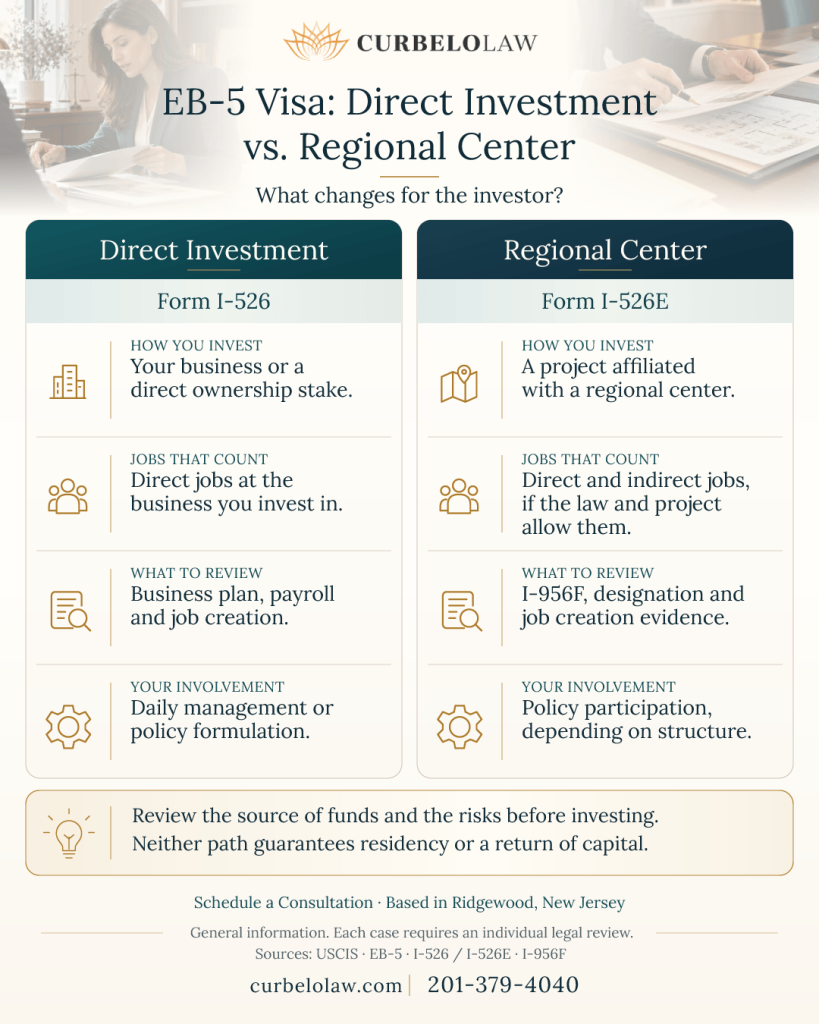
For the regional center pathway, regional center designation is requested through Form I-956, and each applicable offering or project requires a filing using Form I-956F before the investor’s petition. It is important to distinguish a receipt notice from project approval and approval of the individual investor’s petition.
EB-5 Due Diligence: What to Review Before Transferring Capital
The most expensive decision often comes before any form is filed. Curbelo Law can assess whether the documented structure supports a consistent EB-5 petition and identify issues that should be evaluated by an independent securities, financial, or tax advisor.
Project, Business, and Contractual Risks
- Verify the regional center’s current designation, the associated project, and the status of Form I-956F, when applicable.
- Request the private placement memorandum (PPM), subscription agreements, operating agreements, loan documents, and escrow agreements.
- Compare construction schedules, financing, permits, and job creation projections with immigration requirements.
- Review when and under what conditions capital may be returned, and what happens if there are delays, losses, or project substitutions.
- Identify promoter compensation, potential conflicts of interest, and who is responsible for each part of the filing.
USCIS may designate a regional center without endorsing the safety of its investments. The SEC warns about fraudulent offerings, promises of guaranteed permanent residency, and assured profits. Immigration legal review does not replace independent financial analysis. See the joint SEC-USCIS EB-5 investment fraud alert.
Lawful Source of Funds and Documentation Trail
For USCIS, showing that you have money in a bank account is not enough. You must demonstrate where the money came from and how it reached the EB-5 investment. We can organize this evidence in three steps:
- Establish the source: Wages, business profits, property sales, inheritances, gifts, or loans, depending on the circumstances.
- Gather supporting records: Tax returns, pay statements, contracts, deeds, financial statements, and relevant bank records.
- Trace the funds: Identify accounts, currency exchanges, and every transfer to the U.S. project or business.
Example: If you sell a family business, you should be able to connect your ownership and the sale to the proceeds, bank transactions, and EB-5 investment. If you receive a gift or loan, its source and terms must also be documented.
How to Get an EB-5 Visa: Steps and Forms
The process involves filing an immigrant petition, obtaining conditional permanent residency, and eventually removing the conditions. Concurrent filing for adjustment of status is available only when immigration eligibility and visa availability requirements are met.
- Assessment and documentation: Determine the investment pathway, admissibility, source of funds, qualifying family members, and project risks.
- USCIS petition: File Form I-526 for a standalone investment or Form I-526E for a regional center investment, with supporting evidence.
- Conditional permanent residency: If eligible, apply for adjustment of status (Form I-485) from within the United States or complete consular processing (Form DS-260) abroad.
- Job creation monitoring: Retain business activity and employment records while capital remains invested in accordance with program rules.
- Form I-829: Petition to remove conditions during the 90 days before the second anniversary of conditional permanent residency, submitting the required evidence.
A properly filed Form I-485 may allow an applicant to request employment authorization (Form I-765) and advance parole for travel (Form I-131). Those benefits are not automatically granted by filing Form I-526 or I-526E alone. Do not work or travel based solely on an EB-5 petition receipt.
What Happens After Your EB-5 Petition Is Approved?
Approval of Form I-526 or I-526E is an important milestone, but it does not automatically grant you a Green Card. The next steps depend on your location and visa availability:
- If you are outside the United States: When a visa is available, you will continue the process through the National Visa Center and a U.S. consulate, including Form DS-260. If needed, you can seek assistance from a DS-260 immigrant visa lawyer.
- If you are inside the United States: If you qualify for adjustment of status, USCIS will process Form I-485, filed when permitted under immigration law and visa availability rules. EB-5 petition approval does not replace that application.
- After obtaining conditional permanent residency: You must file Form I-829 during the 90 days before the second anniversary, with evidence showing that you meet the requirements to remove conditions.
The Form I-829 petition may include eligible derivative family members. Filing requirements and individual circumstances must be reviewed for each case.
How Much Does an EB-5 Visa Cost? Filing Fees and Expenses
The cost of an EB-5 case has two separate components: the capital you invest and the expenses associated with the immigration process. The investment amount does not include USCIS filing fees or other services.
Official filing fees change depending on when the application is submitted. The federal rule published on September 30, 2026 establishes the following amounts:
| Form or Fee | Through Nov. 29, 2026 | Starting Nov. 30, 2026 |
|---|---|---|
| I-526 (standalone investment) | $3,675 | $7,615 |
| Initial I-526E (regional center) | $3,675 | $7,850 |
| Integrity Fund fee (in addition to initial I-526E) | $1,000 | $1,100 |
| I-829 (removal of conditions) | $3,750 | $5,000 |
Important: The new fees apply to applications postmarked on or after November 30, 2026. The new I-526 and I-526E filing fees already include the $75 technology fee. Do not add it again.
You should also budget for additional expenses, which vary by case:
- Project costs: Potential administrative fees and other expenses specified in the investment agreements.
- Professional advice: Attorney fees and, when needed, financial or tax advisor fees.
- Immigration processing: Adjustment of status or consular processing, medical examinations, translations, and family members’ applications.
There is no universal total cost. Before paying, consult the official USCIS Form G-1055 fee schedule and confirm the amounts applicable to your form and filing date.

What Happens if the Project Is Delayed, Loses Jobs, or Receives an RFE?
A Request for Evidence (RFE), a material change to the project, or termination of a regional center does not have a single automatic solution. The appropriate next step depends on the petition’s status, when the investment was made, and the available evidence of job creation and capital.
Our review distinguishes financial setbacks from immigration consequences. We examine which documents can still be obtained, who holds the records, whether specific legal protections apply to affected investors, and which deadlines remain in effect. No change of project, reinvestment, or new petition should be promised without examining the facts.
Carolina Curbelo’s Experience in Business Immigration and Investments
Carolina T. Curbelo, founder and principal attorney of Curbelo Law in Ridgewood, New Jersey, has experience in business immigration and real estate matters. We advise small business owners, professionals, and investors, including on strategies involving the E-2 visa and employment- and investment-based paths to permanent residency.
For an EB-5 investor, that business perspective allows us to assess practical issues such as:
- If you want to expand a business: We examine how your business plan and corporate structure relate to the invested capital and your ability to document 10 qualifying jobs.
- If you are considering a New Jersey real estate project: We review commercial real estate matters in New Jersey, such as contracts, permits, and ownership, while distinguishing them from EB-5 immigration requirements.
- If you are investing from abroad: We assess how to document the source of funds, transfers, and the immigration circumstances of accompanying family members.
From our office in Ridgewood, New Jersey, we serve investors from other states and abroad in English and Spanish. EB-5 is a federal immigration classification: you do not need to invest in New Jersey to seek guidance from Curbelo Law.
Why Should You Consider Other Business Immigration Options?
Not everyone planning to invest in the United States needs an EB-5 visa. Before committing capital, consider how these options differ:
- If you want permanent residency through an investment: EB-5 may be an option if you meet its capital, job creation, and documentation requirements.
- If you want to operate a business: If you are a national of a treaty country, an E-2 investor visa may be appropriate. However, it is temporary and has different requirements.
- If you already manage a company outside the United States: The L-1A visa for executives and managers may be an alternative if the companies have the required qualifying relationship and other eligibility criteria are met.
- If you are a professional or entrepreneur: Consider the EB-2 visa with a National Interest Waiver (NIW) if you meet its specific criteria.
The goal is to choose an immigration pathway that fits your business venture and your family’s plans, without tying up capital in an option you may not need.
Frequently Asked Questions About the EB-5 Program
Does EB-5 Guarantee a Green Card or the Return of My Money?
No. USCIS decides immigration eligibility, and the investment must satisfy the at-risk capital requirement. Neither regional center approval nor an investment offering guarantees approval of the individual petition, repayment of funds, or approval of Form I-829.
Can I Live in Another State if My Project Is in New Jersey?
Generally, permanent residency does not require you to live in the state where your investment project is located. You must still maintain immigration eligibility and meet applicable legal obligations. Our firm can handle federal EB-5 immigration cases for investors throughout the United States and abroad.
Is an E-2 Visa the Same as an EB-5 Visa?
No. The E-2 treaty investor visa is a temporary classification subject to treaty nationality and other requirements. EB-5 is an immigrant classification that can lead to conditional permanent residency and, later, removal of those conditions.
How Long Does EB-5 Take, and What Happens to My Children?
Processing times depend on the form, project, country of birth, visa availability, and government review. Children’s ages and age-protection rules require individualized analysis. Review USCIS processing times and the Visa Bulletin before making decisions based on a particular timeline.
Discuss Your EB-5 Investment With Curbelo Law
If you are considering starting a business, investing through a regional center, or filing a petition from another country, we can first assess your immigration strategy, source of capital, and the documents most likely to affect eligibility. Our office is in Ridgewood, New Jersey, and we handle federal immigration matters without limiting representation to clients in the state.
If you are looking for an EB-5 visa lawyer, schedule a consultation with Curbelo Law to discuss your proposed investment, immigration circumstances, and family members you wish to include. An individual assessment can identify the documents and decisions that require attention before transferring funds.
Let us know about your case We can help you