The H-2A visa program allows U.S. agricultural employers to hire foreign workers on a temporary basis when there are not enough available U.S. workers to fill temporary or seasonal agricultural jobs.
The process does not begin with a worker applying for a visa independently. There must first be a genuine job offer and a U.S. employer or agent that completes the labor certification process and files the appropriate petition. At Curbelo Law, we help review the immigration strategy and supporting documentation to ensure each stage is consistent before moving forward.
Let us know about your case We can help youOn this page
What Is the H-2A Visa Program and How Does It Work?
The H-2A visa program is a nonimmigrant classification for temporary or seasonal agricultural employment. It allows U.S. employers to meet agricultural labor needs without adversely affecting the wages or working conditions of U.S. workers in similar jobs.
- The work must be agricultural: examples include planting, cultivating, harvesting, and work on ranches, in nurseries, greenhouses, orchards, or similar operations.
- The need must be temporary or seasonal: typically tied to a particular time of year, a growing cycle, or a need limited in duration.
- The employer leads the process: the employer must first meet Department of Labor (DOL) requirements and then file a petition with USCIS.
- The worker applies for a visa afterward: when required, the worker completes consular processing after the petition is approved, then travels to the United States and requests admission.
Curbelo Law’s practical approach: before preparing an H-2A petition, it is important to confirm three things, in order: that the work is genuinely agricultural, that the employer’s need is temporary or seasonal, and that the job dates align with the labor certification. Inconsistencies between the job offer, dates, and petition can create problems even when the worker has agricultural experience.
To compare this category with other employment options, read our guide to U.S. work visa requirements or our overview of the different types of U.S. visas.

What Are the H-2A Visa Program Requirements?
Requirements differ for the employer seeking H-2A workers and the foreign worker who will fill the position. Keeping these responsibilities separate helps avoid a common misconception: workers do not obtain the labor certification themselves or file the main petition with USCIS.
Main Requirements for Employers
- Be a U.S. employer, an agricultural association acting in an authorized capacity, or an agent that meets the applicable rules.
- Offer full-time agricultural employment that is temporary or seasonal in nature.
- Demonstrate that there are not enough able, willing, qualified, and available U.S. workers to perform the work.
- Demonstrate that hiring H-2A workers will not adversely affect the wages or working conditions of similarly employed U.S. workers.
- Obtain temporary labor certification from the DOL before filing the H-2A petition with USCIS, unless an applicable exception applies.
What Does a Foreign Worker Need?
The worker needs a legitimate H-2A job offer connected to an employer following the federal process. The worker must also gather the documents required for the visa application and demonstrate that they meet the requirements of the offered position.
- A valid passport that meets applicable consular requirements.
- Form DS-160 confirmation for consular processing.
- Information about the approved petition, including the receipt number or any documentation requested by the consulate.
- Any additional documents the U.S. embassy or consulate may require based on the circumstances.
Effective January 17, 2025, DHS eliminated the rule that generally limited H-2A petitions to nationals of countries on an annually designated list. Nationality is no longer a general eligibility requirement based on that list for USCIS approval of an H-2A petition.
How to Apply Through the H-2A Visa Program: Step by Step
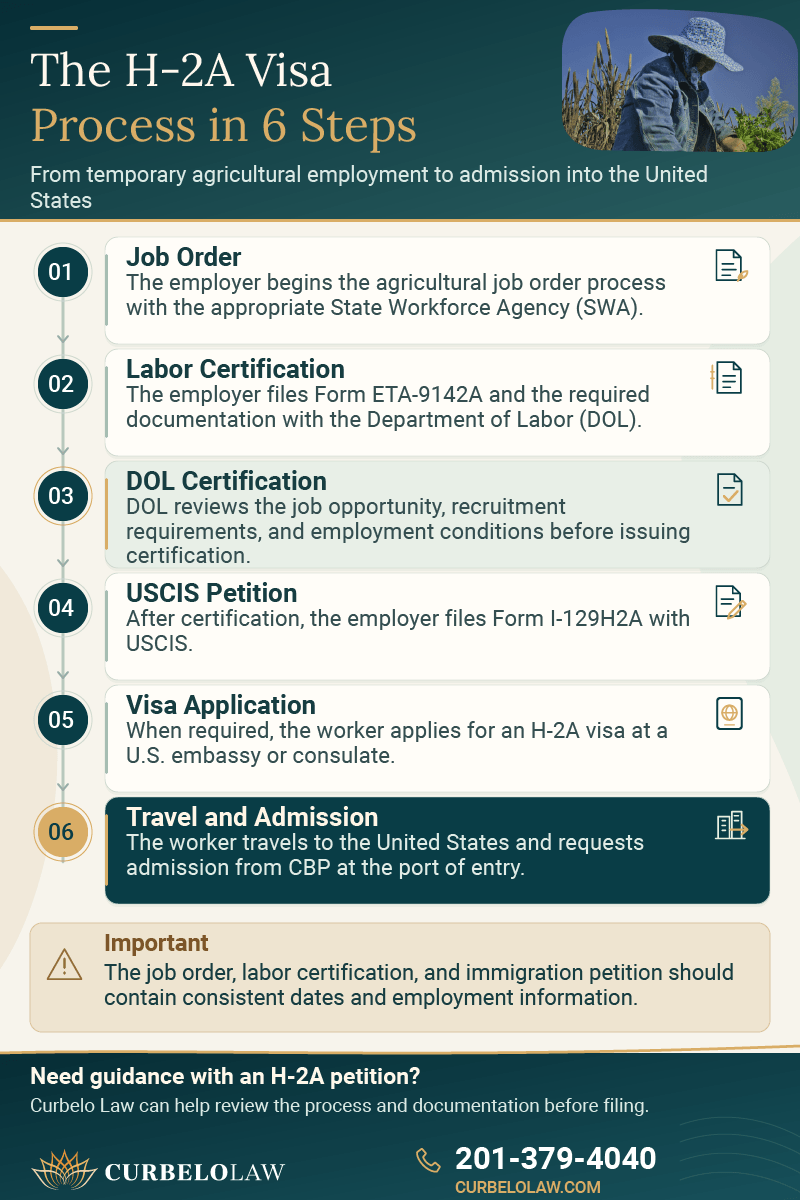
The standard process involves the state workforce agency, the DOL, USCIS, and, for workers who need a visa, the Department of State. The sequence matters because each stage depends on the one before it.
- Job order with the State Workforce Agency (SWA). The employer initiates the agricultural job order within the applicable filing timeline and begins coordinating with the state agency.
- Application for temporary labor certification. The employer files Form ETA-9142A and the required documentation through the DOL’s FLAG system. The process also involves review of the job order and recruitment of U.S. workers.
- DOL certification. If the employer meets the requirements, the DOL issues a determination that allows the employer to move forward with the immigration petition.
- H-2A petition with USCIS. The employer files Form I-129H2A with the labor certification and supporting evidence.
- Visa application and interview, when required. After the petition is approved, a worker outside the United States completes the H-2A visa application process with the Department of State.
- Travel and admission. Approval of a petition or issuance of a visa does not replace the entry inspection. The worker must request admission from CBP at the port of entry.
USDA explains that the standard H-2A hiring process is generally planned approximately 60 to 75 days before the employment start date. The application for labor certification must normally be submitted to the DOL at least 45 days before work begins. An emergency procedure with its own requirements is available for needs arising fewer than 45 days in advance.
What we review before filing: the job order dates, the date workers are actually needed, the worksite, job duties, offered wage, and employer documentation must all tell the same story. If one of these elements changes, it may be necessary to adjust the strategy before filing rather than attempting to correct the case after the agricultural hiring timeline is already underway.
How Long Does USCIS Take to Process an H-2A Petition?
Once USCIS has received the petition, you can also consult our guide to USCIS processing times. For H-2A petitions, USCIS also states that petitioners may contact the agency if Form I-129 has been pending for more than 15 days without a decision or a request for evidence.
H-2A Workers’ Rights and Benefits
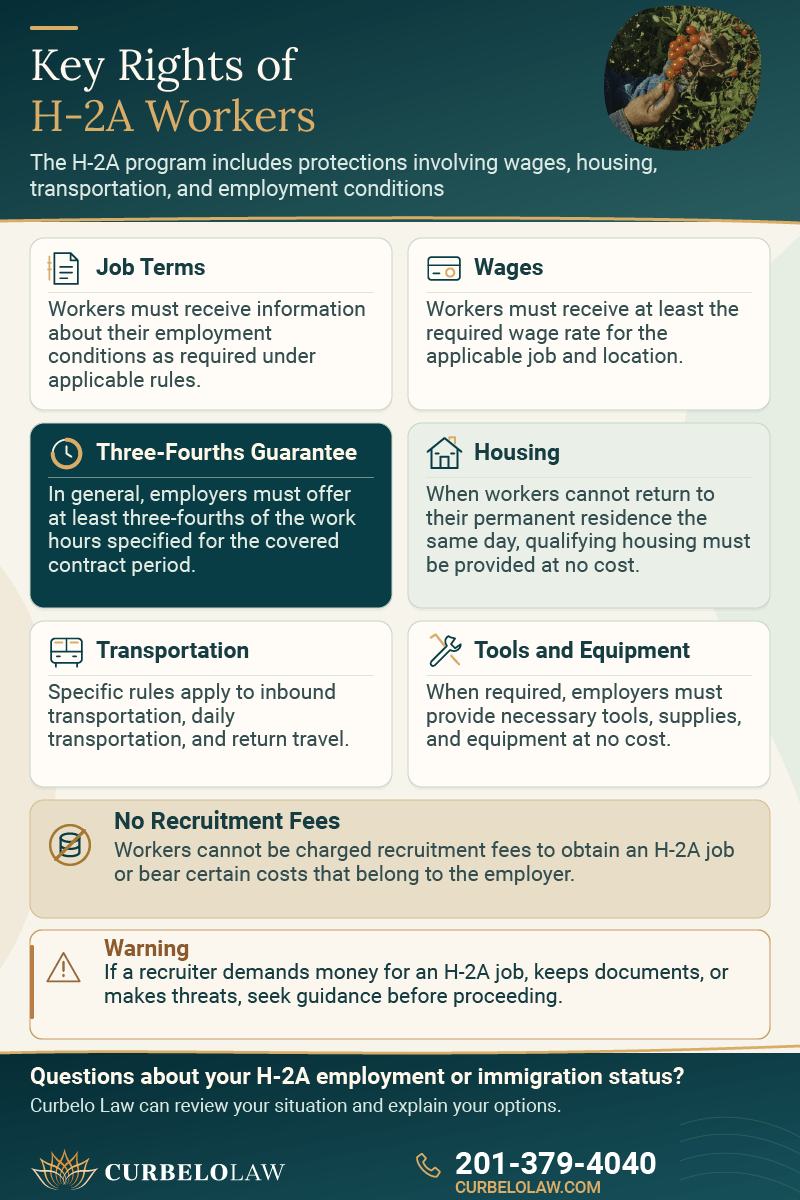
H-2A workers have specific employment protections. The program is not simply permission to work. It also regulates employment agreements, wages, housing, transportation, tools, and certain expenses.
- Employment contract or job order: workers must receive written information about the terms of employment in a language they understand, as required by applicable rules.
- Wages: workers must be paid at least the required rate for the job and location under DOL rules and the terms of the job order.
- Three-fourths guarantee: employers generally must offer employment for at least three-fourths of the hours specified for the period covered by the contract, subject to applicable rules.
- Housing: when workers cannot return to their permanent residence on the same day, employers must provide safe housing at no cost.
- Transportation: employers have obligations concerning inbound travel, daily transportation, and return transportation, with payment or reimbursement timing depending on the stage of the contract.
- Tools and equipment: employers must provide the tools, supplies, and equipment necessary for the job at no cost when required by applicable rules.
- Protection from improper fees: workers cannot be charged recruitment costs or the fees of the employer’s attorney or agent for obtaining H-2A certification.
Wages, Housing, and Transportation Under the H-2A Program
There is no single nationwide H-2A wage rate. Employers must pay the applicable rate based on DOL rules, the occupation, the geographic area, and the certified job order. The DOL publishes the current Adverse Effect Wage Rates (AEWRs) and updates its methodology when applicable.
Housing must be provided at no cost when workers cannot return to their permanent residence on the same day. There are also rules governing daily transportation, inbound and return travel, and meals or cooking facilities. The applicable wages and working conditions should be verified against the certified job order and the worker’s employment contract.
Recruitment Fees and Warning Signs of Exploitation
This is especially important for workers recruited outside the United States. The DOL warns that paying a recruiter to obtain an H-2A job can be a red flag. To find legitimate opportunities, the official SeasonalJobs.dol.gov portal lists temporary and seasonal jobs.
If a situation involves recruitment fees, withheld documents, threats, coercion, or exploitation, it may be necessary to examine protections beyond the H-2A program itself. Our website explains human trafficking and migrant smuggling and provides information about T visas for trafficking victims when the circumstances meet the requirements for that protection.
Length of Stay, Changing Employers, and Status Under the H-2A Visa Program
USCIS may approve H-2A classification for the period authorized for temporary employment. Extensions may be granted in increments of up to one year, but the maximum period of continuous stay in H-2A status is three years.
After reaching the three-year maximum, an uninterrupted absence of at least 60 days allows a worker to begin a new total period of up to three years in H-2A status. A shorter departure does not automatically reset that period.
Can an H-2A Worker Change Employers?
Yes, under certain circumstances. Since January 2025, an eligible H-2A worker who is lawfully present in the United States may benefit from portability rules and begin working for a new H-2A employer after USCIS properly receives the new petition, without necessarily waiting for approval.
The decision depends on the worker’s status and the timing of the change. Before advising someone to begin working for a different employer, Curbelo Law would review their I-94, current employment dates, new petition, and any period of unemployment. A new job offer alone is not enough. It is essential to confirm that the worker meets the portability requirements and that no interruption changes the analysis.
What Grace Periods Are Available to H-2A Workers?
Current rules provide for up to 10 days before the petition’s validity period and up to 30 days after it ends. In addition, there may be a grace period of up to 60 days following termination of employment or revocation of the petition, or until the end of the authorized admission period, whichever comes first.
These periods help protect the maintenance of status in specific situations, but they do not, by themselves, provide general employment authorization. Employment must be covered by a valid petition or an applicable rule, such as portability.
Can Family Members Accompany an H-2A Worker?
Spouses and unmarried children under age 21 may apply for H-4 classification to accompany or join an H-2A worker. However, H-4 dependents of H-2A workers do not receive authorization to work in the United States solely because of that status.
Does the H-2A Visa Program Lead to a Green Card?
Not by itself. H-2A is a temporary nonimmigrant classification, and time spent in the United States does not automatically lead to permanent residence.
A worker may eventually qualify through a separate immigration pathway, and current rules allow certain steps toward permanent residence without automatically losing H-2 status. If a viable pathway exists, our guide on how to get a Green Card provides an overview of general categories that may be considered based on the circumstances.

What Is the Difference Between the H-2A Visa Program and the H-2B Visa?
The main difference is the type of work. H-2A covers temporary or seasonal agricultural jobs, while H-2B is used for certain temporary nonagricultural jobs.
- H-2A: agricultural employment, without a general annual numerical cap like the one that applies to H-2B.
- H-2B: temporary nonagricultural employment, generally subject to annual numerical limits and cap-related rules.
If the position is not agricultural, read our guide to the H-2B visa process. You can also compare H-2A with the H-1B visa for specialty occupations, which addresses a completely different need and has different requirements.
How Much Does the H-2A Visa Program Cost?
Government filing fees depend on how the petition is filed, the size of the employer, and whether the workers are identified by name. The following are the main amounts currently published by the DOL, USCIS, and the Department of State:
| Fee | Amount | What You Should Know |
|---|---|---|
| DOL temporary labor certification | $100 + $10 for each certified H-2A worker, up to $1,000 per employer | The DOL bills this fee when it grants certification. |
| Form I-129H2A with named workers | $1,090 for a regular petitioner; $545 for a small employer or nonprofit organization | A petition may include up to 25 named beneficiaries. |
| Form I-129H2A with unnamed workers | $530 for a regular petitioner; $460 for a small employer or nonprofit organization | USCIS applies a different fee when the petition requests unnamed workers. |
| USCIS Asylum Program Fee | $600 for a regular petitioner; $300 for a small employer; $0 for a nonprofit organization | USCIS defines a small employer as one with 25 or fewer full-time equivalent employees. |
| Consular H visa application | $205 per applicant | An additional visa issuance or reciprocity fee may apply depending on nationality. |
Before filing, check the current fees in USCIS Form G-1055, as a petition submitted with an incorrect fee may be rejected. The amounts above do not include housing, transportation, meals, professional fees, or other compliance costs that may apply to the employer. The total cost of an H-2A hire therefore varies based on the operation and number of workers.

Mistakes, Compliance Issues, and Warning Signs in the H-2A Visa Program
Many H-2A problems begin before a worker reaches the consulate, when the job offer or the employer’s documentation does not meet program requirements. The following are warning signs that deserve closer review:
- A recruiter demands money from a worker to secure the job or cover expenses that are the employer’s responsibility.
- The job offer describes agricultural work, but the actual duties are primarily nonagricultural.
- The dates in the employment contract, labor certification, and petition do not match.
- The wage promised verbally differs from the wage listed in the job order.
- The worker assumes they can automatically change employers without reviewing their status, the new petition, and the portability rules.
- Someone promises an automatic Green Card after several years in H-2A status.
Reporting Obligations for H-2A Employers
H-2A petitioners must notify USCIS within two working days of certain worker-related events, including specified failures to report to work, absence without notice for five consecutive working days, dismissal, or termination of employment more than 30 days before the scheduled end date.
USCIS may also consider certain previous H-2A or H-2B program violations when deciding new petitions. Since January 2025, enhanced program integrity rules have allowed or required the denial of certain petitions involving specified sanctions, fraud, misrepresentation, or other violations described in the regulations.
What Happens if the Visa Is Denied?
If a visa application is denied or a consular issue arises, the next step depends on the specific reason. Our guide on what to do if your visa application is denied explains why not all denials can be addressed in the same way.
Frequently Asked Questions About the H-2A Visa Program
Can I Apply for an H-2A Visa Without an Employer?
No. H-2A is tied to a legitimate need of a U.S. employer and a petition filed under the program. Workers may search for legitimate job offers, but they cannot self-petition for an H-2A visa.
Is There an Annual Cap on H-2A Visas?
There is no general annual numerical cap on H-2A visas comparable to the H-2B cap. This does not eliminate the labor, immigration, or consular requirements applicable to each case.
Can I Work for Any Farm With an H-2A Visa?
Not automatically. Authorized employment is tied to the petition and the corresponding employer. A change may be possible under portability rules, but the new petition and the worker’s status must be evaluated before work begins.
What if an Employer Needs Workers in Fewer Than 45 Days?
The DOL provides an emergency procedure for certain situations. The employer must submit the required documentation and justify the request for an exception to the normal filing timeline. Approval is not automatic.
How Can Curbelo Law Help With the H-2A Visa Program?
The H-2A process requires coordination of labor and immigration rules, documents from multiple agencies, and deadlines tied to the hiring calendar. Our approach is to review the case structure before filing: who the petitioner is, what work is being offered, why the need is temporary, which dates and locations appear on the certification, and whether the immigration petition aligns with that foundation.
What Curbelo Law Reviews Before Filing
Attorney Carolina T. Curbelo and the Curbelo Law team can assess the immigration process, identify inconsistencies in supporting documents, and explain the next step based on the employer’s or worker’s circumstances. The firm handles immigration matters from its office in Ridgewood, New Jersey.
If you need guidance on this category, contact our immigration lawyers in New Jersey to review your situation before filing or responding to an issue in your case.
Let us know about your case We can help you