
The H-2B visa allows U.S. employers to temporarily hire foreign workers for nonagricultural jobs when specific federal requirements are met. An H-2B visa lawyer can help coordinate the labor certification process before the U.S. Department of Labor (DOL), the petition before USCIS and, when applicable, the worker’s consular processing stage.
For a New Jersey employer, timing, temporary need, wages, recruitment, and the cap can determine whether the case can move forward on time.
For a worker, having a valid H-2B job offer and an approved petition is essential: this visa does not allow workers to apply on their own for temporary employment in the United States. If you need broader immigration guidance, you can consult our immigration lawyers in New Jersey.
Let us know about your case We can help youOn this page
What does an H-2B visa lawyer do during the process?
For the employer, legal assistance may include reviewing whether the need qualifies for H-2B classification, coordinating deadlines between DOL and USCIS, preparing evidence, and responding to requests for evidence or compliance issues. For the worker, it may include reviewing consular documentation, individual eligibility, and the consequences of changing employers or a prior H-2B stay.
The lawyer does not replace the decision-making authority of DOL, USCIS, the Department of State, or CBP. A labor certification or an approved petition also does not, by itself, guarantee visa issuance or admission at a port of entry.
H-2B process: labor certification, petition, and consular processing
The H-2B process includes several stages coordinated among DOL, USCIS, the Department of State, and CBP. The following infographic summarizes the full process:
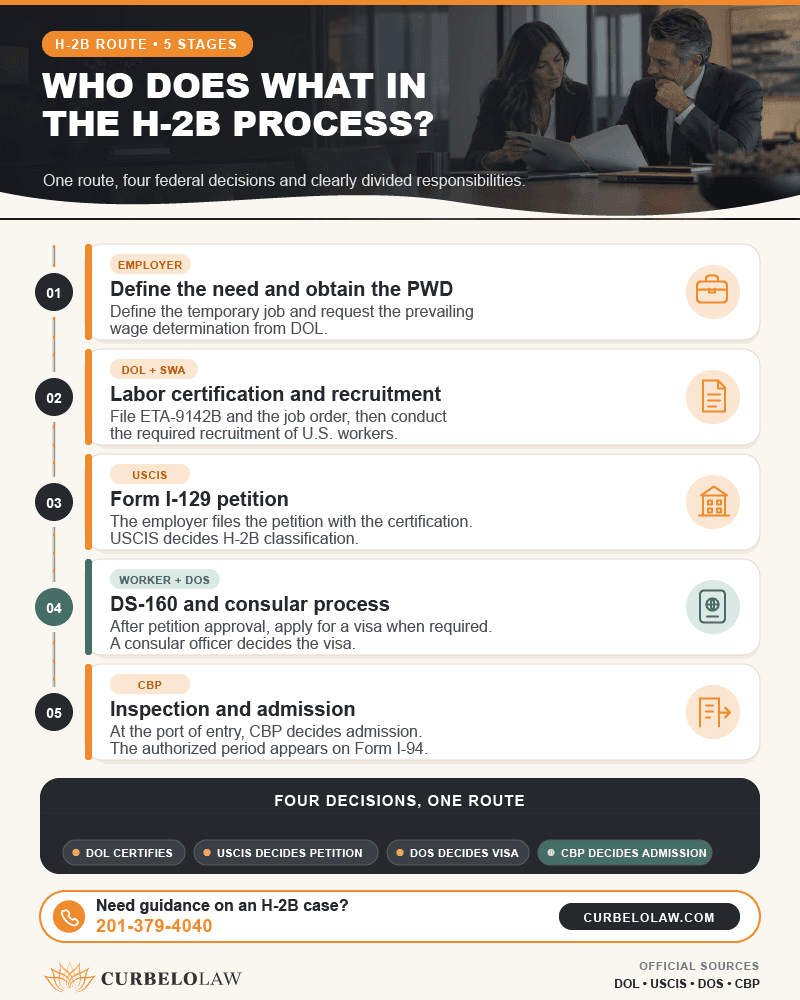
In practical terms, this process can be grouped into three main stages:
1. Prepare the temporary labor certification
Before filing an H-2B petition with USCIS, the petitioner must first obtain a temporary labor certification from the U.S. Department of Labor (DOL).
The employer generally first requests a prevailing wage determination using Form ETA-9141. DOL recommends submitting that request at least 60 days before the determination is needed.
Then, within the applicable filing window, the employer submits the job order to the appropriate state agency and Form ETA-9142B with its appendices to DOL. For standard dates of need, DOL indicates a filing window of 75 to 90 days before the employment start date.
If the employment will be in New Jersey, the NJDOL Foreign Labor Certification unit participates in the state-level process. Employers can also consult the H-2B program in FLAG for instructions and electronic filing.
2. File Form I-129 with USCIS
Once the DOL temporary labor certification is obtained, the petitioner must file Form I-129 with USCIS. In addition:
- The petitioner must submit evidence of the approved temporary labor certification in accordance with current USCIS instructions.
- If the certification was processed through DOL’s FLAG system, the petitioner must retain the final determination and submit the required documentation with the petition.
- When a petition includes named beneficiaries, USCIS limits the number of named workers to 25 per Form I-129; filing rules may vary for unnamed beneficiaries.
3. Apply for the visa and admission to the U.S.
Once USCIS approves the petition, prospective workers who are outside the U.S. must apply for:
- An H-2B visa at a U.S. embassy or consulate, when required, and
- Admission to the U.S. through U.S. Customs and Border Protection (CBP) at a port of entry.
The consular application generally requires Form DS-160, a passport, and information from the approved petition, along with any other documents required by the consulate. You can learn more about this stage in our guide to U.S. consular processing and review the official information on temporary worker visas.
An H-2B visa lawyer can review whether the labor certification, petition, and consular documents consistently describe the same temporary employment.
Who can qualify for an H-2B visa in the United States?
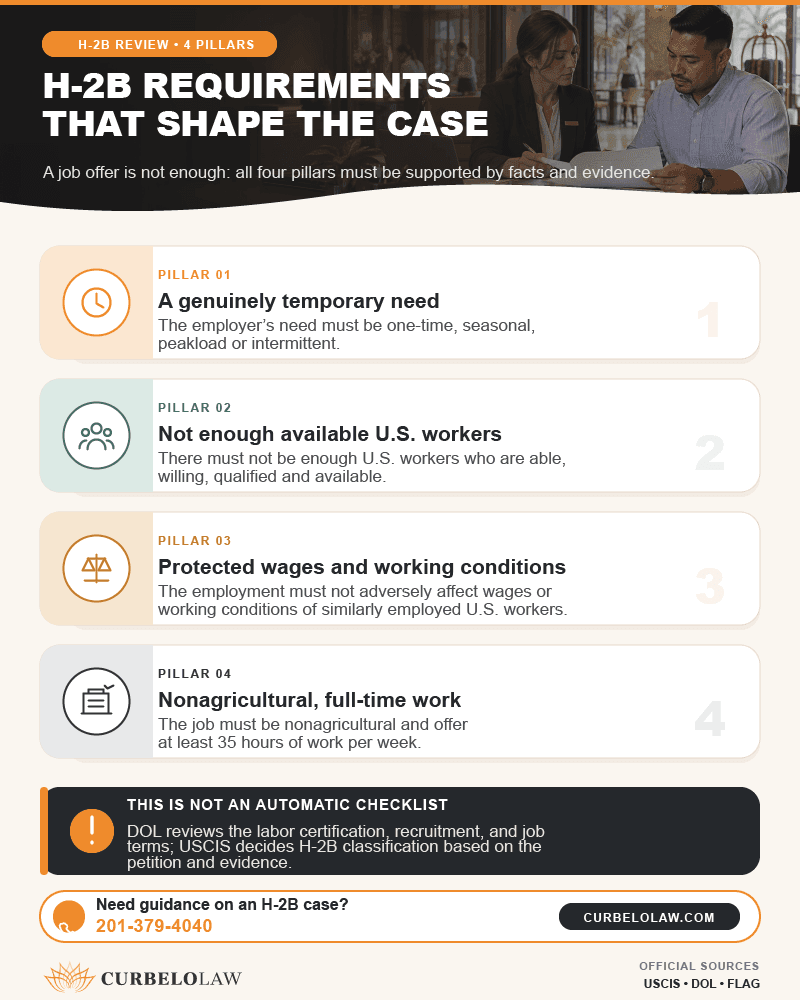
To qualify for an H-2B visa, the employer must demonstrate that:
- There are not enough U.S. workers who are able, willing, qualified, and available to perform the temporary work.
- Hiring H-2B workers will not adversely affect the wages and working conditions of similarly employed U.S. workers.
- The need for the prospective worker’s services or labor is temporary.
What qualifies as a temporary need for the employer?
An employer’s need for H-2B workers is considered temporary and may be based on:
- A one-time occurrence.
- A seasonal need.
- A peakload need.
- An intermittent need.
Except for the one-time occurrence category, DOL generally considers a need temporary if it lasts nine months or less. H-2B work must also be full-time, generally at least 35 hours per week. The specific duration of a certification depends on the facts and the type of temporary need.
H-2B cap, demand, and employer planning
The H-2B program remains subject to the standard statutory cap of 66,000 visas per fiscal year. These are divided into two periods:
- 33,000 visas for workers whose employment begins between October 1 and March 31.
- 33,000 visas for workers whose employment begins between April 1 and September 30.
If visas remain unused during the first half of the fiscal year, they may be carried over to the second half, but not to the next fiscal year. Some categories are also exempt from the cap. For that reason, cap analysis should be based on the employment start date, the worker’s history, and the type of petition, not only on the annual total of 66,000.
Demand can significantly exceed the standard cap. For reference, DOL reported receiving 10,062 H-2B labor certification applications covering 162,603 positions with an April 1, 2026 start date, compared with the statutory cap of 33,000 for the second half of the fiscal year.
Those figures represent positions requested through DOL, not visas issued by USCIS, but they illustrate why early planning is important.
In addition to the standard cap, some fiscal years include supplemental H-2B visas authorized through temporary rules. Those allocations may have additional requirements, specific groups of eligible workers, and their own deadlines. Employers should not plan future hiring on the assumption that the number or structure used in a prior year will be repeated; the rule in effect for the applicable fiscal year should be verified.

If you are considering other U.S. visa options, we invite you to read about L-1A visas and L-1B visas. Our team can provide the guidance you need to determine which option may be appropriate for your situation and assist you throughout the process.
Employer obligations and denial risks
USCIS may deny an H-2B petition because of eligibility, evidence, or compliance issues. Since January 17, 2025, the regulations have also strengthened consequences related to certain labor violations and the collection of prohibited fees from H-2 workers.
Under current regulations, beneficiaries of this visa, or anyone acting on their behalf, may not be charged employment-related fees. This includes:
- Job placement fees.
- Payments to the employer, agent, or recruiter as a condition of obtaining H-2B employment.
- Other prohibited compensation connected with obtaining the employment.
The employer must also pay at least the offered and required wage during the certification period, comply with the three-fourths guarantee when applicable, and follow the rules on transportation, tools, housing when applicable, and recruitment of U.S. workers. In addition, the employer must identify and monitor recruiters or agents to prevent prohibited fees.
An H-2B visa lawyer can review these obligations together with the petition strategy to help avoid inconsistencies between the filing record and hiring practices.
Petitioners for H-2B workers must notify USCIS within two business days if the worker fails to report for employment, leaves the job without notice, is terminated before completing the contract, or finishes the work more than 30 days before the expected end date. The notification must include the information required by USCIS about the petitioner, the worker, and the event being reported.
Important H-2B visa changes since 2025
Since January 17, 2025, Department of Homeland Security (DHS) regulations no longer require USCIS to consider the applicant’s nationality when evaluating eligibility for H-2B classification.
Under the regulatory change, eligibility for H-2B classification is no longer limited by the applicant’s nationality. This eliminated the former annual list of eligible countries as a requirement for USCIS approval of H-2B classification.
The 2025 rule also made a form of portability permanent: certain H-2B workers who are in the United States may begin working for a new employer after USCIS receives a new, properly filed, nonfrivolous H-2B petition, if they meet the regulatory conditions. This is not a general authorization to change employment without a new petition.
The period that can interrupt the calculation of the three-year maximum was also reduced. If a worker has reached the cumulative maximum, an uninterrupted absence of at least 60 days may allow a new maximum period, subject to the evidence and other applicable rules.
How long can you stay in the U.S. with an H-2B visa?
Generally, with an H-2B visa, you may remain in the United States for the period authorized by the temporary labor certification.
This visa may be extended in increments of up to one year, provided that a new valid labor certification is submitted. However, the maximum period of stay in H-2B status is three years.
If you have been in H-2B status for a total of three years, you must leave the United States and remain outside the country for at least 60 days before seeking H-2B classification again.
Worker’s family members and H-4 status
H-2B workers may bring their spouse and unmarried children under 21 to the United States in H-4 status.
However, family members are not authorized to work while maintaining H-4 status derived from the H-2B worker.
Can an H-2B visa lead to lawful permanent residence?
The H-2B visa does not provide lawful permanent residence on its own. However, a worker in H-2B status may have another independent basis to immigrate, such as through a qualifying family relationship or permanent employment sponsorship.
Permanent employment-based sponsorship may require PERM labor certification, but PERM and H-2B temporary labor certification are separate procedures. An H-2B approval should not be treated as an automatic path to a Green Card.
H-2B compared with other work visas
The main difference between the H-1B and H-2B visas is that the H-1B is used for specialty occupations that meet their own requirements, while the H-2B is used for temporary nonagricultural work. The H-2A visa, by contrast, is for temporary agricultural work.

To learn more about the H-2A visa, how to apply, and its features, we invite you to read our article about the H-2A visa program.
H-2B visa costs and processing times in 2026
There is no single H-2B visa cost. The employer and worker are involved in stages with different fees, and some fees depend on the size or type of petitioner. Agencies may change their fees, so it is advisable to confirm the amounts in the official USCIS fee schedule and in the consular instructions before filing or scheduling an appointment.
| Item | Official fee in 2026 | Who handles it |
|---|---|---|
| Form I-129 H-2B with named beneficiaries | $1,080; $540 for a small employer or nonprofit | Petitioner |
| Form I-129 H-2B with unnamed beneficiaries | $580; $460 for a small employer or nonprofit | Petitioner |
| H-2B Fraud Prevention and Detection Fee | $150 per petition | Petitioner |
| Asylum Program Fee | $600; $300 for a small employer; $0 for a nonprofit | Petitioner, when applicable |
| H visa application | $205 | Applicant, subject to the employer’s payment or reimbursement obligations |
| Premium processing, Form I-907 | $1,780 | Optional for the USCIS stage |
The $205 consular fee does not represent the total cost of the case. Under H-2B labor rules, the employer must pay or reimburse, during the first workweek, the visa fee, visa processing charges, and other related fees paid by the worker, except for primarily personal expenses such as the passport.
There is also no single processing time. DOL recommends requesting the prevailing wage at least 60 days before it is needed and, in the regular cycle, filing ETA-9142B and the job order between 75 and 90 days before the date of need. USCIS premium processing may require action on certain H-2B petitions within 15 business days, but it does not expedite the DOL stages or guarantee a consular interview date.
How can Curbelo Law help you obtain an H-2B visa?
Some employers choose to seek legal support to coordinate the labor and immigration stages of the H-2B visa process.
An H-2B visa lawyer can help identify timing, eligibility, evidence, or compliance issues before a petition moves to the next agency. Attorney Carolina T. Curbelo can assist with document preparation and the legal strategy applicable to the case.
Contact us for a private consultation if you need to evaluate an H-2B hiring matter, a petition for temporary workers, or an issue related to your status.
Let us know about your case We can help you