A P visa attorney helps athletes, performers, entertainment groups, and sponsors prepare petitions for temporary work in the United States. The attorney evaluates the appropriate classification, supporting evidence, Form I-129, and any required labor consultation.
Based in Ridgewood, New Jersey, Curbelo Law provides federal immigration counsel to clients in other states and abroad. Carolina T. Curbelo has extensive experience with P visa matters.
Let us know about your case We can help youOn this page
How a P Visa Attorney Helps Athletes, Performers, and Sponsors
The first decision is to identify who will perform, which organization is involved, and which classification applies. An impressive track record cannot make up for choosing a visa category that does not fit the project.
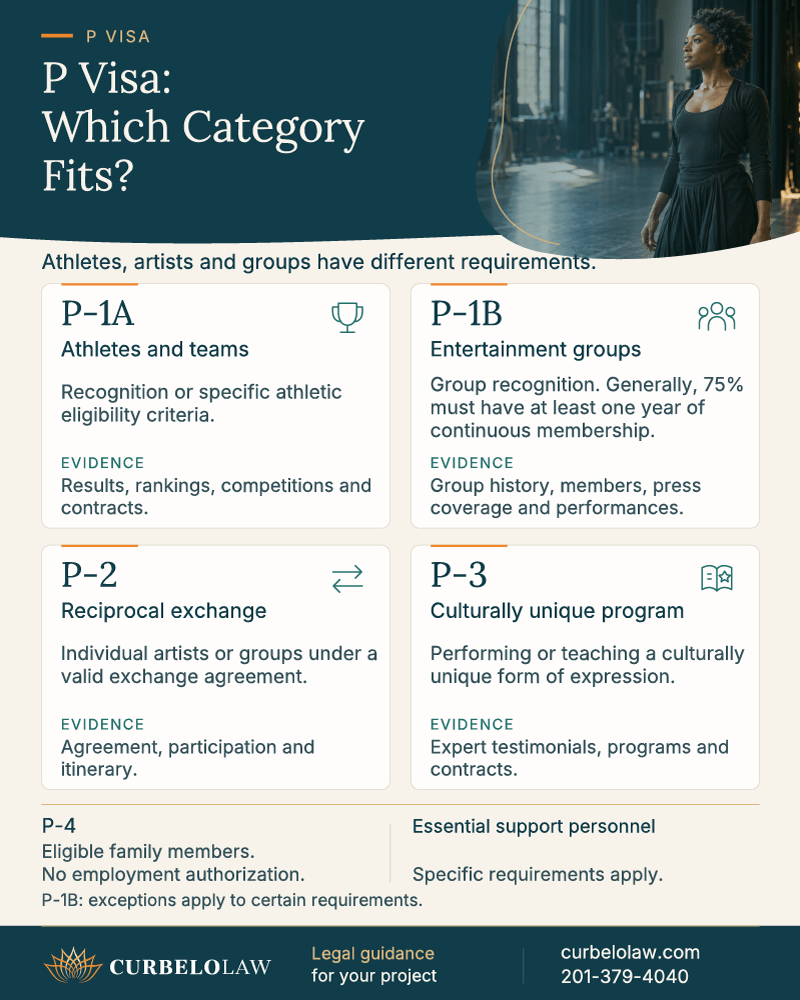
- Eligibility: distinguish P-1A athletes, P-1B entertainment groups, P-2 exchanges, and P-3 cultural programs.
- Sponsorship: determine who will file the petition and whether an agent represents one or multiple employers.
- Evidence: connect achievements, recognition, agreements, labor consultations, and itineraries to the applicable requirements.
- Filing: prepare Form I-129, anticipate potential requests for evidence (RFEs), and coordinate consular processing or an eligible change of status.
At Curbelo Law, we can assess an individual’s credentials alongside those of the group or event. This analysis helps determine what must be established first, which documents are missing, and when another classification may be worth considering.

What Is a P Visa and Who Qualifies?
The P visa is a temporary classification for certain athletic competitions, performances, artistic exchanges, and culturally unique programs. It also provides options for essential support personnel and eligible family members.
Not every sports or entertainment professional meets the requirements. The specific activity planned in the United States determines which category applies and what evidence is needed.
If you are still comparing options, explore the different types of U.S. visas and their purposes.
P-1A: Individual Athletes, Teams, and Specific Athletic Categories
P-1A covers, among others, internationally recognized individual athletes and teams coming to participate in a qualifying competition. Separate provisions also apply to certain professional and amateur leagues and coaches.
When a petition relies on international recognition, showing that the athlete is a professional is not enough. The significance of the athlete’s achievements and the proposed competition must also be documented.
Depending on the applicable category, evidence may include:
- Competition history and achievements: international rankings, national team participation, titles, and significant results.
- Independent recognition: specialized sports coverage, awards, rankings, or statements from experts.
- Contracts and events: appropriate agreements, the league’s standing, and competition schedules.
For the international recognition category, USCIS provides alternative evidentiary criteria, generally requiring at least two of the regulatory criteria when applicable. Other P-1A categories have their own requirements.
When reviewing a petition, Carolina can determine whether a contract establishes participation in a qualifying league or merely documents an invitation. Those are not equivalent forms of evidence.
P-1A also covers certain theatrical ice-skating productions. This option has specific conditions that differ from those applicable to an ordinary performing arts company.

P-1B: Internationally Recognized Entertainment Groups
P-1B is intended for members of entertainment groups, not performers seeking to work independently. As a general rule, the required recognition must belong to the group as a whole.
Generally, the group must have been established and performing regularly for at least one year. At least 75% of its members must demonstrate a substantial and sustained relationship with the group for one year, subject to limited exceptions.
In addition to that continuity, the regulations allow recognition to be established through significant international awards or at least three of six alternative types of evidence. Examples include:
- Leading performances: prominent shows or productions and documented evidence of the organizers’ reputation.
- Outside recognition: reviews, specialized media, publications, and expert evaluations.
- Group achievements: commercial or critical success, contracts, and significant compensation when applicable.
If a band has replaced several members, Curbelo Law can compare its current lineup with past contracts and performance programs. A lead singer’s fame does not automatically resolve a problem with the 75% rule.
Combining individual reviews of the members is not enough, either. The petition must establish that the group traveling to the United States meets the applicable requirements.
P-2: Performers in Reciprocal Exchange Programs
P-2 allows individuals or groups to perform under a reciprocal exchange program between U.S. and foreign organizations. The central requirement is the exchange agreement, not the performer’s fame.
The petition must document the formal agreement, participating organizations, and comparability of the artists’ skills and employment terms in both countries.
When reviewing a P-2 case, we can compare the signed agreement with the performances, dates, and compensation of those traveling. A standalone invitation does not, by itself, establish reciprocity.
P-3: Culturally Unique Performances and Instruction
P-3 covers artists or entertainers coming to perform, teach, or coach in a culturally unique program. The program may involve traditional, musical, theatrical, folk, or other artistic expressions.
Expert letters should explain the writers’ knowledge of the tradition and why the proposed activities are culturally distinctive. Reviews, programs, and repertoire documentation can provide additional support.
At Curbelo Law, we can compare expert statements with the contract and program. If those materials describe a generic show, they may not establish that the advertised performances are genuinely culturally unique.
Essential Support Personnel and P-4 Family Members
Certain coaches, trainers, technicians, and production staff may qualify as P-1S, P-2S, or P-3S essential support personnel. Simply traveling with an athlete or performer is not sufficient.
The petition must explain the person’s duties, experience, connection to the activity, and why the services are essential. A separate Form I-129 petition is generally filed for these personnel.
Spouses and unmarried children under age 21 may apply for P-4 status. They may attend school, but P-4 status does not independently authorize employment.
Required Documents, Labor Consultations, and Mistakes to Avoid
A petition must establish two things: the eligibility of the individual or group and the legitimacy of the proposed work. A P visa attorney should connect each document to a specific requirement rather than submit evidence without a clear purpose.
- Contracts: parties, duties, terms, and dates, or an acceptable summary of oral agreements.
- Itinerary: events, cities, venues, and duration of the activities.
- Eligibility: athletic results, the group’s history, a P-2 exchange agreement, or a P-3 program’s cultural uniqueness.
- Petitioning arrangements: petitioner identity, agent authorizations, and beneficiary lists where applicable.
- Labor consultation: a written advisory opinion from the appropriate labor organization, subject to applicable exceptions.
A labor consultation (advisory opinion) is not the same as PERM labor certification from the Department of Labor. Confusing the two processes may lead to unnecessary or incomplete documentation.
When no appropriate labor organization exists, the regulations provide for particular circumstances. The consultation requirement should not be assumed to be waived simply because the organization is difficult to locate or does not respond.
When USCIS issues a request for evidence (RFE), the response should address the deficiency identified. For example, submitting more concert photos will not necessarily cure a lack of evidence showing how long the group’s members have been together.

Who Can Sponsor a P Visa and How to File Form I-129
Depending on the circumstances, the principal petition may be filed by a U.S. employer, a sponsoring organization, or an authorized agent. A foreign employer may also participate through an agent in the United States.
Projects involving multiple employers require particular attention to agent authorization and contracts. Participation in a tour does not automatically make every promoter an eligible petitioner.
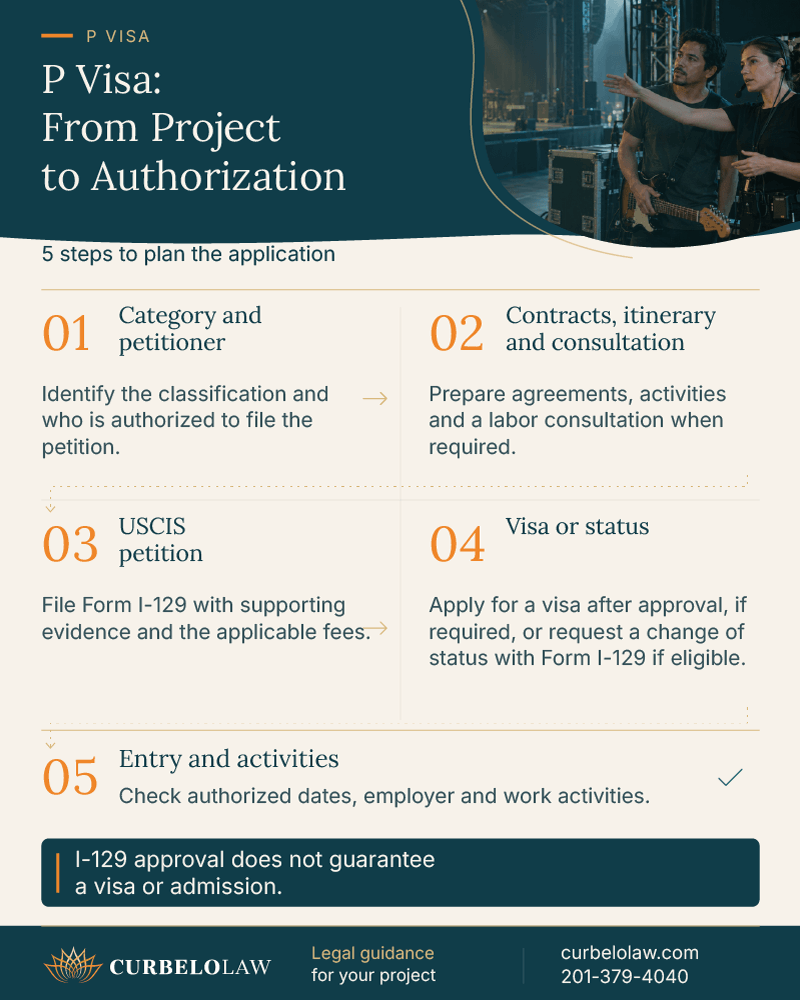
- 1. Identify the category and petitioner: confirm who will travel, what work they will perform, and who is authorized to petition.
- 2. Prepare the case: gather contracts, the itinerary, category-specific evidence, and the labor consultation.
- 3. File with USCIS: submit Form I-129, the applicable supplement, and filing fees.
- 4. Complete the immigration process: after approval, pursue consular visa issuance or an eligible change of status.
- 5. Confirm the scope of authorization: comply with the approved dates, employers, and activities.
Depending on the classification and applicable rules, up to 25 beneficiaries may be included in a single petition. The group must meet the relevant requirements; principal beneficiaries and essential support personnel cannot simply be combined without regard to their classifications.
For consular processing of a P visa, applicants complete Form DS-160, not Form DS-260, which is used for immigrant visas.
Approval of Form I-129 does not guarantee that a consulate will issue the visa or that CBP will authorize admission. Appointment availability, immigration history, and individual requirements also matter.
For tours spanning several states, Carolina can compare the agent’s authorizations with each contract and scheduled date. If the documents do not align, restructuring the sponsorship arrangement before filing may be the right solution.
How Much Does a P Visa Cost and How Long Does It Take in 2026?
Costs depend on the category, petitioner, and whether premium processing is requested. The main federal fees as of October 2026 are:
- Form I-129 P petition: $1,015 base filing fee; $510 for eligible small employers and nonprofit organizations.
- Asylum Program Fee: generally $600; $300 for small employers and $0 for qualifying nonprofit organizations.
- Consular visa application: $205, plus any applicable reciprocity fees based on nationality.
Review the USCIS regulatory fee schedule and official consular fees. Attorney fees, translations, and other expenses are calculated separately.
Can Premium Processing Speed Up a P Visa Petition?
Yes. Form I-907 allows petitioners to request premium processing for eligible P petitions. The fee is $2,965 effective March 1, 2026.
USCIS must take an adjudicative action within 15 business days. That action may be an approval, denial, or request for evidence. It does not mean the visa will be issued within that period.
There is no single processing time for standard filings. Check USCIS processing times and allow additional time for labor consultations and interviews.
P Visa Validity, Extensions, and Changes of Employer
The authorized period depends on the activity and classification. The petition validity period should not be confused with the expiration date of the visa stamp in the passport or the date on Form I-94.
- Individual P-1A athletes: up to five years initially, with possible extensions of up to five years and a maximum total stay of ten years.
- P-1A teams and P-1B, P-2, and P-3 beneficiaries: generally up to one year initially, with extensions of up to one year to continue or complete the activity.
Extending the principal beneficiary’s status generally requires a new Form I-129 petition. P-4 family members may need to file Form I-539.
Can You Change Employers, Tours, or Activities?
Changes may be possible, but a new employer generally must obtain approval of its petition before the individual begins working. Material changes involving agents, contracts, or duties may also require action with USCIS.
A special rule applies to certain transfers of P-1 professional athletes. It should not automatically be applied to performers, technicians, or other athletes.
P Visa vs. O-1 Visa: Which Is Right for an Artist or Athlete?
The right choice depends on the project and supporting evidence, not on how prestigious a visa category sounds. P-1B focuses on the group; P-2 on the exchange; and P-3 on cultural uniqueness.
O-1 has its own standards for individual extraordinary achievement. A P visa attorney should also distinguish the P-1A athletic classifications from the O-1A criteria.
Hypothetical example: an award-winning singer begins touring with a newly formed band. The singer’s individual achievements do not automatically establish the group’s P-1B eligibility.
In that situation, we would review the group’s history and the O-1 visa option for artists before deciding which petition to prepare.
Immigration Counsel in New Jersey for Clients Across the U.S. and Abroad
Curbelo Law is located in Ridgewood, Bergen County, New Jersey. Because immigration law is federal, we can advise individuals and organizations in other states or countries on P visa matters when the circumstances permit.
A tour or competition does not have to take place in New Jersey. A production spanning Florida, California, and New York primarily raises questions about the petitioner, contracts, dates, and work authorization.
The review can be coordinated with the U.S. promoter and an artist or athlete located abroad. The appropriate consulate and the individual’s immigration history still require case-specific analysis.
Frequently Asked Questions About P Visas
Can an Individual Performer Apply for a P Visa?
Yes, under categories that allow individual performers, particularly P-2 or P-3 if the requirements are met. P-1B generally requires membership in a recognized group, while P-1A covers certain individual athletes.
Is Hiring an Attorney Required?
No. However, selecting the correct category, arranging sponsorship, obtaining labor consultations, and preparing evidence can raise complex issues. Legal representation can be especially useful when multiple employers are involved or event dates are approaching.
Can a P Visa Holder Work With Multiple Promoters?
Potentially, if the petitions and agent arrangements are properly structured. What matters is whether the authorized work covers the relevant employers and activities. A P visa does not automatically authorize every new contract.
Does a P Visa Lead to a Green Card?
No. A P visa does not automatically grant permanent residence. Some individuals may qualify to explore a separate immigrant visa pathway, such as the EB-1 category for eligible applicants, which has different requirements and no guarantee of approval.
Talk to Carolina T. Curbelo About Your P Visa Petition
Attorney Carolina T. Curbelo has experience with employment-based immigration and P visa matters. Our approach starts by identifying the appropriate category, the sponsor, and the evidence that is actually missing.
If you are looking for a P visa attorney for a competition, tour, or cultural program, contact Curbelo Law. We can evaluate contracts, itineraries, recognition, and potential risks before you commit to dates and expenses.
Let us know about your case We can help you